







Definition and Meaning
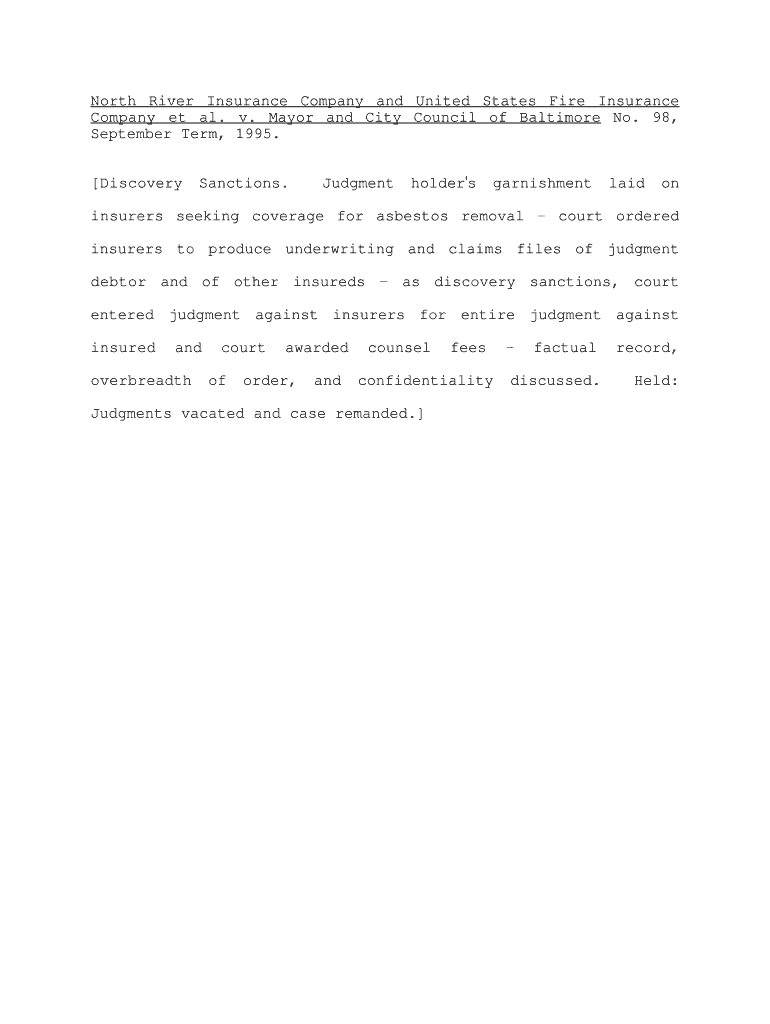
The North River Insurance Company and United States Fire Insurance - courts state md case involves legal proceedings related to discovery violations. Specifically, it pertains to garnishment actions for asbestos removal costs and examines the implications of court-ordered sanctions stemming from discovery failures. In this legal context, "discovery" refers to the pre-trial phase where parties exchange necessary information relevant to the case. The case highlights critical legal principles regarding compliance with discovery requests and the potential consequences of non-compliance.
Legal Use and Context
The case provides insight into the legal usage of sanctions in the context of discovery violations. It illustrates how courts can impose penalties on parties that fail to comply adequately with discovery orders, potentially affecting the outcome of a case. In this specific scenario, a default judgment was issued against the insurers for not fulfilling their discovery obligations. However, the appellate court vacated this judgment, indicating that sanctions must be appropriately justified and that confidentiality needs must be considered.
Steps to Complete Discovery Compliance
- Understanding Discovery Requirements: Parties must first comprehend the scope of information required by the court, typically outlined in legal requests.
- Collection of Required Documents: Gather underwriting and claims files or other relevant documents as specified in the discovery request.
- Review of Confidentiality Concerns: Evaluate whether there are any confidentiality issues associated with the documents and address them before submission.
- Submission of Documents: Comply with discovery timelines by submitting requisite documents to the requesting party.
- Responding to Objections: If there are objections to the scope of the discovery request, parties should promptly file motions to resolve such disputes.
- Ensuring Compliance: Regularly consult legal counsel to ensure ongoing compliance with discovery obligations and avoid potential sanctions.
Important Terms Related to the Case
- Discovery: The legal process of exchanging information between parties in a lawsuit.
- Sanctions: Penalties imposed by a court for non-compliance with legal procedures, such as failure to meet discovery obligations.
- Default Judgment: A judgment in favor of one party based on the other party's failure to take a necessary action or comply with court orders.
- Appellate Court: A court that reviews the decisions of lower courts to ensure the correct application of law.
Key Elements of Discovery in Legal Proceedings
- Court Orders: The necessity to follow specific court orders outlining discovery requirements.
- Objections and Justifications: The ability to object to discovery requests if they lack justification or are overly broad.
- Confidentiality Issues: The obligation to maintain confidentiality while providing necessary information.
- Compliance and Consequences: Understanding the serious implications of failing to comply with court orders, which may include sanctions or default judgments.
State-Specific Rules and Considerations
In the context of Maryland (md) courts, local rules and procedures govern discovery and related legal activities. Understanding state-specific laws and regulations is crucial, as variations can impact how cases proceed and how sanctions are applied. Maryland courts, for example, may have unique requirements regarding the submission of documents and the handling of confidentiality issues.
Examples of the Application of Court Sanctions
Court sanctions in this context highlight the potential for severe consequences following non-compliance in legal procedures. For example, a case where insurers didn't produce required documents led to a default judgment against them. However, when an appellate review determined the imposition of overly broad discovery requirements, the judgment was overturned. This reflects the necessity for appropriate measures when enforcing court orders.
Who Typically Uses This Information
Legal professionals, including attorneys specializing in insurance litigation, often analyze cases like North River Insurance Company and United States Fire Insurance. Understanding detailed case outcomes aids in strategizing defenses or appeals in similar legal proceedings. Insurers and legal consultants also study these legal precedents to ensure compliance with court orders in future cases, thereby avoiding sanctions.
Version Control and Alternatives to Standard Procedures
Continuous updates in court procedures and legal practices necessitate staying informed about changes to ensure compliance. Legal professionals must regularly consult updated court rulings and guidance to adapt to new standards or alternative procedures, mitigating risks associated with default judgments or additional legal challenges.




