
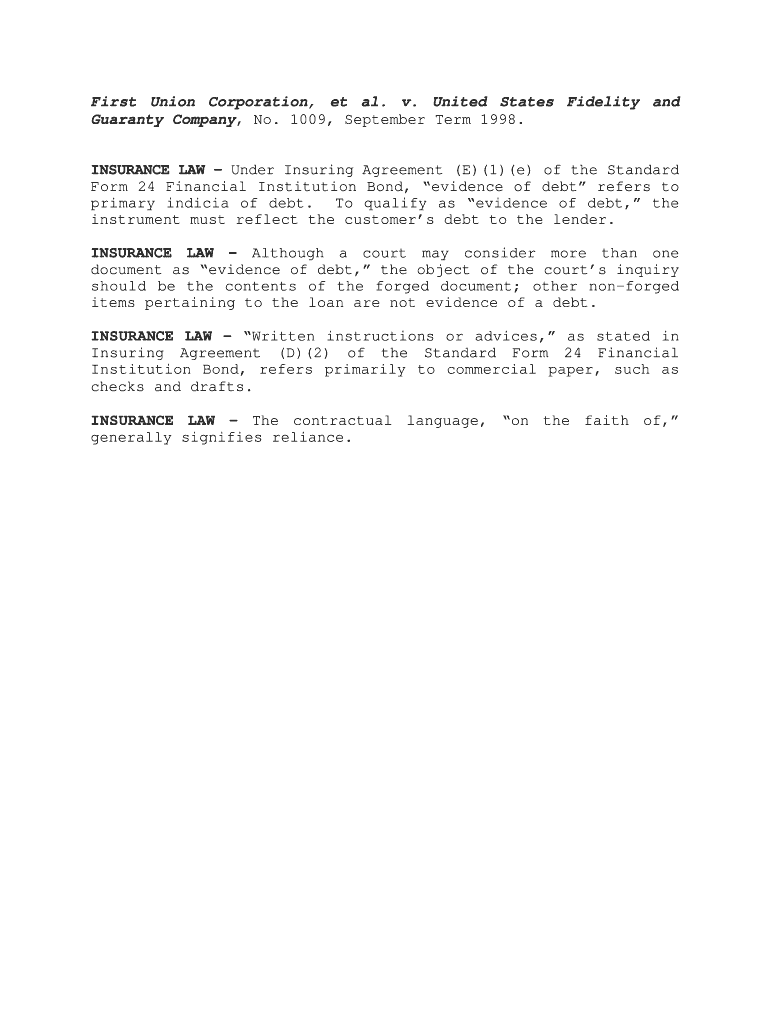







Overview of the First Union Corporation Case
The case of First Union Corporation v. United States Fidelity and Guaranty Company emerged from an insurance dispute linked to a fraudulent loan scheme implemented by an individual named Ed Reiners. By misrepresenting facts, Reiners convinced Signet Bank to authorize a $300 million loan for an illusory project. This legal standoff highlighted the intricacies of insurance documentation and contract stipulations.
Definition and Meaning of the First Union Corporation, et al - courts state md
This form, associated with legal proceedings, serves as a critical document in court cases involving financial and insurance disputes. It encompasses official court filings, showcasing arguments, evidence submissions, and judicial decisions. Understanding its components is essential for navigating legal disputes effectively.
Key Elements of the Form
A close examination of this form reveals several critical elements:
- Case Identification: It includes the names of the parties involved, case number, and relevant jurisdiction.
- Claims and Arguments: Details about the claims put forward by each party, including any requested relief or damages, are prominently displayed.
- Evidence Submission: Lists all evidence deemed pertinent to the case like contracts, loan documents, and correspondences.
- Judicial Opinions and Orders: Features court orders and the rationale behind judicial decisions.
How to Use the First Union Corporation, et al - courts state md
Utilizing this form correctly involves several strategic steps:
- Thorough Review: Read the document carefully to fully grasp the legal arguments and evidence presented.
- Evidence Cross-Verification: Ensure all pieces of evidence align with your claims or defenses.
- Proper Filing and Submission: Submit the form within the stipulated deadlines adhering to procedural rules specific to the state and court.
Legal Use of the First Union Corporation, et al - courts state md
This form is crucial for maintaining a lawful stance during financial dispute resolutions. It:
- Qualifies as an official submission for state court reviews.
- Serves as documentation for appeals, should parties find it necessary to challenge the ruling.
Steps to Complete the Form
- Gather Case Information: Compile pertinent names, dates, and reference numbers associated with the dispute.
- Present Claims and Evidence: Clearly articulate your claims and attach certified copies of all relevant documents.
- Review for Accuracy: Double-check the form for consistency and factual correctness.
- File Form Appropriately: Follow the court’s specified method for submission, whether in-person, via mail, or online.
Who Typically Uses This Form
This form is predominantly used by:
- Legal representatives handling financial and insurance dispute cases.
- Financial institutions and insurance companies engaging in litigation or requiring judicial intervention.
- Individuals involved in disputes over financial contracts or guarantees.
State-Specific Rules for This Form
Different states might have unique requisites for this form. For instance, Maryland courts might impose specific formatting or supplementary documentation needs. Always verify with local court guidelines to ensure compliance with all relevant procedural mandates.
Examples of Using this Form
For illustrative purposes, consider a case where a bank disputes an enormous loan loss due to alleged forgery. Using the form, a detailed account of the bank’s reliance on forged documents would be chronicled, forming the foundation for legal redress.
Form Submission Methods
- Online Submission: Many jurisdictions now accept electronic filings via state court portals.
- Mail Submission: Traditional postal services remain a valid method, necessitating ample time for delivery.
- In-Person Delivery: Direct submission at the court clerk’s office is advisable for ensuring immediate processing.
This comprehensive guide offers vital insights into the practical application and intricacies of the form “First Union Corporation, et al - courts state md,” enhancing comprehension and effective utilization in relevant legal contexts.




