







Definition & Meaning
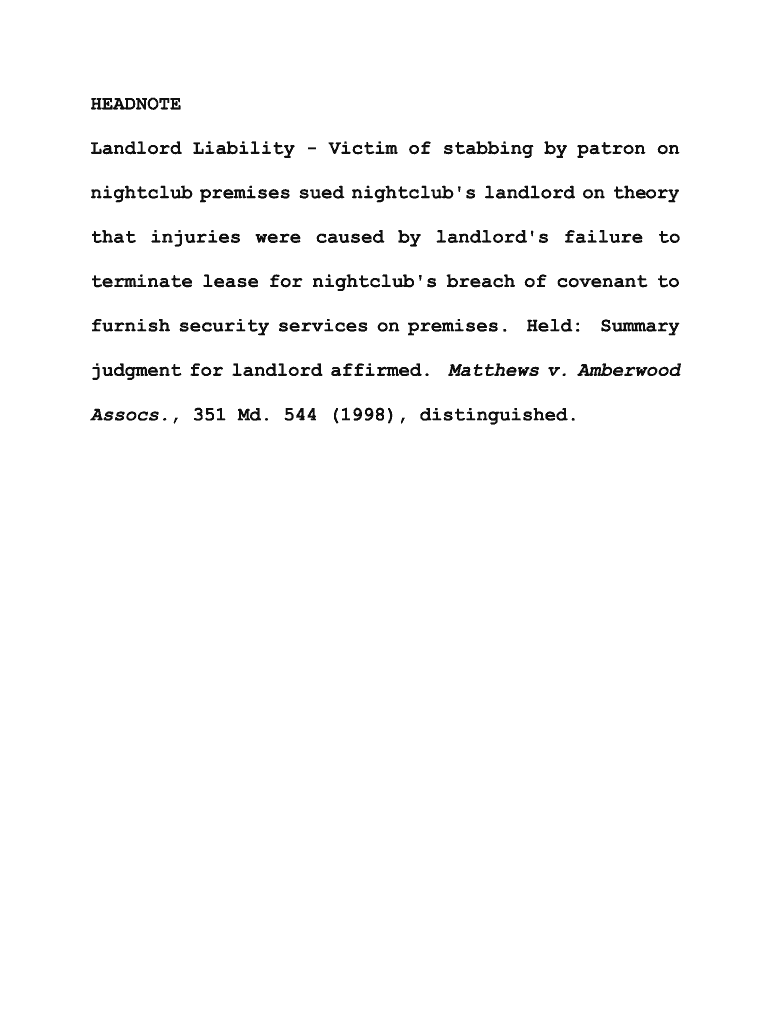
The "HEADNOTE Landlord Liability - Victim of stabbing - Maryland Courts" represents a legal summary that addresses the responsibility of landlords concerning incidents like a stabbing on their property. In Maryland, the liability of a landlord is generally limited, unless they have prior knowledge of potential dangers that could affect patrons or tenants. This headnote summarizes a court decision affirming a landlord's non-liability in a certain case where a stabbing occurred on leased premises. The court found no duty of care was breached, highlighting the legal nuances involved in determining landlord liability for criminal acts by third parties.
How to Use the HEADNOTE Landlord Liability - Victim of Stabbing - Maryland Courts
To effectively use this headnote, legal professionals reference it for precedent in cases where landlord liability for tenant or patron safety is questioned. It serves as a guideline for understanding under which circumstances a landlord might be held accountable for criminal acts happening on their property. Lawyers can cite it in arguments to either support or refute claims of negligence, depending on the case specifics. It's crucial for illustrating distinctions between landlord obligations and the limits of their legal responsibilities.
Steps to Complete the Analysis
-
Review the Case Details: Carefully examine the specific instances cited in the headnote, including the court's rationale for the judgment.
-
Identify Relevant Precedents: Pull other cases with similar circumstances to understand how interpretations have evolved or remained consistent.
-
Consult Legal Literature: Reference any academic commentary or legal analysis for deeper insights into case implications.
-
Draft Legal Documentation: Utilize the headnote’s highlights in drafting briefs or legal motions to either bolster or defend against similar claims.
-
Update Case Strategy: Adjust legal approaches based on how this case might influence or reflect current legal trends in landlord liability.
Key Elements of the HEADNOTE
-
Duty of Care: Articulation of when a landlord is expected to take precautionary measures against potential criminal acts.
-
Notice of Danger: Examination of whether the landlord had prior knowledge of hazardous conditions that could lead to criminal activity.
-
Scope of Liability: Defining limits and extents of landlord responsibility in maintaining safe premises for tenants and visitors.
-
Precedent Influence: The ruling’s role in shaping future landlord-tenant criminal liability disputes.
Legal Use of the HEADNOTE
Legal professionals use this headnote to argue landlord defenses in liability cases, demonstrating the absence of duty to prevent third-party criminal acts without prior notice of danger. It is a tool for showcasing the delineation of obligations within landlord-tenant relationships. In Maryland courts, understanding and leveraging this case’s ruling helps lawyers frame arguments regarding reasonable care expectations and liability boundaries.
State-Specific Rules for Maryland
In Maryland, the courts underscore that a landlord's liability for criminal acts on their property is limited unless there is clear evidence of negligence, such as failure to address known dangers. This state-specific perspective differs from jurisdictions with broader interpretations of landlord responsibilities. Maryland cases focus on the principle that landlords must have had actual notice of specific threats to be culpable.
Examples of Using the HEADNOTE
-
Case Arguments: Legal teams can reference this headnote in defense strategies for landlords accused of negligence related to crimes occurring on their property. It serves as a precedent for no further duty beyond reasonable care.
-
Legal Education: Professors may analyze this headnote in law courses to discuss the complexity of premises liability and the threshold for landlord responsibility.
-
Policy Reviews: Property management firms might review this to understand the extent of their legal obligations and inform their safety protocols.
Important Terms Related to the HEADNOTE
-
Negligence: Involvement or absence of due diligence expected in maintaining safe property conditions.
-
Summary Judgment: A court decision made without a full trial, used here to resolve the case quickly based on the lack of a material issue of fact.
-
Actual Notice: Knowledge that is directly provided to or acquired by a landlord, making them aware of potential risks or dangers.
Who Typically Uses This Headnote
Primarily used by legal professionals, including attorneys and judges, this headnote is also beneficial for real estate experts and landlords who seek to navigate the intricacies of liability law. Additionally, law students and educators might use it for academic purposes to study landlord-tenant legal relationships and their implications in criminal law contexts.




