







Definition & Meaning
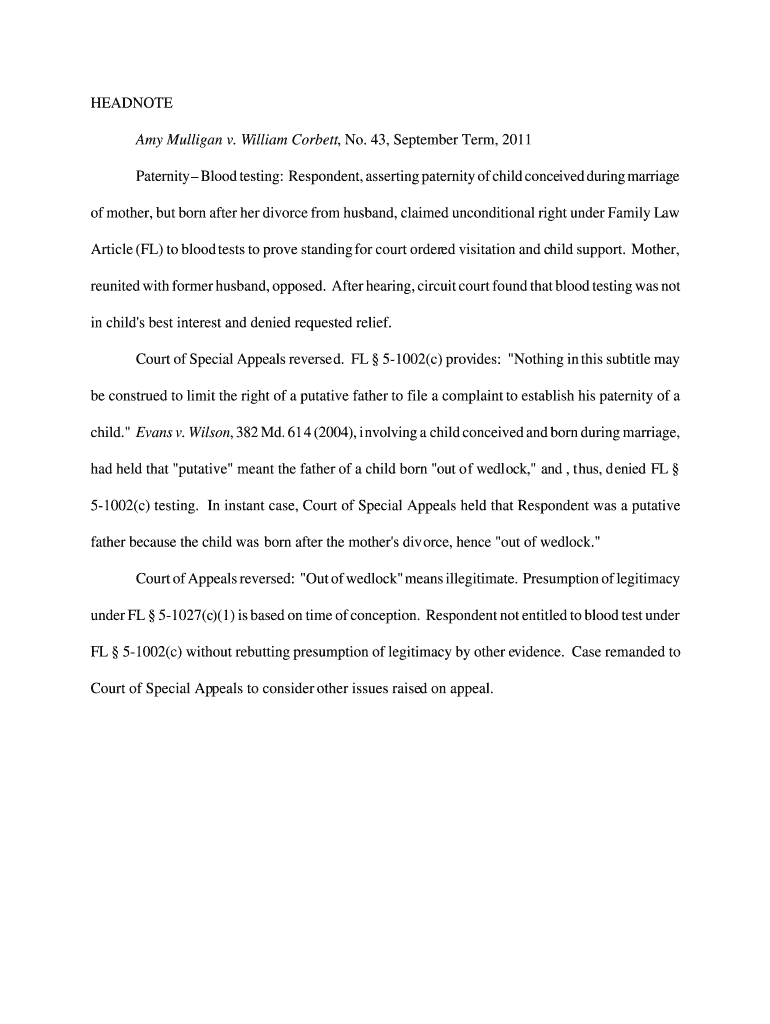
The HEADNOTE Amy Mulligan v. William Corbett, No 43, September is a summary of a legal case involving the determination of paternity and the rights of a putative father in Maryland. This case addresses whether a man can request a blood test to establish paternity when the child was conceived during the mother's marriage but born post-divorce. It reflects on legal issues related to family law, specifically the legitimacy of children and the procedural rights of individuals claiming to be biological parents.
Key Elements of the Case
This headnote outlines several critical elements:
- Child's Best Interest: The initial court ruling denied the blood test, reasoning it wasn't in the child's best interest.
- Court of Special Appeals Decision: This decision was reversed, emphasizing the putative father's legal rights.
- Evidence for Rebuttal: The need for a man to present evidence rebutting the presumption of the child's legitimacy.
- Dissenting Opinion: It highlights disagreements about the necessity of providing preliminary evidence, arguing it might undermine children's rights to paternity certainty.
Legal Use of the Headnote
In legal settings, this headnote serves as a precedent for similar paternity disputes. It guides legal professionals in understanding how courts balance the presumed legitimacy of children against an individual's right to establish biological paternity. Lawyers can use this as a reference when arguing the rights of a putative father or when addressing issues related to the presumption of legitimacy.
Steps to Engage With the Case
- Review Court Decisions: Study each court's decision within the case, focusing on the reversing of the circuit court's denial.
- Examine Legal Precedents: Consider the legal precedents cited in the appeals and their application in similar family law cases.
- Understand Maryland Law: Understand how Maryland law defines the rights of putative fathers and the presumption of legitimacy.
- Analyze Dissenting Opinions: Examine dissenting views for different perspectives on the necessity of initial evidence in paternity claims.
State-Specific Rules
In Maryland, like other states, laws regarding paternity and parental rights can differ. The state's law presumes a child born during a marriage is the legitimate child of the couple. To challenge this presumption:
- Maryland Law: Allows putative fathers to file motions for paternity testing.
- Court's Discretion: Courts hold power to deny such requests based on the child's best interests unless clear evidence suggests otherwise.
Examples of Application
- Family Law Attorneys: May reference this case to advise clients on their rights regarding paternity issues.
- Judges: Use this precedent for assessing similar future cases, especially for balancing the presumption of legitimacy against a putative father's claims.
- Academics and Students: Analyze this headnote in family law studies to understand how legal principles are applied in real-world scenarios.
Important Terms
- Putative Father: A man who alleges to be the biological father of a child, especially when the child was born during the mother's marriage to another man.
- Presumption of Legitimacy: A legal assumption that a child born within a marriage is the legitimate offspring of the couple.
- Rebuttable Presumption: A presumption in law that can be challenged by presenting evidence to the contrary.
Who Typically Uses the Headnote
- Legal Practitioners: Lawyers and judges utilize headnotes for quick case summaries to facilitate legal research.
- Law Students: Benefit from these summaries for educational purposes as they learn about case law and its implications.
- Families in Legal Disputes: Putative fathers contemplating paternity actions may reference this case to understand their legal standing.


Digital vs. Paper Versions
Legal professionals and students primarily access the headnote, Amy Mulligan v. William Corbett, through digital platforms. This facilitates easy online research and integration into legal databases or arguments. Paper versions might exist in law libraries but are less frequently used due to the convenience of digital access.
Software Compatibility
Legal research tools like Westlaw and LexisNexis often provide access to headnotes and case summaries. These platforms are compatible with common legal documentation software, enabling practitioners to smoothly incorporate case law into briefs, memos, or consultations.
Penalties for Non-Compliance
While the case itself doesn't specify penalties, ignoring court rulings in paternity cases under Maryland law can result in:
- Lost Parental Rights: Potential forfeiture of a putative father's claim to parental rights.
- Civil Liability: This may occur for failing to comply with the legal process or court orders.
The Amy Mulligan v. William Corbett case is a vital reference point for those involved in family law, offering insights into the balance between protecting children's interests and respecting individuals' rights to assert paternity.




