




01. Edit your form online
Type text, add images, blackout confidential details, add comments, highlights and more.

Type text, add images, blackout confidential details, add comments, highlights and more.

Draw your signature, type it, upload its image, or use your mobile device as a signature pad.

Send it via email, link, or fax. You can also download it, export it or print it out.
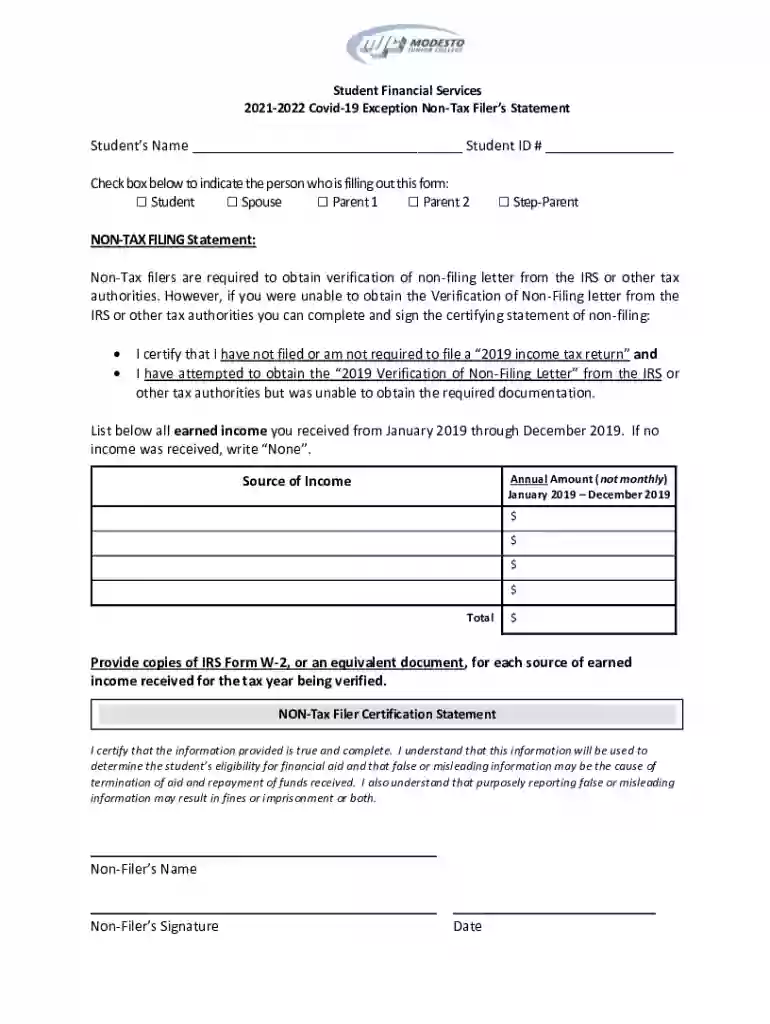
The Student Non-Tax Filer Statement 2 is a critical document for individuals seeking financial aid for the academic year without having filed a tax return. It serves as a certification of one's non-tax filing status, required by Student Financial Services to verify the absence of a tax return filing. This form, specifically for the 2 cycle, is utilized to affirm the financial standing of applicants, facilitating their eligibility for aid. The statement includes key details like the relationship to the student, any earned income from 2019, and a certification of truthful information, ensuring transparency and accuracy in financial reporting.
The legal application of this form rests in its requirement under financial aid regulations. It certifies the financial status required for processing aid applications within U.S. educational institutions. The declaration section serves as a legal oath, ensuring that all information provided is complete and factual, mitigating fraud risk.


Non-compliance with the requirement to submit a truthful Student Non-Tax Filer Statement can result in severe repercussions, notably the denial of financial aid. Misrepresentation or omissions, if detected, may also warrant legal penalties, emphasizing the importance of truthful and complete submission.
The submission cut-off typically aligns with the financial aid deadlines for the academic year in question. It is pivotal to consult educational institutions for specific dates to ensure compliance, as late submissions can jeopardize financial aid eligibility.
Although not submitted to the IRS, this form adheres to IRS guidelines by reflecting accurate non-filer status. Compliance with these guidelines ensures legitimacy and enhances the credibility of the statement within financial aid proceedings.
At DocHub, your data security is our priority. We follow HIPAA, SOC2, GDPR, and other standards, so you can work on your documents with confidence.



If the student, spouse, or parents were not required to file a tax return, the student should still report any income earned from work in lines 3839 (student
We anticipate that tax policies, bans, subsidies, and other measures will be imposed by the Ministry of the Environment and Energy, promoting the proliferation
This form must be completed by each person in your household who did not file a tax return in 2019 and provided data on your FAFSA.


