
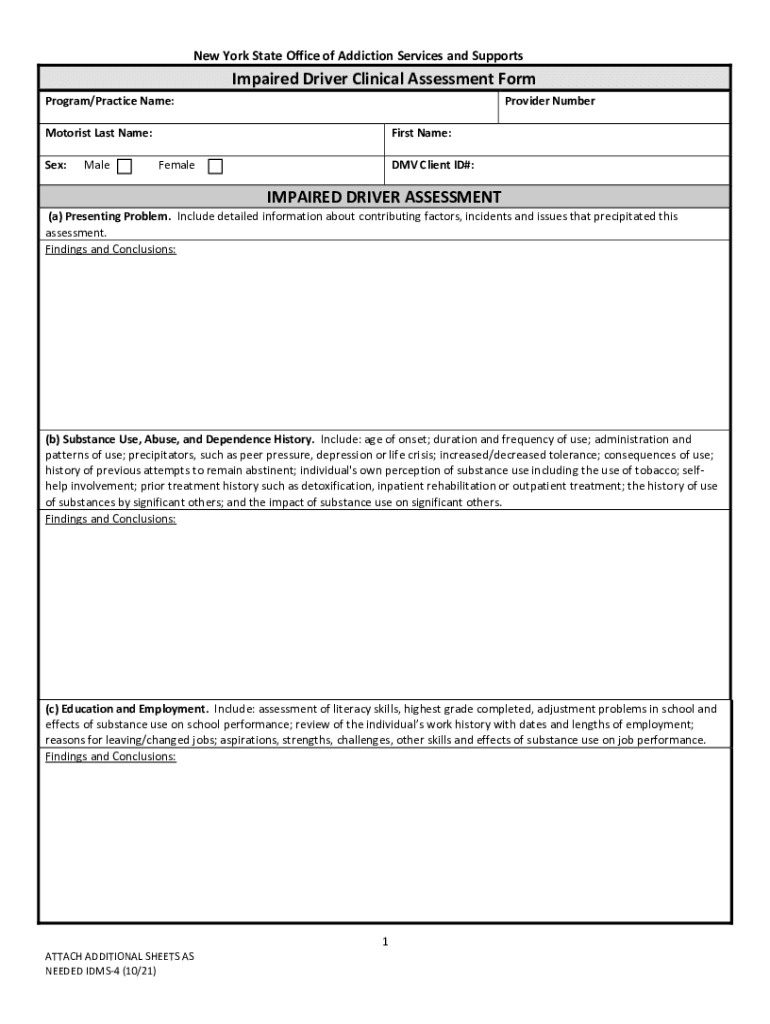







Definition and Purpose of the New York State Office of Impaired Driver Clinical Assessment Form
The New York State Office of Impaired Driver Clinical Assessment Form serves as a comprehensive tool designed to evaluate individuals involved in impaired driving incidents. The form is created and managed by the New York State Office of Addiction Services and Supports (OASAS). Its primary purpose is to gather detailed information across various domains such as substance use history, mental health, education, employment status, family and social activities, legal involvement, and medical health. By collecting this data, the form guides professionals in developing accurate diagnosis and treatment recommendations, ultimately contributing to informed decisions around rehabilitation and public safety.
Importance of Completing the Form Accurately
Accurate completion of the New York State Office of Impaired Driver Clinical Assessment Form is crucial for multiple reasons. First, the data gathered influences the legal outcomes for the individual involved, impacting sentencing, probation, or alternative rehabilitation programs. An accurate portrayal of a person's history and current status ensures that they receive appropriate interventions and resources that fit their specific needs. Moreover, transparency and correctness prevent legal complications typically arising from discrepancies or omissions during court proceedings. Rehabilitation professionals rely on this form to tailor treatment plans that address underlying issues contributing to impaired driving tendencies, facilitating long-term behavior change.
How to Use the New York State Office of Impaired Driver Clinical Assessment Form
To utilize the New York State Office of Impaired Driver Clinical Assessment Form effectively, it is essential to follow a methodical approach:
-
Preparation: Collect all personal documents such as identification, medical records, employment history, and any legal documentation related to the impaired driving incident.
-
Understand Each Section: Familiarize yourself with the different sections of the form. Pay close attention to areas focusing on personal habits and mental health, as inaccuracies can result in misleading assessments.
-
Detailed Responses: Provide comprehensive answers, avoiding brief or generic replies. Use detailed examples of past incidents or experiences that relate to each question, creating an encompassing view of your circumstances.
-
Consultation: If possible, consult with a legal advisor or counselor familiar with these forms. Their insights can clarify complex questions and help align your answers with legal and therapeutic expectations.
-
Review and Submit: Before submission, review all entries for consistency and completeness. Missing information can delay processing or lead to non-compliance issues.
Key Elements of the Assessment Form
The New York State Office of Impaired Driver Clinical Assessment Form includes several critical components, each designed to evaluate different aspects of an individual's life:
- Substance Use History: Evaluates the frequency and type of substances regularly consumed.
- Mental and Emotional Health: Includes questions about past diagnoses, current mental health status, and habitual behaviors impacting psychological well-being.
- Educational and Occupational Status: Details about educational achievements and current or previous employment roles and stability.
- Family and Social Dynamics: Looks into relationships with family, friends, and social activities, identifying patterns that might contribute to or mitigate impaired behavior.
- Criminal and Legal History: Captures prior legal issues or ongoing cases, particularly concerning substance use and driving offenses.
- Medical Health: Investigates chronic or acute health conditions that might impact the individual's decision-making or influence substance use.
Steps to Complete the Form Successfully
Completing the New York State Office of Impaired Driver Clinical Assessment Form can be exhaustive but manageable if approached step-by-step:
-
Begin with Personal Information: Fill in all demographic details, ensuring accuracy in name, address, and contact information.
-
Substance Use Detail: Document all historical and present substance use, including frequency, duration, and type of substance.
-
Mental Health Assessment: Provide a thorough account of any mental health issues, therapy experiences, and medication history.
-
Educational and Employment Data: Complete this section by listing all relevant details concerning schools attended, degrees earned, and job history.
-
Family and Social Information: Offer insights into familial relationships, highlighting any supportive or detrimental influences.
-
Legal Context: Elaborate on any legal incidents related or unrelated to substance use; this might affect eligibility for diversion programs or therapeutic interventions.
-
Health Overview: Conclude with a comprehensive health status, particularly focusing on conditions that could influence mental acuity, mobility, or general wellness.
Legal Use and Compliance
The New York State Office of Impaired Driver Clinical Assessment Form holds significant legal importance. It is used in judicial proceedings to assess the individual's risk and capability to engage in rehabilitation. Misrepresentation or incomplete submission may lead to legal repercussions, including charges of non-compliance or perjury if evidence suggests deliberate falsification. It is crucial for individuals and attorneys to ensure that all information provided can be substantiated through documentation or witness testimonies to maintain legal integrity.
State-Specific Regulations and Differences
Within New York State, the deployment of the Impaired Driver Clinical Assessment Form follows guidelines specific to local legal and health systems. Unlike other states, New York mandates this assessment as part of the integrated treatment approach, often leading to diversionary programs based on the results. Any differences in state legislation can affect the processing and outcomes of the assessment. Practitioners and legal representatives must remain updated on legislative amendments affecting assessment processes to maintain compliance and optimize rehabilitation outcomes.
Digital vs. Paper Version
The New York State Office of Impaired Driver Clinical Assessment Form is available in both digital and paper formats, each with distinct advantages:
-
Digital Format: Offers ease of completion and submission, with features enabling input validation, auto-save, and real-time updates. Digital submissions reduce processing time and ensure data accuracy.
-
Paper Format: Provides accessibility for individuals without reliable internet access or those who prefer physical documentation. Some legal environments still require physical copies for archival purposes.
Regardless of the version used, it is critical to meet submission deadlines and retain copies of the completed form for personal records and any required follow-up actions.
Who Issues the Form and How It Is Obtained
The form is issued by the New York State Office of Addiction Services and Supports (OASAS), available through several channels:
- Online Portal: Accessible via the OASAS official website for download and online completion.
- Local Health Departments: Many local agencies within New York State provide copies directly or through referral programs tied to impaired driving cases.
- Legal Institutions: Attorneys and public defenders often have access to these forms as part of client representation in related legal matters.
In summary, obtaining and completing the New York State Office of Impaired Driver Clinical Assessment Form requires adherence to specified procedures, detailed and accurate information, and an understanding of its legal and therapeutic roles within the broader context of driving offense management.




