




01. Edit your form online
Type text, add images, blackout confidential details, add comments, highlights and more.

Type text, add images, blackout confidential details, add comments, highlights and more.

Draw your signature, type it, upload its image, or use your mobile device as a signature pad.

Send it via email, link, or fax. You can also download it, export it or print it out.
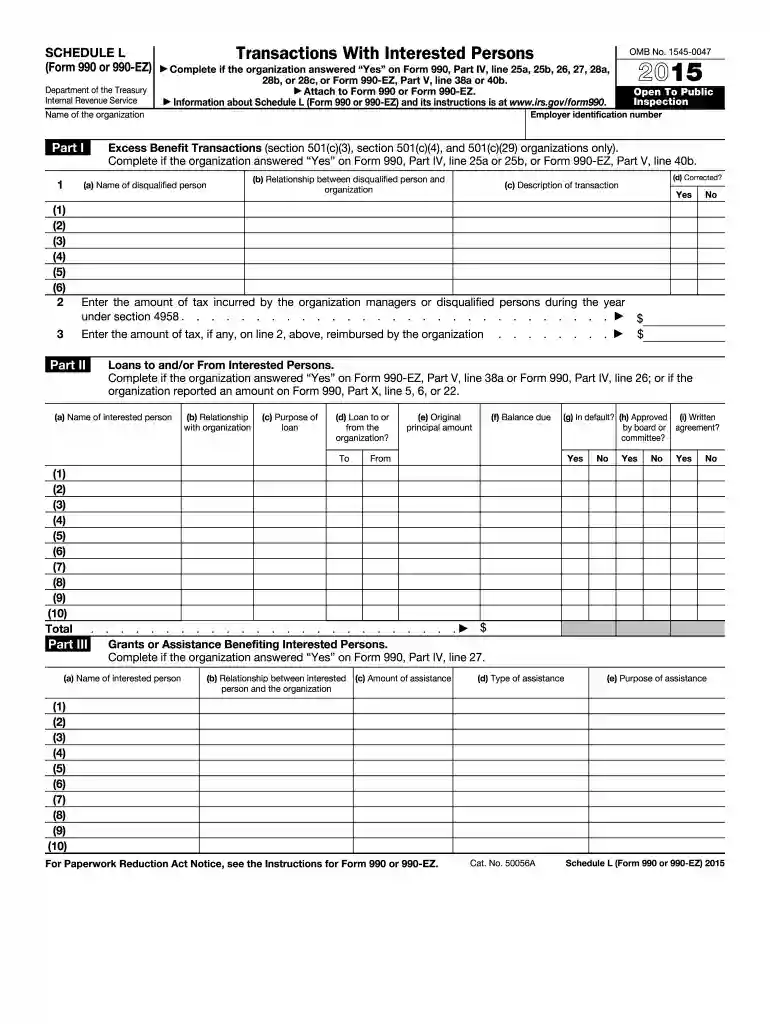
Schedule L of Form 990 or 990-EZ, specifically the "(b) Relationship between disqualified person and," is utilized to report information concerning certain relationships and transactions between an organization and a disqualified person. A disqualified person is typically someone with significant influence over the organization, such as officers, directors, or major donors. The purpose of this form is to ensure transparency and accountability in the financial interactions occurring within non-profit organizations. This form section helps to identify and assess any potential conflicts of interest.
To correctly use this form section, organizations must identify individuals or entities considered disqualified persons based on their influence or relationship with the organization. The organization then describes the nature of these relationships and the transactions conducted with these individuals. It's essential to detail whether these transactions represent loans, grants, or contracts, ensuring they conform to legal and ethical standards. Maintaining comprehensive records of these transactions aids in completing this section accurately.
Non-profit organizations and certain government entities primarily use this form section when completing their annual tax filings. These groups must have a clear understanding of their financial obligations and the relationships affecting these obligations. Organizations that receive considerable donations or have complex structures may find this form section particularly beneficial for maintaining transparency.


The IRS mandates the completion of Schedule L to ensure transparency in non-profit financial dealings. Organizations must keep thorough records and be prepared to present them during audits. The IRS provides specific instructions on identifying disqualified persons and the relationship types that must be reported. Compliance with these guidelines helps prevent conflicts of interest and potential penalties.
Non-compliant organizations may face penalties, including fines or the revocation of their tax-exempt status. The IRS requires accurate reporting to maintain transparency and legality in financial dealings. Mistakes or omissions can lead to audits or other legal repercussions, significantly affecting the organization's operations and reputation.
To complete this form section, organizations must possess:
With these comprehensive guidelines, organizations can ensure that their uses of the (b) Relationship between disqualified person and section of Schedule L are accurate, compliant, and effectively demonstrate transparency in their financial disclosures.
We've got more versions of the (b) Relationship between disqualified person and form. Select the right (b) Relationship between disqualified person and version from the list and start editing it straight away!
| Versions | Form popularity | Fillable & printable |
|---|---|---|
| 2024 | 4.9 Satisfied (33 Votes) | |
| 2023 | 4.5 Satisfied (44 Votes) | |
| 2022 | 4.1 Satisfied (24 Votes) | |
| 2021 | 4.8 Satisfied (166 Votes) | |
| 2020 | 4.2 Satisfied (87 Votes) | |
| 2019 | 4.3 Satisfied (124 Votes) | |
| 2018 | 4.4 Satisfied (363 Votes) | |
| 2017 | 4.3 Satisfied (254 Votes) | |
| 2016 | 4.4 Satisfied (123 Votes) | |
| 2015 | 4.2 Satisfied (72 Votes) | |
| 2013 | 4.6 Satisfied (58 Votes) |
At DocHub, your data security is our priority. We follow HIPAA, SOC2, GDPR, and other standards, so you can work on your documents with confidence.

Jun 28, 2026 An introduction to how to determine the amount involved for acts of self-dealing, specifically the lending of money to disqualified personsRead more
B is in a position to exercise substantial influence over the affairs of Y. Therefore, B is a disqualified person with respect to Y.


