







Definition & Meaning
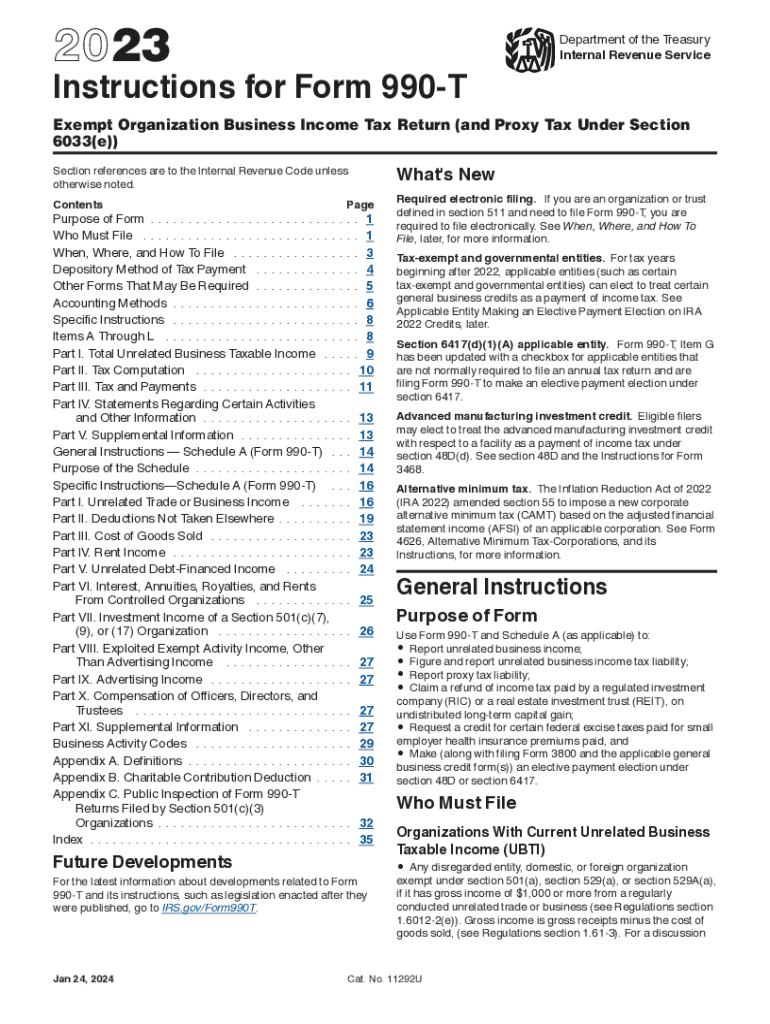
Form 990-T is an essential document for certain exempt organizations filing a tax return for unrelated business taxable income (UBTI). This IRS form helps organizations report income generated from business activities unrelated to their primary exempt purposes, ensuring compliance with federal tax laws. The 2023 instructions for Form 990-T provide detailed guidance for correctly completing this document, addressing complex scenarios such as income deductions and credits.
Key Concepts
- Exempt Organizations: Typically organizations recognized under sections like 501(c)(3) that do not usually pay federal income tax on most of their income.
- Unrelated Business Taxable Income (UBTI): Income from business operations not substantially related to the organization's exempt functions.
- Purpose of Form: Ensure organizations pay taxes on business-income activities not related to their exempt purpose.
Important Terms Related to Form 990-T
Understanding the terminology is crucial for accurate completion of Form 990-T. Misinterpretation can lead to errors, late submissions, or penalties.
Common Terms
- Revenue: Income received from usual business activities, reported on Form 990-T.
- Deductions: Eligible expenses that can be subtracted from total revenue to calculate taxable income.
- Schedule A: Part of Form 990-T used to report different lines of businesses.
Filing Deadlines / Important Dates
Meeting filing deadlines is critical to avoiding penalties. Organizations must be aware of key dates associated with Form 990-T.
Key Dates
- Standard Filing Deadline: Generally due the 15th day of the 5th month after the end of the organization's taxable year.
- Extensions: Organizations can file for extension using Form 8868 but still must pay any tax due by the original deadline.
Steps to Complete Form 990-T
Completing Form 990-T involves a series of structured steps to ensure accuracy and compliance with IRS regulations.
- Gather Required Documents: Collect all relevant financial statements and records of unrelated business activities.
- Calculate UBTI: Identify and compute UBTI by subtracting allowable deductions from gross unrelated business income.
- Complete Schedule A: Use Schedule A to detail different unrelated business activities.
- Determine Tax Payable: Apply the correct tax rate to the UBTI to ascertain the amount owed.
- Submit: File electronically or via mail to the IRS to complete the process.
IRS Guidelines
The IRS provides comprehensive guidelines to help organizations accurately fill out Form 990-T.
Compliance Requirements
- Accurate Reporting: Ensure all unrelated business income is reported, and associated expenses appropriately deducted.
- Documentation: Maintain detailed records to support all claims made in the form.
Penalties for Non-Compliance
Not adhering to Form 990-T requirements can lead to financial penalties and additional scrutiny from the IRS.
- Late Filing Penalty: Usually five percent of the unpaid tax per month, not exceeding 25 percent.
- Negligence Miscalculation: Incorrect filings due to negligence can result in penalties and interest on unpaid amounts.
Who Typically Uses Form 990-T
Certain types of organizations are required to file Form 990-T to report unrelated business activities.
Typical Filers
- Colleges and Universities: Often have unrelated business income from activities like sports and entertainment events.
- Charitable Organizations: Those engaging in commercial enterprises not related to their primary exempt function.
Required Documents
Accurate completion of Form 990-T calls for supporting documents that validate reported figures.
Essential Documentation
- Income Statements: Reflect all income from unrelated business activities.
- Expense Receipts: Proof of deductions claimed to offset UBTI.
Disclosure Requirements
Form 990-T has specific disclosure requirements to ensure transparency in tax reporting.
Public Inspection
- Section 501(c)(3) Organizations: Must make Form 990-T available for public inspection, fulfilling transparency mandates.
Digital vs. Paper Version
Form 990-T can be filed digitally or in paper form, each with unique benefits.
Filing Methods
- Electronic Filing: Offers speed and efficiency, often preferable for larger organizations.
- Paper Submission: Traditional method, generally used by organizations with simpler filing needs.
Software Compatibility
Many organizations use tax preparation software to simplify Form 990-T submissions.
Compatible Platforms
- TurboTax and QuickBooks: Commonly integrate well with Form 990-T, streamlining the data input process.
Key Takeaways
Understanding and correctly completing Form 990-T is crucial for exempt organizations engaging in unrelated business activities. Familiarity with the form's instructions and maintaining comprehensive documentation are fundamental practices to ensure compliance and avoid penalties.




