
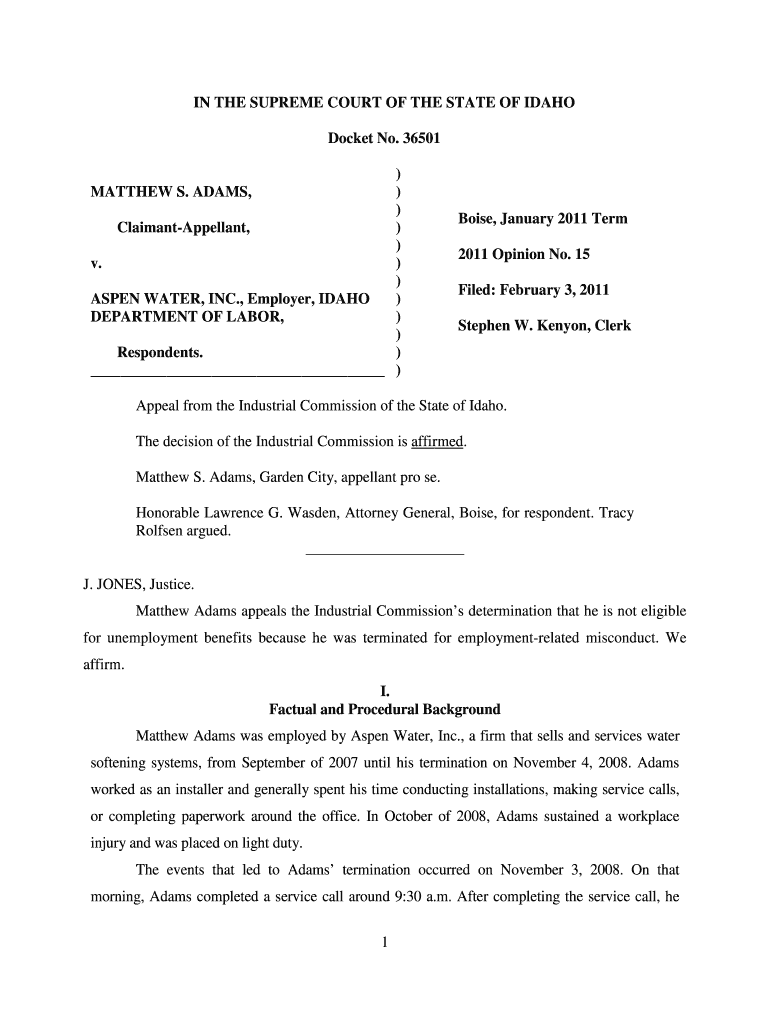







Definition and Meaning of the MATTHEW S
The term "MATTHEW S" relates to the context of a legal or administrative proceeding concerning unemployment benefits. Here, it involves a Supreme Court opinion that affirms a decision by the Industrial Commission regarding Matthew S. Adams. This individual was deemed ineligible for unemployment benefits following his termination due to employment-related misconduct. The term's importance lies in understanding its association with legal judgments related to employment law and misconduct.
Steps to Complete the MATTHEW S Process
Completing the MATTHEW S process involves understanding the specific legal procedures in handling cases related to unemployment benefits and employment misconduct. The steps would typically include:
-
Understanding Misconduct Criteria: Familiarize yourself with what constitutes employment-related misconduct under the law.
-
Gathering Evidence: Collect supporting documents or testimony that can provide justification or context to the actions leading to the dismissal.
-
Filing for Unemployment Benefits: Submit an application demonstrating eligibility for unemployment benefits, citing any relevant legal arguments or exceptions.
-
Legal Representation: Consider securing legal counsel to navigate complex legal proceedings and represent your interests.
-
Attending Hearings: Participate in scheduled hearings, present evidence, and respond to any claims made against you regarding misconduct.
-
Awaiting a Decision: After hearings, the commission will render a decision which can be subjected to appeals if not in your favor.
Key Elements of the MATTHEW S Case
In the context of the "MATTHEW S" case, the following elements played a critical role:
-
Employment Misconduct: The central issue was whether leaving work without permission to run personal errands constituted misconduct.
-
Termination Justification: Aspen Water, Inc.'s grounds for terminating Matthew S. Adams was fully examined for reasonability and adherence to legal employment standards.
-
Impact on Benefits Eligibility: The court evaluated whether the termination on these grounds justified denying unemployment benefits, ultimately affirming the ineligibility based on misconduct findings.
Legal Use of the MATTHEW S
The MATTHEW S represents a legal precedent used to guide decisions involving unemployment benefits appeals, particularly where misconduct is alleged. It underscores the importance of evidence in proving or contesting claims of misconduct and how those claims affect eligibility for unemployment support.
-
Precedent in Misconduct Cases: This serves as a reference for similar cases where misconduct is debated.
-
Application in Legal Strategy: Attorneys might use the case as precedent to argue or refute misconduct claims in unemployment cases.
Important Terms Related to MATTHEW S
Understanding the MATTHEW S context requires familiarity with several legal and employment-related terms:
-
Misconduct: Refers to improper or unprofessional behavior by an employee that violates company policy or expectations.
-
Unemployment Benefits: Government-provided financial support for individuals who have lost their jobs through no fault of their own.
-
Industrial Commission: A body that adjudicates disputes related to employment and workers’ compensation claims.
State-specific Rules for the MATTHEW S
While the MATTHEW S outcome is significant, it’s crucial to note that state-specific laws can vary regarding unemployment and misconduct. Thus:
-
State Legal Frameworks: Different states might have unique criteria or definitions of misconduct affecting unemployment benefits eligibility.
-
Jurisdictional Differences: Pay attention to how state jurisdictions interpret or apply legal precedent in employment-related rulings.
Examples of Using the MATTHEW S in Legal Contexts
Practical application of the MATTHEW S judgment emerges in situations where:
-
Subsequent Cases: It guides judicial reasoning in similar employment-related disputes.
-
Legal Training: Law students and practitioners analyze it to better understand the intersection of employment actions and legal consequence.
-
Policy Formulation: Employers and policymakers might refer to this to draft clearer guidelines and policies on employee conduct.
Digital vs. Paper Version in Legal Contexts
While not directly tied to MATTHEW S, understanding format processing remains relevant:
-
Efficiency in Digital Systems: Courts increasingly use digital submissions for filing documents, allowing for faster processing and lesser reliance on paper formats.
-
Security Protocols: Ensure that all legal documents comply with digital security measures to protect sensitive information.
-
Accessibility Concerns: Digital systems must be accessible, ensuring fair access to all parties involved in legal proceedings.
Penalties for Non-Compliance
Non-compliance with legal rulings or procedural requirements, as illustrated by MATTHEW S, could include:
-
Denial of Benefits: Failing to provide adequate justification for actions leading to termination can result in denial of unemployment claims.
-
Legal Penalties: Misconduct might attract additional legal consequences, varying by state laws and circumstances.
-
Reputational Impact: A finding of misconduct upheld by higher legal bodies can impact employment prospects and professional reputation.




