







Definition & Meaning
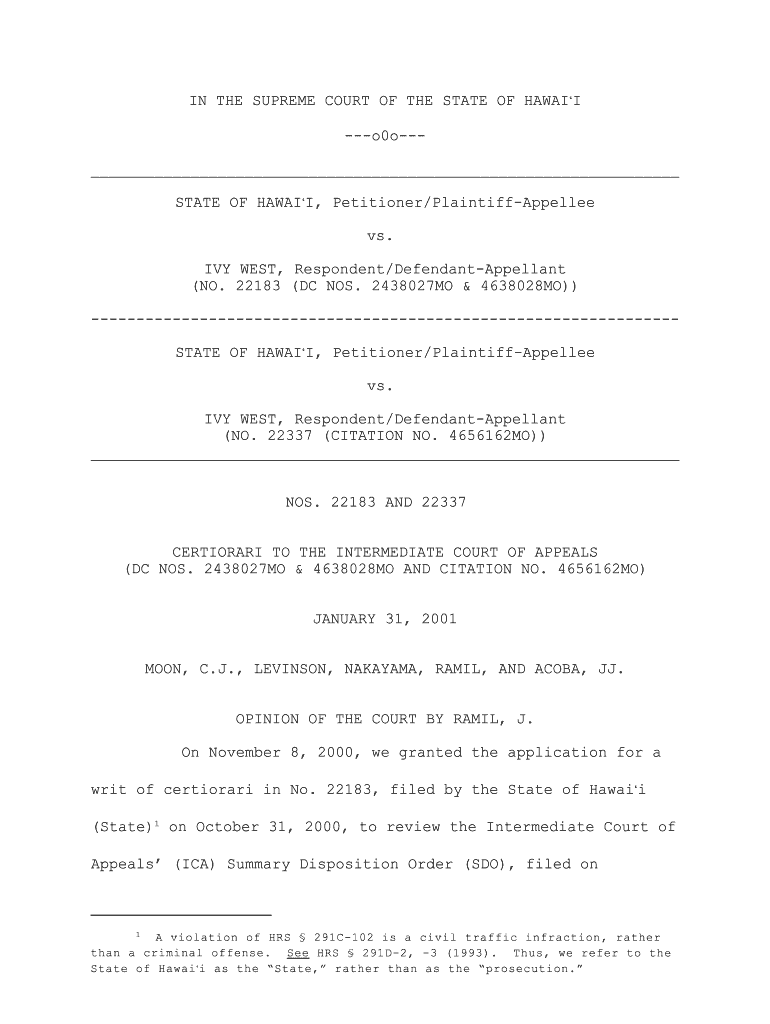
The term "STATE OF HAWAI#I, Petitioner Plaintiff-Appellee" refers to a legal position held by the State of Hawaii when it acts as a petitioning party in a court case, specifically targeting appeals processes. In judicial proceedings, the State of Hawaii assumes this role to advocate on behalf of government interests or to uphold prior judicial decisions. This designation is generally used in appellate cases where the state successfully defended a judgment and now responds to further appeals. Understanding the position of "Petitioner Plaintiff-Appellee" is crucial to grasp the state's role and interests in legal disputes.
Steps to Complete the STATE OF HAWAI#I, Petitioner Plaintiff-Appellee
Fulfilling the role of "STATE OF HAWAI#I, Petitioner Plaintiff-Appellee" involves navigating the appellate process strategically. Below are the steps typically taken:
-
Initiate the Appeal: File a notice of appeal with the appropriate court to begin the appeal process.
-
Prepare Legal Briefs: Draft detailed briefs outlining the state's legal arguments, including reasons for supporting the existing judgment.
-
Submit Evidence: Present evidence in alignment with the state's narrative to justify upholding earlier court decisions.
-
Attend Hearings: Participate in court proceedings to argue the case and provide clarity on legal standpoints.
-
Review Court Decisions: Analyze resulting court judgments for future reference or further action as necessary.
Adhering to these meticulous steps ensures effective representation and supports the state's position in legal proceedings.
Key Elements of the STATE OF HAWAI#I, Petitioner Plaintiff-Appellee
Several components are essential to the role of "Petitioner Plaintiff-Appellee" in Hawaii's legal setting:
-
Judgment Defense: Concentrating on defending a lower court's decision previously in favor of the state.
-
Legal Representation: Engaging experienced legal teams specialized in appellate law to foster a robust case.
-
Judicial Notice: Utilizing rules like Hawaii's Rules of Evidence to streamline judicial recognition of relevant facts.
-
Compliance with Procedures: Ensuring strict adherence to appellate procedural rules to maintain case integrity.
These elements form the foundation of the state's involvement in appellate procedures, ensuring a structured and effective legal approach.
Who Typically Uses the STATE OF HAWAI#I, Petitioner Plaintiff-Appellee
This legal designation is primarily used by government agencies or legal representatives acting on behalf of the State of Hawaii:
-
State Attorneys: Prosecutors or special state-appointed lawyers tasked with handling appellate matters.
-
State Departments: Agencies with vested interests in the outcomes of specific litigations seeking appellate resolution.
Law professionals within these entities frequently leverage this designation to assert the state’s stance during appeals.


Legal Use of the STATE OF HAWAI#I, Petitioner Plaintiff-Appellee
Legally, the "STATE OF HAWAI#I, Petitioner Plaintiff-Appellee" represents standard practice in appeals where the state is defending a prior ruling. This involves:
-
Advocating for State Interests: Pursuing legal actions that serve public interests or uphold state statutes.
-
Utilizing Judicial System: Engaging in the judicial appeals process as a lawful means to resolve disputes or confirm judgments.
Such usage underscores the state's legal rights and duties to safeguard its decisions within judicial settings.
Important Terms Related to STATE OF HAWAI#I, Petitioner Plaintiff-Appellee
Understanding specific terms enhances comprehension of the legal context involving the "STATE OF HAWAI#I, Petitioner Plaintiff-Appellee":
-
Appellee: The party in an appellate case who argues to uphold the lower court's decision.
-
Petition: A formal request asking higher courts to review or reconsider legal decisions.
-
Appellate Court: The court responsible for reviewing the decisions of lower courts.
Familiarity with these terms ensures clarity in the procedural aspects of legal appeals.
State-Specific Rules for the STATE OF HAWAI#I, Petitioner Plaintiff-Appellee
The State of Hawaii has unique legal frameworks governing appellate cases:
-
Hawaii Rules of Appellate Procedure: Outlines specific requirements and timing for appeal submissions and related documents.
-
Judicial Notice Protocols: Specifies when and how courts may accept certain facts without evidence testimony, crucial in traffic and civil cases.
These rules distinctly guide practitioners in navigating Hawaii’s appellate landscape effectively and compliantly.
State-by-State Differences
While Hawaii has its unique procedural nuances, variations exist when compared to other states’ legal practices:
-
Evidence Recognition: States differ in how judicial notices and rules of evidence are applied.
-
Appellate Structure: Differences in court hierarchy and jurisdiction between Hawaii and other states.
-
Timeliness Requirements: The period within which appeals must be filed varies across jurisdictions.
Understanding these distinctions is vital when comparing state-focused legal practices in appellate litigation.
Penalties for Non-Compliance
Failure to comply with procedural protocols as the "STATE OF HAWAI#I, Petitioner Plaintiff-Appellee" may result in:
-
Dismissal of Appeal: Non-compliant submissions can lead to procedural dismissals, affecting the outcome.
-
Legal Sanctions: Potential fines or sanctions for failing to meet legal standards or deadlines.
Ensuring adherence to prescribed procedures and timelines is crucial to avoid these negative repercussions.




