




01. Edit your malicious prosecution examples online
Type text, add images, blackout confidential details, add comments, highlights and more.

Type text, add images, blackout confidential details, add comments, highlights and more.

Draw your signature, type it, upload its image, or use your mobile device as a signature pad.

Send malicious prosecution cases via email, link, or fax. You can also download it, export it or print it out.
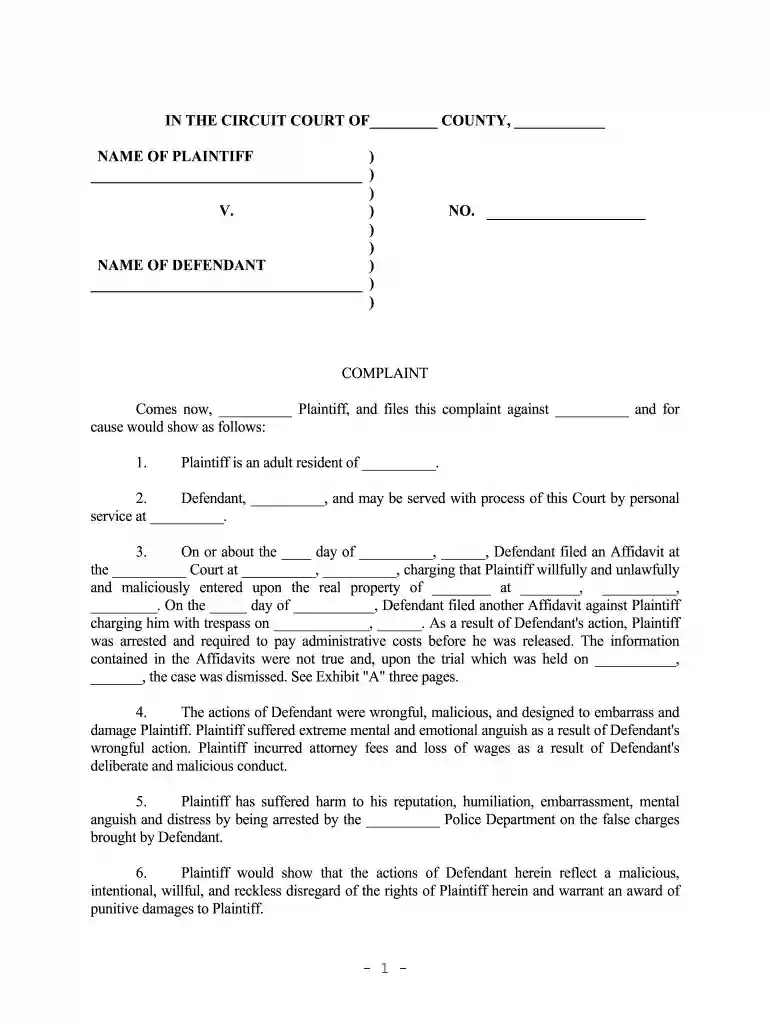
A civil complaint is a formal legal document filed by a plaintiff to initiate a lawsuit against a defendant, outlining the plaintiff's allegations and the relief they seek. It typically includes the parties involved, the factual basis for the claims, and the specific damages or remedies requested. In the United States, a civil complaint can address a variety of issues such as breaches of contract, personal injury, or civil rights violations. The document acts as a notification to the defendant about the legal action and sets the stage for subsequent legal proceedings. Understanding the nature and requirements of a civil complaint is essential for both plaintiffs and defendants to navigate the legal process effectively.
When utilizing a civil complaint template, certain key steps should be followed to ensure accuracy and compliance with legal standards. First, gather all necessary information such as names and contact details of the parties involved, a detailed description of the events leading to the claim, and any relevant evidence or documentation. Input this data into the appropriate sections of the template, such as the introductory statement, factual allegations, and damage claims. It is crucial to review the completed template carefully to ensure that all information is accurate and that legal terminology is correct. Legal counsel is often advisable to assist with finalizing the document to avoid errors that could affect the case's outcome.
Identify the Parties: Begin by listing the full names and addresses of the plaintiff and the defendant. This section confirms the identity and location of each party involved in the dispute.
Establish Jurisdiction: Provide the court's jurisdiction over the case by citing the relevant laws or legal principles that apply. This might involve detailing the defendant's location or the location where the incident occurred.
Outline the Facts: Clearly narrate the sequence of events that gave rise to the complaint. Include dates, locations, and any significant incidents that are central to the case.
State the Claims: Explicitly define each legal claim being made against the defendant. Refer to the statutes, regulations, or case law that supports each claim.
Include a Prayer for Relief: Articulate what remedies or compensation the plaintiff is seeking. This could be in the form of monetary damages, specific performance, or injunctive relief.
A comprehensive civil complaint template should consist of several pivotal elements to ensure legal sufficiency. These include the introductory sections, which lay out the parties and jurisdictional statements; the body of the complaint, where factual allegations are detailed; and the concluding sections, which specify the claims for relief and desired outcomes.
A civil complaint template serves as a foundational tool in civil litigation. It ensures that all necessary legal formalities are adhered to while presenting the plaintiff’s case. The template must be customized to fit the specific facts and legal theories of the case at hand. Given that different jurisdictions might have varying rules, it's important to align the complaint with local court procedures. Furthermore, ensuring proper legal language and structure bolsters the document's credibility and effectiveness, which can be crucial for the success of legal proceedings.
In the U.S., civil complaint requirements can vary significantly from one state to another due to distinct procedural rules. While the federal rules provide a general framework, each state may impose additional requirements. For instance, some states require verification of complaints, while others might have unique formatting rules or specific information that must be included. Plaintiffs should closely review the civil procedure rules applicable in the jurisdiction where the lawsuit is filed.
Civil complaint templates are primarily used by individuals or entities initiating a civil lawsuit. Plaintiffs—ranging from private citizens to corporations—employ these templates to ensure their complaints are comprehensive and adhere to legal norms. This tool is valuable for attorneys and legal teams to streamline the drafting process, although individuals representing themselves (pro se litigants) in simpler cases also utilize these templates to construct their legal arguments effectively.


Real-world applications of civil complaint templates often involve scenarios such as personal injury claims, where a plaintiff sues for medical costs and damages following an accident. Another example could be a breach of contract case, wherein a business seeks compensation for losses due to a vendor failing to meet agreed-upon terms. Templates enable users to systematically outline their grievances and support their claims with structured information, facilitating more efficient legal proceedings.
At DocHub, your data security is our priority. We follow HIPAA, SOC2, GDPR, and other standards, so you can work on your documents with confidence.
Every pleading must have a caption with the courts name, a title, a file number, and a Rule 7(a) designation. The title of the complaint must name all theRead more
Dec 1, 2016 Complaint for a Civil Case Civil Forms Court Reporter Forms Criminal Forms CJA Forms Human Resources Forms Jury Forms Other Forms.Read more


