T12402-WADA-Doping Control form:Layout 1 - World Anti-Doping 2026

Get Form
T12402-WADA-Doping Control form:Layout 1 - World Anti-Doping Preview on Page 1

Here's how it works

01. Edit your form online
Type text, add images, blackout confidential details, add comments, highlights and more.

02. Sign it in a few clicks
Draw your signature, type it, upload its image, or use your mobile device as a signature pad.

03. Share your form with others
Send it via email, link, or fax. You can also download it, export it or print it out.

Definition and Purpose of the T12402-WADA-Doping Control Form

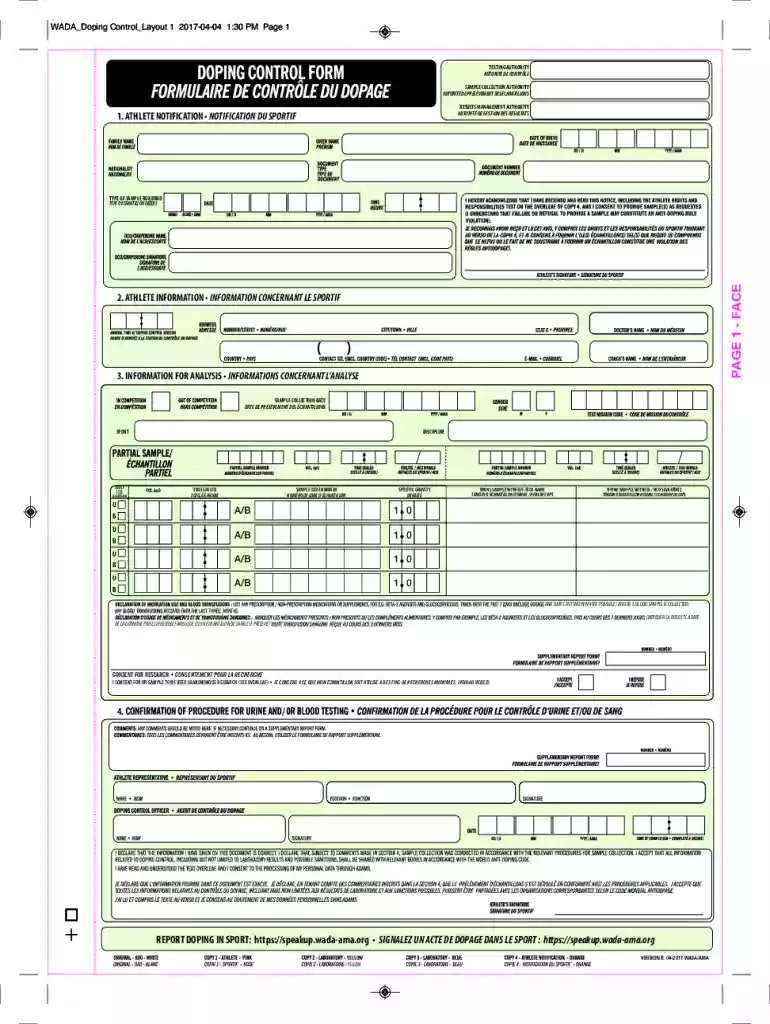
The T12402-WADA-Doping Control Form, also known informally as the Doping Control Form, is utilized in anti-doping procedures to document every phase of the doping control process for athletes. Its primary purpose is to ensure transparency and accountability in competitive sports by outlining the protocols for sample collection, data management, and safeguarding athlete rights. This form serves as a critical tool in maintaining compliance with World Anti-Doping Agency (WADA) standards, emphasizing the importance of adhering to anti-doping rules.

Key Components of the Form

  • Sample Collection: Details the procedures for collecting biological samples from athletes, ensuring adherence to specific protocols to avoid contamination or tampering.
  • Data Management: Establishes how athletes' personal and biological data will be recorded and stored securely, maintaining confidentiality and stakeholders' access rights.
  • Athlete Rights and Responsibilities: Clearly delineates the expectations for athletes, ensuring they understand their obligations and the protections in place regarding their samples and data.

Steps to Complete the T12402-WADA Doping Control Form

Filling out the Doping Control Form requires meticulous attention to detail to ensure integrity and compliance.

  1. Initial Verification: Confirm the athlete's identity using official documentation, ensuring the correct athlete is subject to the test.
  2. Sample Collection: Follow precise guidelines for collecting urine or blood samples, utilizing designated kits and sterile techniques to maintain sample integrity.
  3. Form Documentation: Accurately record all relevant information on the form, including the athlete's details, the date and time of sample collection, and any medications or supplements taken by the athlete.
  4. Consent and Signatures: Obtain informed consent from the athlete, confirming their understanding and agreement with the doping control process. Both the athlete and the Doping Control Officer must sign the form.
  5. Sample Handling and Transport: Securely seal the samples and form, ensuring they are sent to a designated laboratory promptly and under regulated conditions.

Who Typically Uses the T12402-WADA Doping Control Form

This form is a standard tool used by anti-doping agencies, sports governing bodies, and doping control officers.


  • Anti-Doping Agencies: Deployed extensively by national and regional anti-doping bodies for the consistent enforcement of doping regulations.
  • Sport Governing Bodies: Ensures compliance with international sport standards by organizations like the International Olympic Committee and specific sports federations.
  • Doping Control Officers: Critical personnel in the execution of the test, these officers carry out the procedural steps required for sample collection and documentation.
decoration image ratings of Dochub

Legal Use and Compliance Requirements

The Doping Control Form must be completed in accordance with WADA regulations and national law enforcement guidelines concerning doping in sports.

Legal Implications

  • Mandatory Compliance: Failing to comply with the procedures indicated in the form can result in penalties or sanctions against athletes and sports teams.
  • Data Protection Laws: Adherence to privacy laws such as the General Data Protection Regulation (GDPR) for European athletes and comparable U.S. privacy standards is crucial.

Important Terms Related to the Doping Control Process

Understanding specific terms is essential for the proper execution and interpretation of the Doping Control Form.

Glossary

  • Adverse Analytical Finding (AAF): A report from a laboratory that identifies the presence of a prohibited substance or its metabolites in an athlete's sample.
  • Provisional Suspension: A temporary suspension that may be enforced while awaiting the outcome of a case regarding doping rule violations.
  • Therapeutic Use Exemption (TUE): Allows athletes to take medications containing prohibited substances, provided they meet specific criteria for medical necessity.

Examples of Using the T12402-WADA Doping Control Form

Practical application of the form can vary based on the sport and country-specific regulations.

  • International Competitions: Used during events such as the Olympics or World Championships where global compliance with anti-doping rules is required.
  • National Events: Applied at national level competitions to ensure local athletes abide by both national and international doping standards.
  • Research Data: Facilitates the collection and analysis of data for research into anti-doping compliance and effectiveness, contributing to global initiatives against sports doping.

Considerations for Digital vs. Paper Version

The choice between digital and paper versions depends on technological infrastructure and data security policies.

Digital Version

  • Efficiency: Streamlines the process with easy data entry and automatic updates to central databases.
  • Security: Enhances security with encrypted data transmission and storage, reducing risk associated with physical document handling.

Paper Version

  • Accessibility: Ensures availability in all testing environments, especially where digital systems are not feasible or reliable.
  • Fallback Option: Serves as a backup in case of digital system failures, ensuring continuity in doping control processes.

Software Compatibility and Integration

Although DocHub specializes in document editing, it supports integration with various systems for seamless processing of digital forms like the Doping Control Form.

Compatible Platforms

  • Google Workspace: Facilitates easy import and export of forms to streamline workflow between colleagues and departments.
  • Standard PDF Editors: Allows for maintaining and manipulating the digital versions of the form, ensuring functionality across various software ecosystems.
be ready to get more

Complete this form in 5 minutes or less

Get form

Got questions?

We have answers to the most popular questions from our customers. If you can't find an answer to your question, please contact us.
Contact us
Glycerol is prohibited as an ergogenic aid by the World Anti-Doping Agency (WADA) due to the potential for its plasma expansion properties to have masking effects.
The 2025 Prohibited List is one of the eight International Standards that are mandatory for all Signatories of the World Anti-Doping Code (Code). It designates what substances and methods are prohibited both in- and out-of-competition and which substances are banned in particular sports.
Glycerol could be used as an energy substrate in nutrition, and could docHubly contribute to the energy yield during exercise (Burelle et al., 2001). Considering its energy substrate function, glycerol could efficiently improve athletic performance (Montner et al., 1999).
Glycerol is prohibited as an ergogenic aid by the World Anti-Doping Agency (WADA) due to the potential for its plasma expansion properties to have masking effects. However, the scientific basis of the inclusion of Gly as a masking agent remains inconclusive.
Substances and techniques that are prohibited by WADA fall into the following categories: S0 non-approved substances; S1 anabolic agents; S2 peptide hormones, growth factors, related substances, and mimetics ; S3 beta-2 agonists; S4 hormone and metabolic modulators; S5 diuretics and masking agents; prohibited methods (

Security and compliance

At DocHub, your data security is our priority. We follow HIPAA, SOC2, GDPR, and other standards, so you can work on your documents with confidence.

Learn more

People also ask

Glycerol is prohibited by the World Anti-Doping Agency (WADA) as masking agent since 2010.