




01. Edit your irs schedule d printable online
Type text, add images, blackout confidential details, add comments, highlights and more.

Type text, add images, blackout confidential details, add comments, highlights and more.

Draw your signature, type it, upload its image, or use your mobile device as a signature pad.

Send guidestar login via email, link, or fax. You can also download it, export it or print it out.
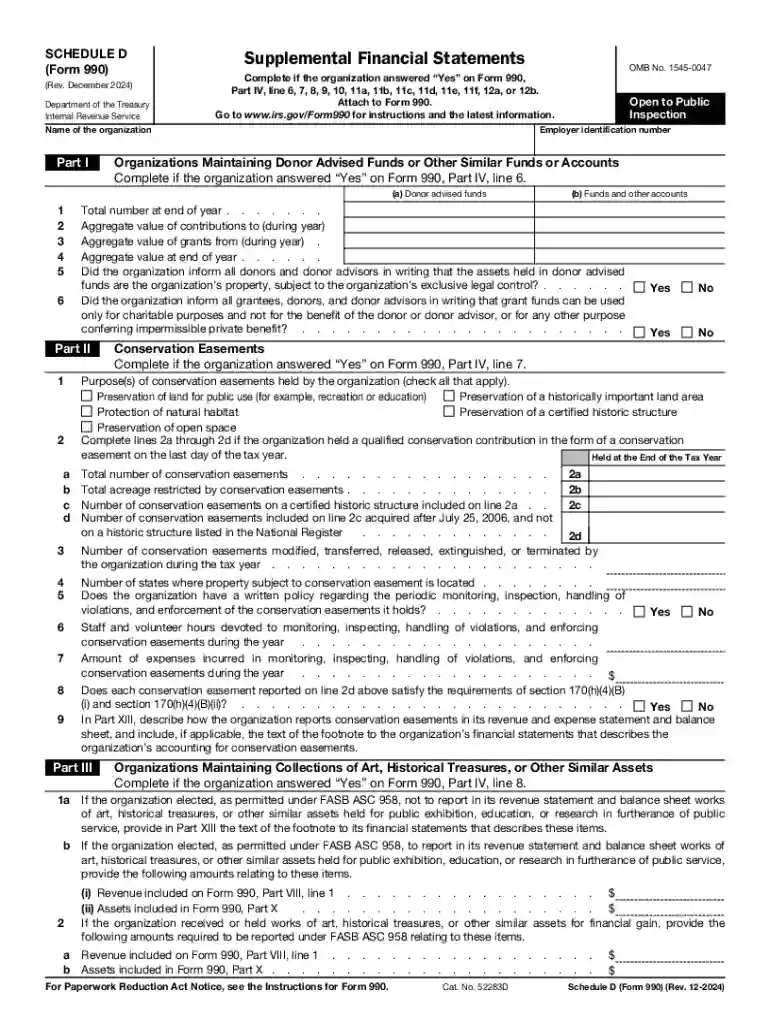
Schedule D (Form 990) (Rev December 2024) Supplemental Financial Statements is a pivotal document submitted to the Internal Revenue Service (IRS) by tax-exempt organizations. This form assists the IRS in verifying financial particulars regarding certain specified assets, such as donor-advised funds, conservation easements, and collections like art or historical treasures. The inclusion of Schedule D in Form 990 provides transparency and compliance with federal tax regulations, ensuring organizations accurately disclose their financial activities.
Schedule D is utilized alongside Form 990 to ensure comprehensive financial reporting. Its primary use is to offer supplemental information that might not be fully captured in Form 990, focusing on specific types of assets and financial activities.
An art museum uses Schedule D to report its extensive collection, ensuring each piece is accounted for in the financial statement.
For accuracy in completing Schedule D, consider the following steps:
Organizations must adhere to IRS guidelines while completing Schedule D, ensuring transparency and compliance with tax laws. The IRS uses this schedule to scrutinize the valuation of assets and the fiscal responsibility of the filing entity.
A conservation organization correctly reports its easements to demonstrate legal adherence to natural preservation commitments.
Schedule D, as part of Form 990, follows specific timelines established by the IRS.
Late submissions may result in penalties, so it's crucial to adhere to these timelines to maintain compliance.
The completion of Schedule D necessitates a host of supporting documents to substantiate the financial information disclosed.
Organizational record-keeping should focus on maintaining up-to-date documentation, facilitating ease of access during form preparation.
Organizations failing to furnish Schedule D correctly or timely face potential penalties enforced by federal authorities.
Filing methods for Schedule D features both traditional and modern approaches.
Using e-filing platforms such as DocHub simplifies submission processes through integrated tools that verify and digitize paper forms seamlessly.
We've got more versions of the irs schedule d printable form. Select the right irs schedule d printable version from the list and start editing it straight away!
| Versions | Form popularity | Fillable & printable |
|---|---|---|
| 2024 | 4.5 Satisfied (39 Votes) | |
| 2023 | 4.3 Satisfied (40 Votes) | |
| 2022 | 4.9 Satisfied (48 Votes) | |
| 2021 | 4.8 Satisfied (171 Votes) | |
| 2020 | 4.4 Satisfied (138 Votes) | |
| 2019 | 4.3 Satisfied (93 Votes) | |
| 2018 | 4.2 Satisfied (79 Votes) | |
| 2017 | 4.2 Satisfied (114 Votes) | |
| 2016 | 4.2 Satisfied (72 Votes) | |
| 2015 | 4 Satisfied (43 Votes) | |
| 2014 | 4 Satisfied (32 Votes) | |
| 2013 | 4 Satisfied (59 Votes) | |
| 2012 | 4 Satisfied (50 Votes) | |
| 2011 | 4 Satisfied (28 Votes) | |
| 2010 | 4 Satisfied (58 Votes) |
At DocHub, your data security is our priority. We follow HIPAA, SOC2, GDPR, and other standards, so you can work on your documents with confidence.





Instruction 990 (Schedule D) Title Instructions for Schedule D (Form 990), Supplemental Financial Statements, Revision Date Dec 2024, Posted Date 12/30/2024.Read more
May 11, 2026 This return has been prepared for electronic filing. schedules and statements, SCHEDULE D Supplemental Financial Statements. Schedule D (Form


