







Definition & Meaning
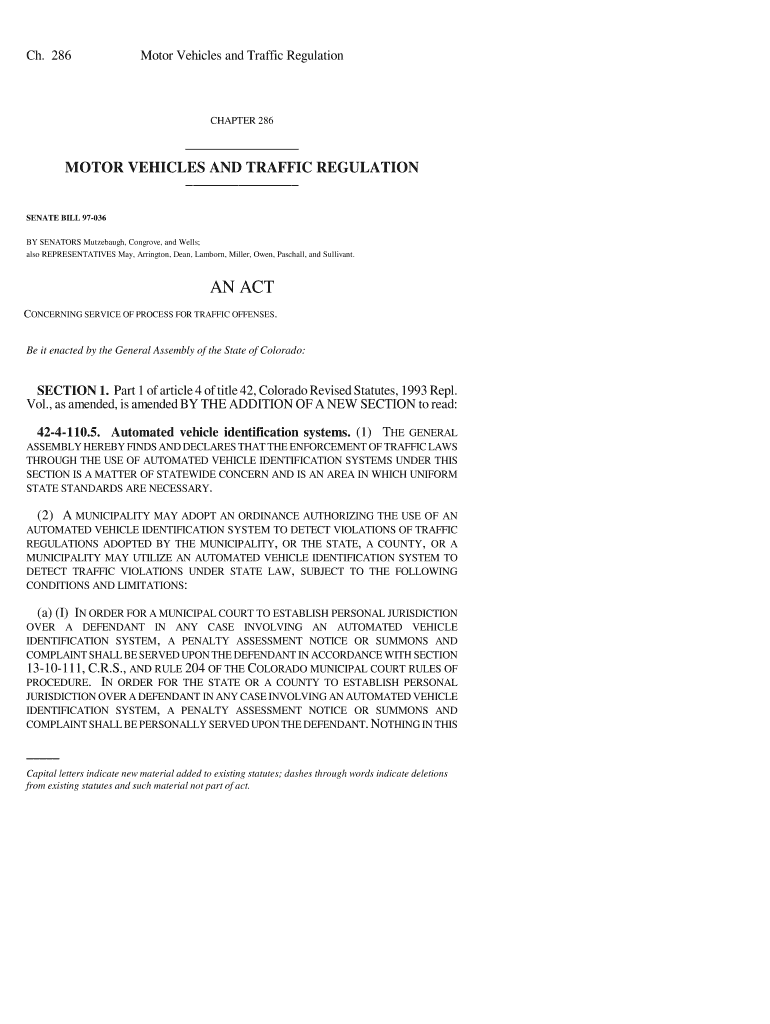
Senate Bill 97-036, officially known as Chapter 286 of the Colorado Revised Statutes, establishes regulations for the use of automated vehicle identification systems in enforcing traffic laws. This bill provides a legal framework for cities and towns in Colorado to implement and manage automated systems that aid in traffic control. It is designed to ensure uniform standards in traffic enforcement across Colorado while protecting drivers' rights by stipulating specific conditions and limitations on the use of these systems.
Key Components of the Bill
- Automated Vehicle Identification Systems: Technologies that capture vehicle information to enforce traffic regulations.
- Municipal Implementation: The bill outlines how municipalities can adopt these systems in a legally compliant manner.
- No Driver's License Points: Violations identified through automated systems do not result in points against a driver's license.
How to Use the SENATE BILL 97-036
Utilizing the provisions of Senate Bill 97-036 involves understanding and applying its rules and conditions effectively. Municipalities planning to implement automated vehicle identification systems must adhere to the bill's guidelines to ensure legal compliance.
Implementation Steps
- Assessment of Needs: Evaluate the necessity and potential impact of implementing such systems in the community.
- System Selection: Choose an appropriate automated vehicle identification system that complies with the bill's requirements.
- Compliance Check: Ensure that all regulations related to notification and privacy are upheld, including not assigning driver's license points for detected violations.
Steps to Complete SENATE BILL 97-036 Requirements
For municipalities intending to enforce traffic laws through Senate Bill 97-036, there are defined steps to ensure full compliance.
Procedure
- Consultation and Planning: Engage legal advisors and community leaders to plan implementation strategies.
- Public Notification: Inform the public about the introduction of new systems and how they operate under the bill.
- Training of Personnel: Ensure that all personnel involved in operating the systems are adequately trained and aware of the legal framework.
Legal Use of the SENATE BILL 97-036
The bill provides a legal structure for utilizing automated vehicle systems in traffic enforcement while safeguarding citizens' rights. It is fundamentally about balancing law enforcement efficiency with citizens' privacy and rights.
Key Legal Provisions
- Service of Penalty Notices: Criteria for how notices are to be delivered.
- Uniform Standards: Ensures consistency in the application of traffic laws across the state.
- Protected Citizen Rights: Violations do not add to driving records or report outstanding judgments.
Important Terms Related to SENATE BILL 97-036
Understanding terminology associated with Senate Bill 97-036 is crucial for interpreting its requirements and implications.
Glossary
- Automated Vehicle Identification: Technology to detect and record vehicle data for traffic law enforcement.
- Penalty Notices: Documents served to inform vehicle owners of detected violations.
- Municipality: A city or town within Colorado that is governed under state laws.
State-Specific Rules for the SENATE BILL 97-036
Senate Bill 97-036 applies specifically to Colorado and includes state-specific rules for implementing automated traffic systems.
Unique Colorado Standards
- Non-Penalty for License Points: Unique to Colorado under this bill, detected violations do not contribute points on a driver's license.
- Standardization Across Municipalities: Ensures that all cities follow the same procedures for enforcement under the bill.
Examples of Using the SENATE BILL 97-036
Practical application of the bill can be illustrated through examples where municipalities successfully deployed automated systems.
Case Studies
- Example 1: A municipality implemented red-light cameras and successfully reduced traffic violations by adhering to the bill's regulations.
- Example 2: A town installed speed cameras, notifying drivers of upcoming enforcement areas, thus increasing compliance with speed limits.
Penalties for Non-Compliance
Failure to adhere to Senate Bill 97-036 can result in significant legal and procedural consequences for municipalities.
Consequences
- Legal Repercussions: Non-compliance may lead to litigation or fines.
- Loss of Public Trust: Failure to implement systems according to the bill may lead to public distrust in municipal traffic management efforts.
Digital vs. Paper Version
Understanding how to implement systems digitally is essential, considering the technological nature of automated vehicle identification systems.
Considerations for Implementation
- Digitized Processing: Automated systems primarily operate with digital data, ensuring faster processing and management of traffic violations.
- Paper-Based Notifications: Although the system is digital, notifications may still need to be delivered in paper form to meet legal requirements for informing offenders.
Software Compatibility
Compatibility with existing software is crucial when deploying automated systems under Senate Bill 97-036.
Integration Examples
- Data Management: Systems can be integrated with municipal databases for seamless record-keeping.
- Software Solutions: Compatible with various traffic management systems and municipal IT infrastructures, ensuring efficient processing and reliability.




