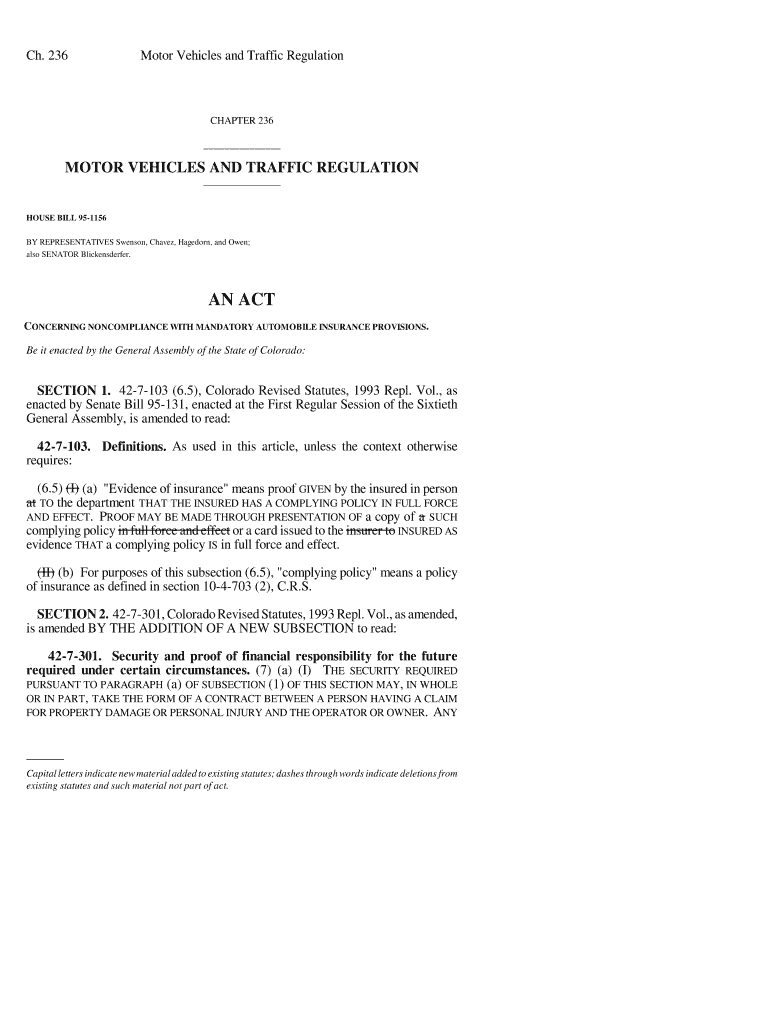







Definition & Overview of the 236 Motor Vehicles and Traffic Regulation House Bill
The 236 Motor Vehicles and Traffic Regulation, often referred to by its shorthand, is a legislative document that aims to address various aspects of motor vehicle use and traffic management. It provides comprehensive guidelines for vehicle registration, driver licensing, and traffic safety measures. It is critical for drivers, vehicle owners, and law enforcement to understand its requirements, as it helps in maintaining orderly and safe roads. House Bill 95-1156 is a notable example, focusing on mandatory automobile insurance compliance and setting forth conditions for license suspension or restoration.
Key Elements of the 236 Motor Vehicles and Traffic Regulation
- Vehicle Registration Requirements: This includes guidelines for proper vehicle ownership documentation and registration processes.
- Driver Licensing Protocols: Specifies the qualifications and testing needed for obtaining a driver's license.
- Traffic Safety Rules: Outlines rules to ensure road safety, such as speed limits, seatbelt use, and impaired driving regulations.
- Insurance Compliance: Emphasizes the necessity for valid insurance coverage and procedures for dealing with insurance noncompliance.
Legal Aspects & Compliance Regulations
Understanding the legal use of the 236 Motor Vehicles and Traffic Regulation is essential for compliance. The regulation mandates adherence to vehicle standards, driver qualifications, and traffic rules to ensure public safety. Noncompliance can lead to penalties, including fines and potential suspension of driving privileges. It's crucial for individuals and businesses to understand their obligations under this regulation to avoid legal issues and contribute to safer roadways.
Steps to Complete Activities Required by the Regulation
-
Obtain Necessary Forms and Documentation: Gather all relevant documents required for your specific need under the regulation, such as insurance certificates or vehicle registration forms.
-
Understand Your Requirements: Determine which parts of the regulation apply to your situation, whether it's vehicle registration, driver licensing, or compliance with traffic laws.
-
Complete Form-Based Requirements: Fill out necessary forms accurately, ensuring all required fields are completed and supporting documents are attached.
-
Submit Forms Appropriately: Depending on the requirement, forms can be submitted online, via mail, or in person at designated offices.
-
Await Confirmation and Approval: After submission, wait for confirmation of receipt and any necessary approval from relevant authorities.
Penalties for Non-Compliance
Non-compliance with the 236 Motor Vehicles and Traffic Regulation can result in several penalties, including:
- Monetary Fines: Financial penalties as immediate repercussions for violations such as failure to maintain proper insurance.
- License Suspension: Temporary loss of driving privileges under specific conditions outlined in the regulation.
- Vehicle Impoundment: In cases of severe non-compliance, such as repeated traffic offenses or lack of insurance coverage.
Who Typically Uses the 236 Motor Vehicles and Traffic Regulation
- Individual Drivers: For personal compliance with driving and vehicle ownership requirements.
- Commercial Vehicle Operators: Ensuring that vehicles used for business purposes meet safety and operational standards.
- Law Enforcement Agencies: To uphold the laws and standards set forth by the regulation, ensuring public safety on the roads.


Important Terms Related to the Regulation
- Financial Responsibility: The obligation to maintain adequate financial backing (like insurance) to cover potential liabilities from vehicle operation.
- Mandatory Insurance Provisions: Legal requirements to maintain valid insurance coverage for every vehicle.
- Traffic Violation: Any violation of rules set forth in the regulation, subject to penalties.
State-Specific Rules & Variations
Each state may have unique implementations or variations of the 236 Motor Vehicles and Traffic Regulation. It's crucial for drivers and vehicle owners to consult state-specific resources to understand local adaptations of these regulations. For instance, while the core principles of the regulation remain consistent, specifics like insurance minimums and penalty structures can vary. This state-by-state approach ensures the regulation is adapted to meet the unique needs and conditions of different regions.