







Definition & Meaning
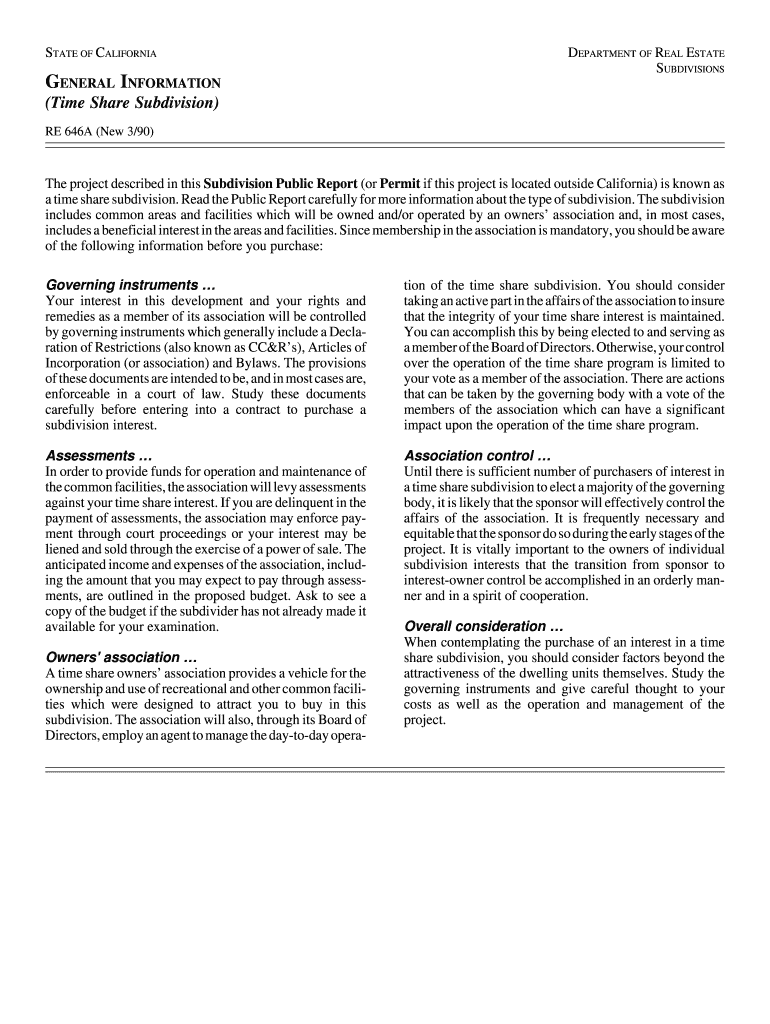
The "General Information (Time Share Subdivision), RE 646A (3 90) General Information (Time Share Subdivi" is a public report issued by the California Department of Real Estate. It serves as a vital document that outlines essential information about time share subdivisions. This document is crucial for potential buyers as it highlights the obligations and rights of owners within the time share’s governing framework, which includes CC&Rs, Articles of Incorporation, and Bylaws. The overall aim is to provide comprehensive guidance on the operational and financial aspects of owning a time share.
Key Elements of the Form
The primary components of the RE 646A form involve detailed accounts of the governing instruments and owners’ responsibilities. Key features include:
- Governing Instruments: Documents like CC&Rs, Articles of Incorporation, and Bylaws that define the legal and operational framework.
- Owner Responsibilities: Guidelines on participation, maintenance assessments, and control transitions from sponsors to owners.
- Financial Obligations: Details about assessments that determine owners’ financial responsibilities toward maintenance costs.
- Control Transition: How control shifts from the sponsor to owners, providing them the autonomy to manage the property.
Steps to Complete the Form
To effectively complete the General Information (Time Share Subdivision), follow these steps:
- Review Governing Instruments: Thoroughly understand the CC&Rs, Articles of Incorporation, and Bylaws.
- Assess Financial Commitment: Evaluate the financial implications related to maintenance and other costs.
- Understand Control Transition: Familiarize yourself with the timeline and requirements for the transition of control.
- Get Input: Consult with financial advisors or legal experts to understand the broader implications.
How to Obtain the Form
The RE 646A form can be acquired through several methods:
- California Department of Real Estate: Directly contact the department for the most reliable source of this document.
- Real Estate Developer: Often provided during the purchase process by the real estate developer involved in the time share.
- Online: Many websites might host the document, but ensure they are reputable to guarantee authenticity.
Who Typically Uses the Form
This form is primarily utilized by:
- Potential Time Share Buyers: Individuals considering purchasing a time share need this form to understand their future responsibilities.
- Real Estate Professionals: Agents and brokers working in the time share market rely on these documents during transactions.
- Legal Advisors: Lawyers might use the form to advise clients on time share investments.

Important Terms Related to the Form
Understanding specific terms within the document is crucial:
- CC&Rs: Covenants, Conditions, and Restrictions that dictate property usage.
- Articles of Incorporation: Documents that set up the legal existence of the association.
- Bylaws: Rules governing the operation of the association and its members.
- Assessments: Fees levied for maintenance and operation costs of shared facilities.
State-Specific Rules
While the RE 646A form is specific to California, certain regulations may vary:
- Local Variations: Understand how local legislative nuances impact time share ownership.
- Compliance Requirements: Verify any additional state-specific filings or disclosures.
Penalties for Non-Compliance
Failure to adhere to the terms and responsibilities outlined in the RE 646A form can lead to penalties, including:
- Legal Action: Potential lawsuits from the owners’ association.
- Financial Penalties: Additional fees or interest on overdue assessments.
- Loss of Property Rights: In extreme cases, non-compliance can result in forfeiting your time share interest.
Legal Use of the Form
This document plays a central role legally by:
- Establishing Rights: Defines the legal rights of time share owners and their voting power.
- Setting Obligations: Clearly lays out what owners must do to remain in good standing with the association.
- Providing Recourse: Offers pathways for resolving disputes according to stipulated legal channels.
Digital vs. Paper Version
In the modern era, the form is usually available in both formats:
- Paper Version: Traditional paper documentation might still be preferred for official record-keeping.
- Digital Version: Offers flexibility and ease of access, facilitating quicker filing and distribution.
Quick Facts
- Purpose: To educate and inform potential time share buyers about their rights and responsibilities.
- Key Elements: Includes governance, financial responsibilities, and legal frameworks.
- Format Options: Available in both digital and paper formats for convenience and choice.




