






Definition & Meaning
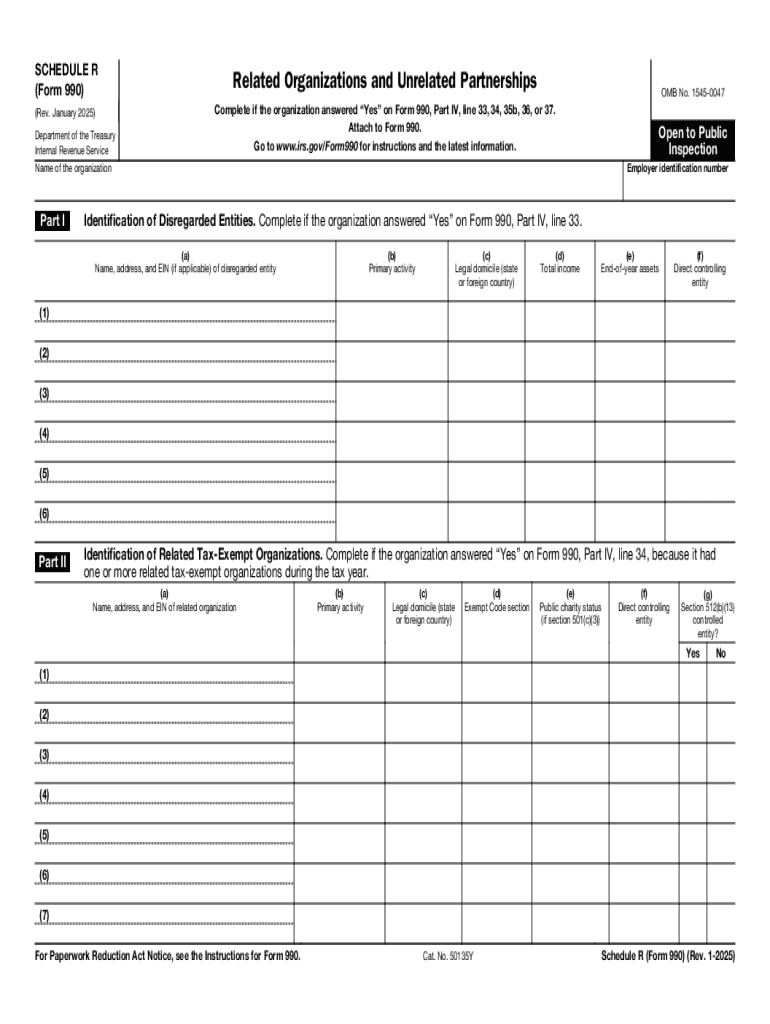
"Schedule R (Form 990) (Rev January 2025) Related Organizations and Unrelated Partnerships" is a tax document required by the IRS for certain organizations. It is particularly used by tax-exempt organizations to provide comprehensive information about their relationships with related organizations and their participation in unrelated partnerships. This schedule aims to ensure transparency and accountability about the financial interactions and structural relationships between the reporting organization and other entities.
Organizations typically required to file Schedule R include those with one or more related or disregarded entities. The form breaks down key information into sections covering different types of affiliations, such as partnerships and other joint ventures to assess compliance and identify possible tax liabilities. The detailed disclosures also help in verifying that these entities are functioning within the boundaries of their tax-exempt status.
How to Use Schedule R (Form 990)
Using Schedule R involves a structured approach. It is essential for tax-exempt organizations to ensure that all sections of the form are accurately completed. The form is structured to collect various pieces of information, including:
- Details of the related organizations, including their names, type, and identification numbers
- Description of the relationship and financial transactions between the entities
- Disclosure of allocations between the reporting organization and partnerships
For efficient completion, organizations should gather all relevant financial records and documentation reflecting their relationships with other entities. Consulting with a tax professional or using advanced tax software can also streamline the process of filling out the form, especially for organizations with complex structures.
Steps to Complete Schedule R
-
Gather Required Information: Before starting, collect all necessary documents and financial records that detail the relationships with related organizations. Include any partnership agreements and transaction records.
-
Identify Related Organizations: Classify all related entities under categories specified by the form, such as disregarded entities, tax-exempt organizations, partnerships, and trusts.
-
Complete Part I: This section requires comprehensive details about disregarded entities, including their names, addresses, and employer identification numbers.
-
Complete Part II-IV: Record information about tax-exempt related organizations, partnerships, and other arrangements. Include income, sharing ratios, and any significant financial transactions.
-
Review and Substantiate: Ensure that all information is consistent and backed by sufficient documentation. Discrepancies can lead to penalties or the need for amendments.
-
File with Form 990: Schedule R needs to be filed as an attachment to Form 990. Ensure that all components of Form 990 are completed accurately.
Filing Deadlines / Important Dates
Schedule R, like Form 990, follows specific deadlines that align with the organization's tax year. Generally, Form 990, along with Schedule R, must be filed by the 15th day of the 5th month following the end of the organization’s accounting period. For example, if the fiscal year ends on December 31, the deadline would be May 15 of the following year. Extensions can be requested, granting an additional six months to file. Timely filing is crucial to avoid penalties and ensure continued compliance with IRS requirements.
Penalties for Non-Compliance
Non-compliance with Schedule R requirements can lead to significant penalties. Failure to file the form, filing incorrect information, or late submission can trigger fines. Penalties accumulate daily and can result in substantial financial liabilities for the organization. Additionally, non-compliance can jeopardize the organization's tax-exempt status or result in increased scrutiny during audits. It is vital to ensure that all filing requirements are met accurately and timely.
Key Elements of Schedule R
Schedule R contains several critical sections, each designed to capture specific details about related organizations and partnerships:
- Disregarded Entities: Information about wholly owned entities whose finances are treated as one with the main organization.
- Related Tax-Exempt Organizations: Reporting financial interactions with other tax-exempt entities related by control or governance.
- Partnerships: Disclosing interests in partnerships, detailing income allocation and financial obligations.
- Transactions: Documentation of significant transactions between the organization and related entities, including asset exchanges or income sharing.
Each section demands thorough and accurate data to provide a complete picture of the organization's external affiliations and internal controls.
IRS Guidelines
The IRS establishes clear guidelines for completing Schedule R. Organizations are expected to adhere to these standards, ensuring that each entry on the form is accurate and comprehensive. The IRS provides instructional materials and publications that offer detailed instructions on how to correctly fill out the form. Reviewing these guidelines is essential for staying compliant and understanding the reporting requirements.
Software Compatibility
In the digital age, many tax-exempt organizations leverage software tools to assist with tax filings. Schedule R is compatible with several popular tax preparation software packages, such as TurboTax and QuickBooks. These tools offer step-by-step guidance, error checking, and electronic submission capabilities, making the filing process more manageable. By integrating these platforms, organizations can increase efficiency, reduce errors, and ensure timely submissions.
Taxpayer Scenarios
Different taxpayer scenarios warrant the use of Schedule R:
- Large Nonprofits: Organizations with complex structures and numerous affiliations must navigate detailed disclosures.
- Affiliated Groups: Churches or educational institutions with a network of related entities.
- Multi-Entity Organizations: Businesses structured around multiple tax-exempt subsidiaries or partnerships.
Each scenario involves unique considerations, such as varying degrees of financial integration, governance overlap, and transactional complexity, necessitating tailored approaches to accurately complete the form.