




01. Edit your irs form 8995 online
Type text, add images, blackout confidential details, add comments, highlights and more.

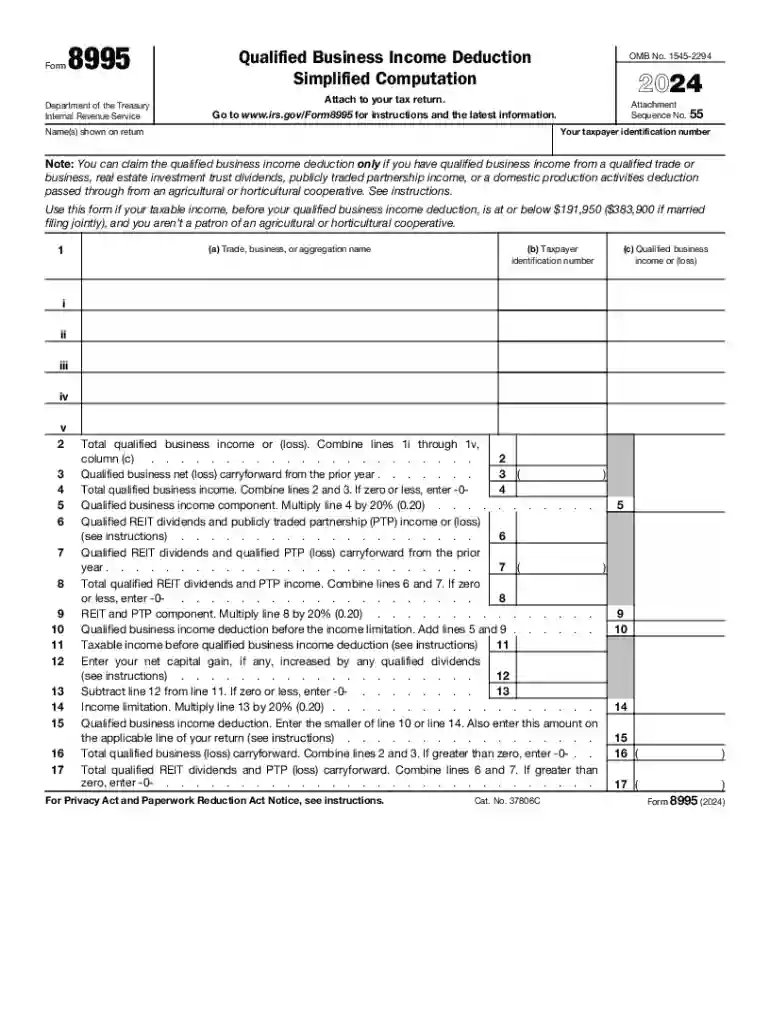
Type text, add images, blackout confidential details, add comments, highlights and more.

Draw your signature, type it, upload its image, or use your mobile device as a signature pad.

Send 2024 8995 form via email, link, or fax. You can also download it, export it or print it out.
Form 8995, issued by the Department of the Treasury's Internal Revenue Service, is utilized for claiming the Qualified Business Income (QBI) Deduction. This deduction is a part of the tax system designed to help taxpayers with certain business income reduce their overall taxable income. The form is essential for detailing eligibility based on income thresholds and allows for the calculation of potential deductions. Primarily, it's targeted towards individuals, estates, and trusts that qualify for Section 199A of the tax code.
Completing Form 8995 requires careful attention to detail to ensure accuracy. Here is a step-by-step guide:
Identify Eligibility: Confirm that you have qualified business income from a trade or business, including partnerships, S corporations, or sole proprietorships.
Gather Income Information: Collect financial records for all relevant income sources, ensuring you have accurate figures for business income, Section 199A dividends, and qualified REIT dividends.
Calculate Deductions: Using the form, follow the instructions to calculate your QBI deduction. This includes computing taxable income, determining any carryover from previous years, and evaluating income phase-out limits if applicable.
Complete Required Sections: Fill out Part I to calculate your QBI deduction and Part II for taxpayer information and certification of the calculated deduction.
Verify Entries: Double-check that all entries are correctly placed and calculated, ensuring compliance with IRS guidelines.
Submit with Tax Return: Attach Form 8995 to your federal tax return, ensuring you meet filing deadlines.
Eligibility for Form 8995 is defined by several factors. Primarily, a taxpayer must have qualified business income, which can include revenue from sole proprietorships, partnerships, S corporations, and trusts. Additionally, there are income thresholds to consider, as taxpayers exceeding these may have limitations or phase-outs on their deductions. It’s also crucial for taxpayers to incorporate this form if they meet specific criteria outlined in Section 199A of the tax code.


The IRS provides comprehensive guidelines for using Form 8995, emphasizing the need to include all relevant income and deduction information. Their instructions highlight how to identify qualified business income and how to accurately calculate deductions. Taxpayers are advised to review these guidelines thoroughly to ensure compliance with tax laws, as missteps could result in penalties or disallowed deductions.
Failing to accurately complete Form 8995 can lead to significant penalties. The IRS may impose fines for underreporting income or incorrectly claiming deductions. Additionally, failing to include Form 8995 when required can result in audits or rejection of your filed tax return. Therefore, adherence to guidelines and accuracy is paramount to avoid financial and legal repercussions.
Form 8995 must be filed concurrently with your Federal tax return, typically due by April 15 of each tax year. Extensions may be available upon request, but these must also comply with IRS standards. Missing the filing deadline can result in penalties and interest charges, emphasizing the importance of timely submission.
Form 8995 is accessible through several methods:
IRS Website: The form can be downloaded directly from the Internal Revenue Service’s official site, ensuring you have access to the most current version.
Tax Software: Many tax preparation software programs include Form 8995 as part of their offered documents, allowing for integrated completion and submission.
Tax Professionals: Accountants or tax preparers often provide this form to clients needing to calculate and claim the QBI deduction.
When completing Form 8995, you will need a variety of supporting documents to confirm your income and deductions. Essential documents include:
Form 8995 can be completed using various tax preparation software such as TurboTax or QuickBooks. These platforms help automate calculations and ensure compliance with IRS rules. They sync with accounting software to import business income data directly, simplifying the process and reducing the likelihood of errors.
Several key elements define Form 8995's structure. Primarily, it's used to:
Each section is designed to facilitate precise dedication calculation in conjunction with broader tax obligations.
We've got more versions of the irs form 8995 form. Select the right irs form 8995 version from the list and start editing it straight away!
At DocHub, your data security is our priority. We follow HIPAA, SOC2, GDPR, and other standards, so you can work on your documents with confidence.




Form 1040 Department of the TreasuryInternal Revenue Service (99) U.S. Individual Income Tax Return 2019. Attach Form 8995 or Form 8995-A .
Form 8995-A Department of the Treasury Internal Revenue Service Qualified Business Income Deduction ▶ Attach to your tax return.


