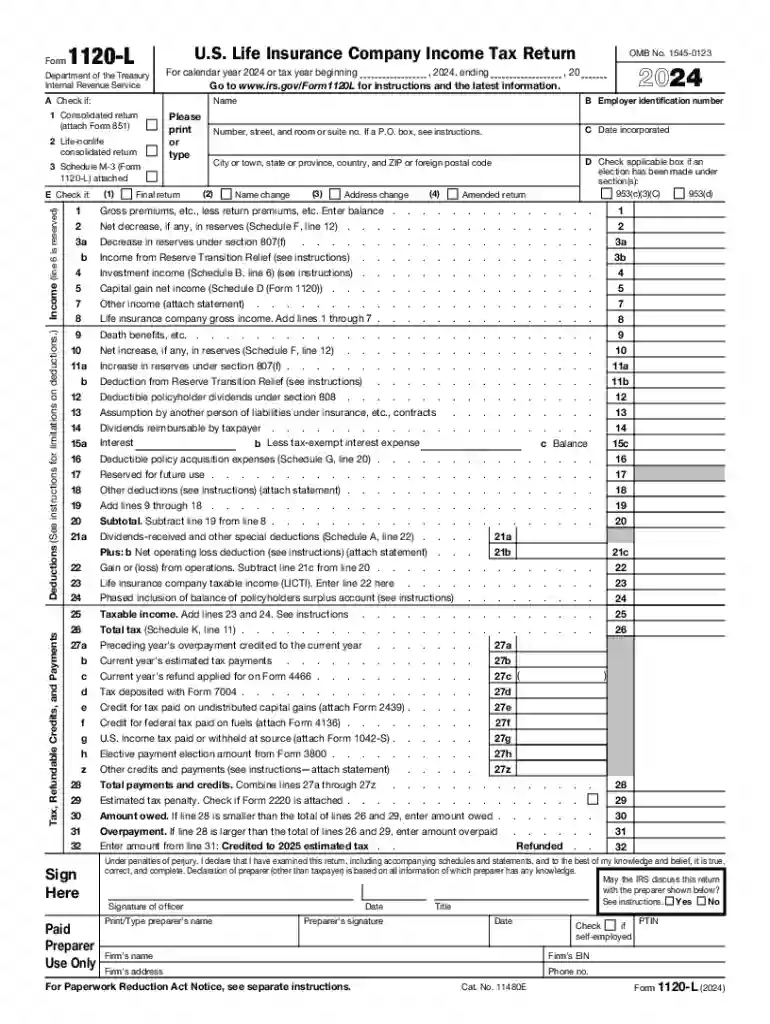
Form 1120-L: Taxable Income for Life Insurers-2026

Get Form
schedule l balance sheet Preview on Page 1

Here's how it works

01. Edit your schedule l balance sheet online
Type text, add images, blackout confidential details, add comments, highlights and more.

02. Sign it in a few clicks
Draw your signature, type it, upload its image, or use your mobile device as a signature pad.

03. Share your form with others
Send form 1120 schedule l via email, link, or fax. You can also download it, export it or print it out.

Definition and Purpose of Form 1120-L

Form 1120-L, also known as the U.S. Life Insurance Company Income Tax Return, is a specific form used by life insurance companies to report their income, deductions, and tax liabilities to the Internal Revenue Service (IRS). This form serves the purpose of summarizing the company's financial activity, particularly regarding taxable income, for a given tax year. Life insurance operations have distinct financial characteristics and regulatory requirements, making this form critical for compliance with federal taxation policies.

  • Taxable Income Reporting: The form provides a framework for calculating taxable income, incorporating both investment income and income from premiums.
  • Deduction Declaration: It allows for the deduction of expenses related to running the insurance operations, ensuring that liabilities are only assessed on net earnings.
  • Regulatory Compliance: Submission of Form 1120-L helps companies adhere to IRS regulations, avoiding penalties and ensuring correct tax computation.

Key Elements of Form 1120-L

Understanding the core components of Form 1120-L is essential for accurate completion. Each section serves a specific function in reporting and calculating tax obligations.

  • Gross Premiums: Companies must report income from premiums, which is a primary revenue source for life insurers.
  • Investment Income: This includes dividends, interest, and other forms of investment income earned during the fiscal year.
  • Reserves: Insurers calculate changes in reserves, an essential component for determining final taxable income.
  • Deductions and Credits: The form allows the deduction of various expenses, including claims and benefits paid out, which reduce overall taxable income.

Filing Deadlines and Important Dates

Timely filing is critical to avoid penalties. The specific deadlines for Form 1120-L align with corporate tax deadlines but come with special considerations due to the insurance industry's unique nature.

  • Annual Filing Date: The form is typically due by the 15th day of the fourth month following the end of the company's tax year.
  • Extensions: Companies can apply for a six-month extension using Form 7004, but it must be filed by the original due date.
  • Quarterly Payments: Estimated tax payments are required throughout the year to avoid underpayment penalties.

Steps to Complete Form 1120-L

Accurate completion of Form 1120-L involves a detailed understanding of revenue and expense reporting. Below is a step-by-step guide.

  1. Gather Financial Documentation: Collect all records related to income, premiums, and investment earnings.
  2. Calculate Income: Complete sections related to gross premiums and investment income.
  3. Determine Deductions: Accurately report allowable deductions, including operational costs and reserved changes.
  4. Final Tax Calculation: Apply tax credits and finalize the tax due, ensuring all figures are double-checked for accuracy.
  5. Review and Submission: Check entries for completeness before submitting the form to the IRS via mail or electronic filing systems.

Who Uses Form 1120-L?

Form 1120-L is primarily used by life insurance companies structured as corporations. Due to unique business operations and revenue models, these entities must ensure compliance with specific taxation requirements.

  • Corporations: It is mandatory for life insurers incorporated as corporate entities to file this form.
  • Regulated Entities: Any insurance company operating with regulatory oversight that provides life insurance products is required to submit this return.

Important Terms Related to Form 1120-L

Understanding the terminology specific to Form 1120-L can improve comprehension and accuracy when completing the form.

  • Premium Income: Revenue earned from selling life insurance policies.
  • Policyholder Benefits: Expenses associated with claims and benefits paid to policyholders.
  • Reserves: Funds set aside to cover future policyholder benefits and claims.
  • Investment Income: Earnings generated through investments in securities, bonds, or other financial instruments.

IRS Guidelines for Form 1120-L

The IRS provides detailed instructions to assist filers in accurately completing Form 1120-L. These guidelines cover everything from definitions to specific line instructions.

  • Instruction Booklet: Available on the IRS website, this provides an in-depth look at each line entry.
  • Help Resources: The IRS offers support through customer service lines for complex inquiries about tax computations.
  • Updates and Announcements: Periodic changes or updates to filing requirements are usually communicated via IRS official releases.

Penalties for Non-Compliance

Failing to comply with filing requirements for Form 1120-L can result in significant penalties. Understanding these consequences is crucial for maintaining compliance.

  • Late Filing Penalties: Companies that fail to submit by the deadline may incur fines based on a percentage of the unpaid tax.
  • Inaccurate Filing: Providing incorrect information, whether intentional or not, can lead to additional penalties or audits.
  • Non-Submission: A complete lack of filing can result in compounded charges and legal implications, highlighting the importance of compliance.

Compatibility with Digital Filing Software

Modern filing practices allow for digital submission, compatible with several tax preparation software tools.

  • Supported Software: Programs like TurboTax and QuickBooks facilitate easier completion and submission of Form 1120-L.
  • E-Filing Advantages: Electronic filing often results in quicker processing and confirmation, reducing turnaround time.
  • Integration with Systems: Many digital platforms allow for streamlined data entry, importing information directly from accounting software systems.

Variations and Alternatives to Form 1120-L

While Form 1120-L is specific for life insurance companies, other similar forms cater to different segments of the insurance industry or related operations.

  • Form 1120-PC: Used by property and casualty insurance companies to report their tax obligations.
  • Comparison: Unlike Form 1120-L, Form 1120-PC focuses on different reserve calculations and revenue categorizations.
  • Contextual Use: Understanding when to use each form ensures correct compliance based on the company's business activities.
be ready to get more

Complete this form in 5 minutes or less

Get form

Got questions?

We have answers to the most popular questions from our customers. If you can't find an answer to your question, please contact us.
Contact us
Purpose of Form Use Form 1120-L to report the income, gains, losses, deductions, credits, and to figure the income tax liability of life insurance companies.
If the corporations total receipts for the tax year AND total assets at the end of the tax year less than $250,000, Schedules L and M-1 are not required.
Who Has To Complete Schedule L. For most C corporations, filing Schedule L with Form 1120 is necessary when their total assets exceed $10 million. This requirement, however, doesnt apply to S corporations or partnerships.
Although they are not taxable income, life insurance proceeds are nevertheless part of the corporations earnings and profits for dividend purposes and IRC 531 purposes.
Form 1120 is the U.S. corporation income tax return. It is an Internal Revenue Service (IRS) document that American corporations use to report their credits, deductions, losses, gains and income. It also helps corporations find out how much income tax they need to pay, according to the IRS.

Security and compliance

At DocHub, your data security is our priority. We follow HIPAA, SOC2, GDPR, and other standards, so you can work on your documents with confidence.

Learn more
ccpa2
pci-dss
gdpr-compliance
hipaa
soc-compliance

People also ask

Generally, life insurance proceeds you receive as a beneficiary due to the death of the insured person, arent includable in gross income and you dont have to report them. However, any interest you receive is taxable and you should report it as interest received.

taxes on life insurance payout