




01. Edit your maryland good standing certificate online
Type text, add images, blackout confidential details, add comments, highlights and more.

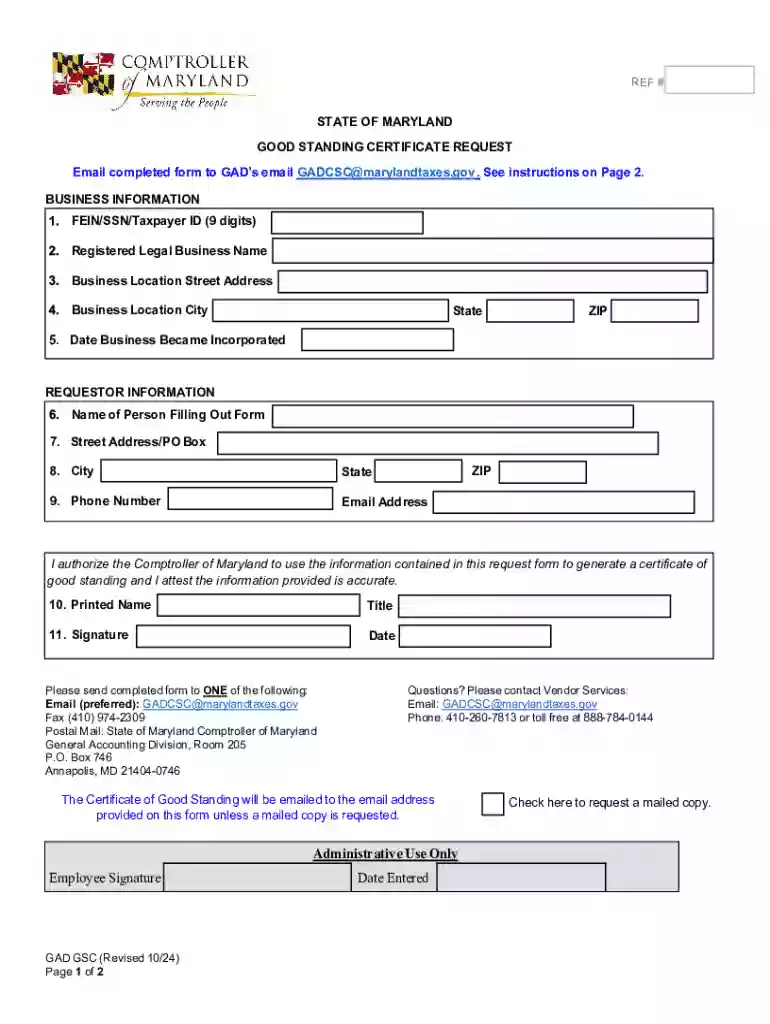
Type text, add images, blackout confidential details, add comments, highlights and more.

Draw your signature, type it, upload its image, or use your mobile device as a signature pad.

Send md good standing certificate via email, link, or fax. You can also download it, export it or print it out.
A Good Standing Certificate Request is a formal application submitted to confirm a business's compliance status within a specific state. This certificate verifies that a business is authorized to operate and has met all legal obligations, including tax payments, regulatory compliance, and fee submissions. Primarily recognized in the United States, this document is essential for businesses seeking to maintain or prove their legitimacy and operational status to stakeholders, partners, and government agencies. Typically used in business transactions, mergers, or loan applications, the certificate serves as an official testament to a company's standing.
Using a Good Standing Certificate Request involves understanding its role in verifying a business's legal standing. Businesses may require this certificate when entering new markets, securing financing, or engaging in partnerships to assure third parties of their compliance and operating status. The request form must be meticulously completed to cover all necessary information required by the state, such as the business name, registration number, and contact details. Once filled, this form is then submitted through the appropriate channels designated by the state, ensuring that the business meets all criteria for certificate issuance.
Gather Business Information: Prepare essential details about your business, including the federal employer identification number (FEIN), business name, and registered address.
Download the Form: Access the Good Standing Certificate Request form from your state’s official website or procurement office.
Complete the Form: Fill out the form, ensuring all sections are accurate. Provide specific information such as the taxpayer identification and contact details of the requestor.
Review Requirements: Check for any additional documents required by the state, such as proof of tax compliance or business registration.
Submission: Send the completed form and accompanying documents via the specified submission method—online, mail, or in-person—following state guidelines.
Payment: Some states require a fee for processing the certificate. Ensure the correct payment method is used and that payment accompanies the request.
Await Processing: Once submitted, the processing time may vary by state. Keep track of any communication from the state authorities regarding your request.
When applying for a Good Standing Certificate, various documents may be required to substantiate the request. These typically include:
It’s crucial to note that requirements, processing times, and procedures for obtaining a Good Standing Certificate may vary significantly across different states. For instance:
Each state may have its own set of forms or additional requirements, so applicants should consult the state's specific instructions.
The method of submission for the Good Standing Certificate Request can vary:
Several factors may necessitate a Good Standing Certificate:
This request assures all stakeholders of the business’s legality and reliability, strengthening its credibility.
Failure to maintain or obtain a Good Standing Certificate can result in several consequences:
Understanding the broader implications helps businesses prioritize compliance to maintain operational integrity.
We've got more versions of the maryland good standing certificate form. Select the right maryland good standing certificate version from the list and start editing it straight away!
At DocHub, your data security is our priority. We follow HIPAA, SOC2, GDPR, and other standards, so you can work on your documents with confidence.



Long-form certificate of good standing and articles. Copies of the certificate of authority, good standing certificates and tax status certificates from all
A Certificate of Status evidencing the existence of a corporation or other business entity (also referred to as a Certificate of Good Standing orRead more
To order a Certificate of Good Standing from the Idaho State Bar, please submit your request below. The fee is $25 for the first certificate and $10 for eachRead more


