Dshs state tx usfoodestablishmentspdfProposed Retail Food Establishment Inspection Report 2026

Get Form
eh 06 Preview on Page 1

Here's how it works

01. Edit your eh 06 online
Type text, add images, blackout confidential details, add comments, highlights and more.

02. Sign it in a few clicks
Draw your signature, type it, upload its image, or use your mobile device as a signature pad.

03. Share your form with others
Send it via email, link, or fax. You can also download it, export it or print it out.

Definition & Meaning of the Proposed Retail Food Establishment Inspection Report

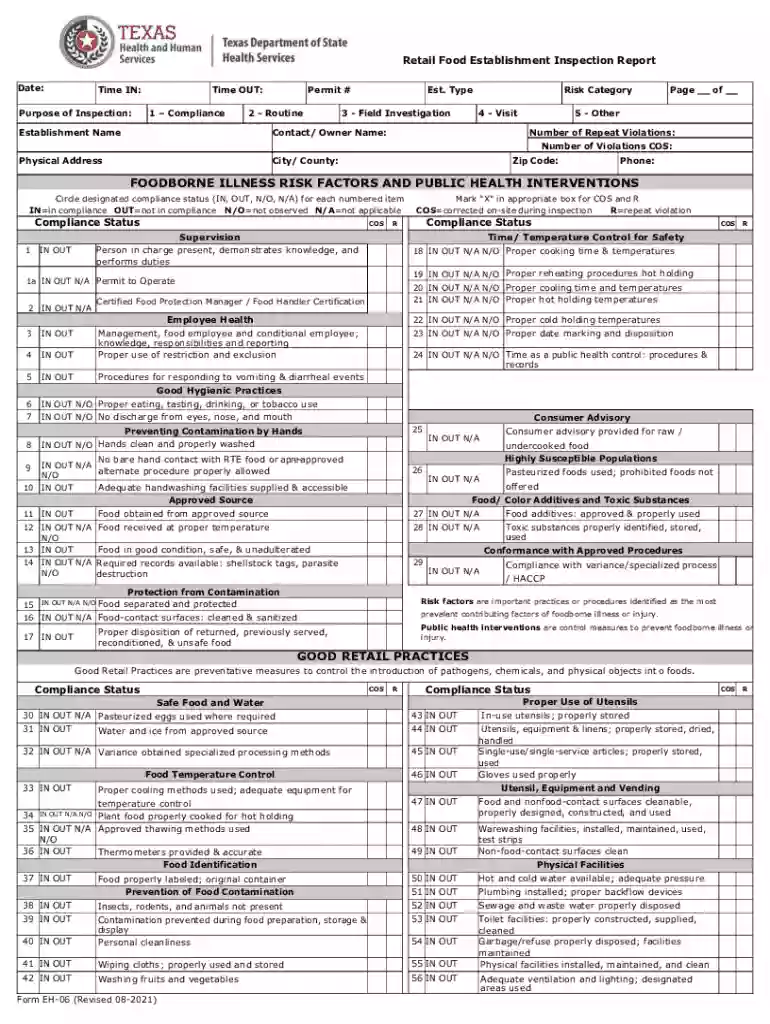
The Proposed Retail Food Establishment Inspection Report is a critical document used by the Department of State Health Services (DSHS) in Texas to evaluate the compliance of food establishments with health and safety regulations. Its primary function is to detail the findings from inspections, ensuring that public health standards are adhered to in areas such as food handling, employee hygiene, and contamination prevention. This form acts as both an assessment tool and a record for tracking improvements or recurring issues across establishments.

How to Use the Inspection Report Effectively

Effectively utilizing the Proposed Retail Food Establishment Inspection Report involves several key actions:

  1. Inspection Preparation: Review the checklist to understand the criteria against which establishments will be judged.
  2. During Inspection: Ensure all sections are thoroughly completed, capturing accurate data about each compliance check.
  3. Analysis Post-Inspection: Analyze the completed report for any noted deficiencies and insights into areas needing improvement.
  4. Actionable Follow-Up: Use the documented corrective actions as a guide for following up on identified issues, ensuring they are addressed promptly.

Steps to Complete the Inspection Report

Completing the Proposed Retail Food Establishment Inspection Report requires adherence to the following step-by-step process:

  1. Inspect Premises: Begin with a physical examination of the entire food establishment to gather firsthand information.
  2. Document Findings: Record observations in the report during the inspection phase, ensuring no detail is overlooked.
  3. Evaluate Compliance: Use the report to check against defined standards for compliance on aspects such as temperature control and sanitation.
  4. Identify Risk Factors: Note any potential health risks, providing detailed comments on corrective actions needed.
  5. Conclude with Recommendations: Finalize the report by summarizing key findings and offering actionable recommendations.

Key Elements of the Inspection Report

The Proposed Retail Food Establishment Inspection Report includes several important sections:

  • Inspection Details: Identifying data such as establishment name, address, and date of inspection.
  • Compliance Checks: A detailed checklist for assessing adherence to safety regulations.
  • Risk Factors: Identified risks concerning foodborne illnesses and associated mitigation strategies.
  • Corrective Actions: Recommended actions to address compliance failures.

Each section must be meticulously documented to ensure the inspection report serves its preventive purpose effectively.

Who Typically Uses the Inspection Report

The primary users of the Proposed Retail Food Establishment Inspection Report are:

  • Health Inspectors: Professionals tasked with conducting inspections to maintain public health standards.
  • Restaurant Managers and Owners: Individuals responsible for maintaining compliance and addressing any issues identified in the report.
  • Public Health Officials: Authorities using the reports to monitor trends and implement broad health policies.
decoration image ratings of Dochub

Legal Use of the Inspection Report

The Proposed Retail Food Establishment Inspection Report serves as an official record of compliance status, which can be used:

  • In Regulatory Actions: As evidence in hearings or legal proceedings related to health violations.
  • For Licensing Purposes: To support applications or renewals for operating licenses of food establishments.

Examples of Using the Inspection Report

Here are practical scenarios demonstrating effective use:

  • Routine Inspections: Regular assessments to ensure ongoing compliance and identify areas for improvement.
  • Follow-Up Inspections: Conducting secondary inspections after the initial report, focusing on previously noted deficiencies.

State-Specific Rules for the Inspection Report

In Texas, specific rules apply to how the Proposed Retail Food Establishment Inspection Report is used:

  • Frequency of Inspections: Established guidelines dictate how often inspections should occur based on risk levels.
  • Public Access: Inspection results may be publicly available to inform consumers about the safety standards of local establishments.

Digital vs. Paper Version

The Proposed Retail Food Establishment Inspection Report is available in both digital and paper formats. Advantages include:

  • Digital Format: Easier distribution and storage, with options for electronic updates and sharing.
  • Paper Format: Traditional use for those establishments not yet equipped for digital processing.

Choosing between formats often depends on the technological integration within an establishment and preference for digital versus physical record keeping.

be ready to get more

Complete this form in 5 minutes or less

Get form

Got questions?

We have answers to the most popular questions from our customers. If you can't find an answer to your question, please contact us.
Contact us
Phone the toll-free USDA Meat and Poultry Hotline at 1-888-MPHotline (1-888-674-6854) or report the complaint online. For details, see Problems with Food Products (USDA). Phone the FDA Main Emergency Number at 888-SAFEFOOD (888-723-3366) or report online through the FDA Safety Reporting Portal.
A Retail Food Establishment is a premise or part of a premise where food is stored, processed, prepared, manufactured, or otherwise held or handled for retail sale. An example of RFE include: grocery stores, meat shops, carryout pizza.
Fees Gross Annual Volume of Food SalesPermitting Fee $0 $49,999.99 $258 $50,000 $149,999.99 $515 $150,000 or more $773
The Texas Department of State Health Services (DSHS) provides the minimum standards for food safety in the state with the Texas Food Establishment Rules (TFER).

Security and compliance

At DocHub, your data security is our priority. We follow HIPAA, SOC2, GDPR, and other standards, so you can work on your documents with confidence.
Learn more
ccpa2
pci-dss
gdpr-compliance
hipaa
soc-compliance