




01. Edit your income schedule e form online
Type text, add images, blackout confidential details, add comments, highlights and more.

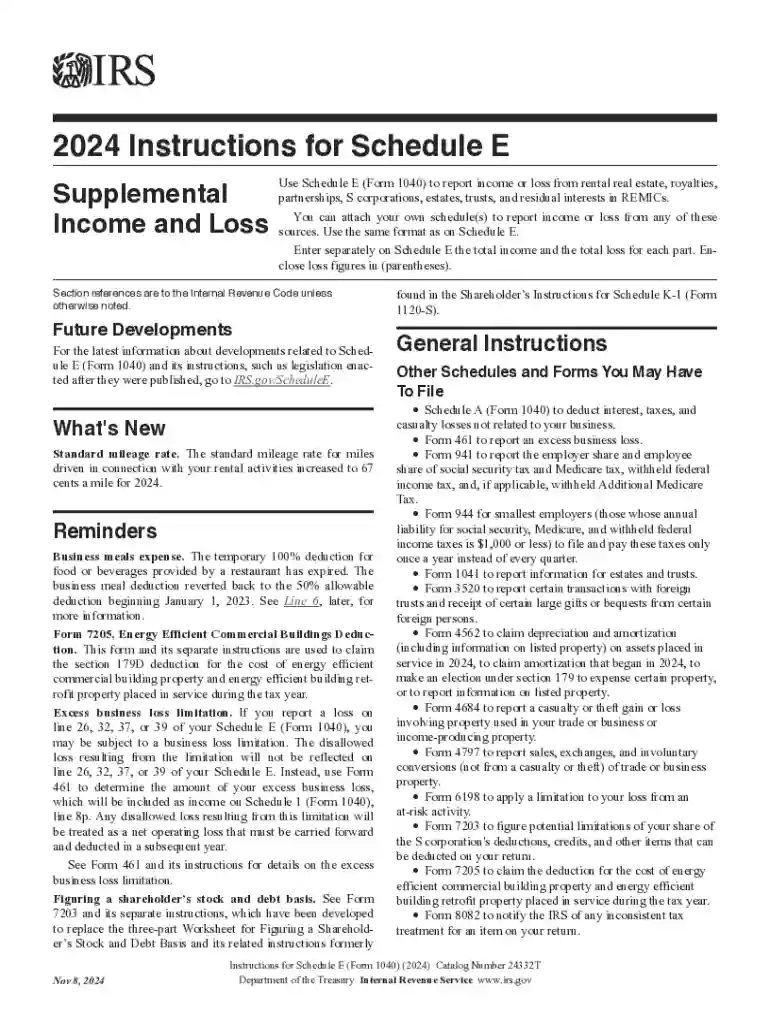
Type text, add images, blackout confidential details, add comments, highlights and more.

Draw your signature, type it, upload its image, or use your mobile device as a signature pad.

Send schedule e forms via email, link, or fax. You can also download it, export it or print it out.
Schedule E (Form 1040) is designed for taxpayers to report income and loss from supplemental sources. It encompasses rental real estate, royalties, partnerships, S corporations, estates, trusts, and residual interests in real estate mortgage investment conduits. The form plays a critical role in detailing income streams beyond wages, salaries, and interest, providing insight into complex revenue structures. Importantly, understanding the nuances of each income type is essential for accurate tax reporting and compliance with IRS regulations.
To effectively use Schedule E, first gather all pertinent financial documents related to your supplemental income. This includes rental agreements, royalty statements, and partnership K-1 forms. Begin by filling out the appropriate section for each income type - for example, Part I for rental real estate and royalties, ensuring each entry aligns with corresponding documentation. For partnerships and S corporations, utilize Part II and III. Record all relevant figures, ensuring deduction opportunities such as depreciation, repairs, and other expenses are correctly accounted for to optimize tax obligations.
Gather Necessary Documentation: Collect all records pertaining to rental income, royalties, or earnings from partnerships and S corporations, including previous Schedule K-1 forms, contracts, and expense receipts.
Fill out Part I: Enter income and expenses related to real estate and royalties. Ensure figures for gross rents and royalties are accurate, and calculate expenses like insurance, maintenance, and management.
Complete Part II and III: These sections are for partnership and S corporation income. Use the K-1 forms received from each entity to accurately report your share of profit or loss.
Calculate Totals: Sum up the figures from each part for the total income or loss, ensuring all calculations match documentation.
Review and File: Carefully review the completed form and compare it against your financial documentation for accuracy before filing with your tax return.
Passive Activity Loss (PAL): Regulations limiting the amount of passive activity losses that can be deducted, generally applicable to rental activities and businesses where the taxpayer does not materially participate.
K-1 Forms: Issued by partnerships, S corporations, and trusts to detail an individual's share of income, deductions, and credits.
Depreciation: An expense deduction method for the gradual decrease in asset value, often related to real estate under Schedule E.
Understanding these terms is pivotal to correctly navigating Schedule E, ensuring compliance and optimization of potential tax deductions.
The IRS outlines specific guidelines for the completion and submission of Schedule E. References to IRC sections help clarify deductibility of certain expenses and the treatment of different income types. Taxpayers must ensure compliance with at-risk rules and passive activity loss limitations as dictated by IRS regulations to avoid adjustments or penalties. Detailed instructions are provided for situations such as the handling of partnership debt or the segregation of royalties from actively managed mineral property rentals.
Adhering to IRS deadlines for Schedule E is critical for compliance. The form is due by April 15, aligned with the federal income tax return deadline. Taxpayers requiring an extension must submit Form 4868 by this date, granting an additional six months for filing. It's advisable to monitor any changes in tax law or filing dates, often communicated by the IRS during the tax year.
A variety of documents support the accurate completion of Schedule E:
Schedule E is supported by numerous tax preparation software platforms, offering digital ease and accuracy. Software solutions like TurboTax and QuickBooks enhance user experience through automated data entry and computation tools, reducing error risk. Integrations with financial management platforms ensure seamless transferring of documentation, further simplifying the filing process. Evaluate these tools to determine the most compatible solution for your tax situation.
We've got more versions of the income schedule e form form. Select the right income schedule e form version from the list and start editing it straight away!
| Versions | Form popularity | Fillable & printable |
|---|---|---|
| 2025 | 4.6 Satisfied (48 Votes) | |
| 2024 | 4.4 Satisfied (51 Votes) | |
| 2023 | 4.2 Satisfied (58 Votes) | |
| 2022 | 4.4 Satisfied (36 Votes) | |
| 2021 | 4.8 Satisfied (101 Votes) | |
| 2020 | 4.3 Satisfied (206 Votes) | |
| 2019 | 4.3 Satisfied (29 Votes) | |
| 2018 | 4.3 Satisfied (47 Votes) | |
| 2017 | 4.4 Satisfied (305 Votes) | |
| 2016 | 4.4 Satisfied (614 Votes) | |
| 2015 | 4 Satisfied (55 Votes) | |
| 2011 | 4.2 Satisfied (39 Votes) | |
| 2011 | 4.3 Satisfied (64 Votes) |
At DocHub, your data security is our priority. We follow HIPAA, SOC2, GDPR, and other standards, so you can work on your documents with confidence.



An official website of the Alabama State government. Schedule E (Form 40) Supplemental Income and Loss Download Form Forms. Tax Incentives Tax
They report their income on IRS Form 1040, Schedule E, Supplemental Income and Loss. Example 1: George operates a corn and soybean farm,


