
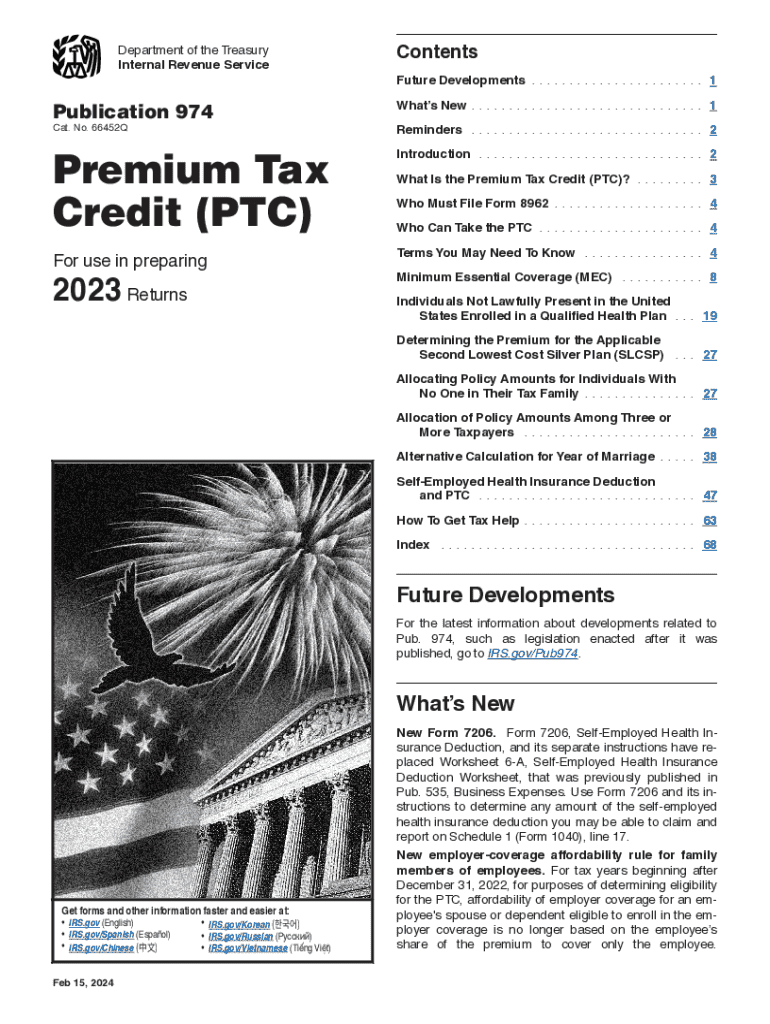







Definition & Meaning
The Premium Tax Credit (PTC) serves as a refundable credit designed to help eligible individuals and families pay for their health insurance premiums purchased through the Health Insurance Marketplace. The 2023 Publication 974 offers comprehensive guidance on how to calculate and claim the PTC for taxpayers based in the United States who are enrolled in qualified health plans. This publication is crucial for understanding the conditions under which the tax credit is applicable, ensuring that taxpayers comply with IRS requirements.
Key Features of the PTC
- Refundable Credit: The PTC can increase your tax refund or reduce the amount you owe, making it particularly beneficial for taxpayers with lower incomes.
- Income-based Adjustment: The amount of PTC varies depending on your household income and number of dependents.
- Health Plan Requirement: To qualify, individuals must be enrolled in a health insurance plan purchased through the Marketplace.
Eligibility Criteria
Understanding the eligibility criteria for the Premium Tax Credit is fundamental. The 2023 Publication 974 delineates specific requirements that taxpayers must meet to qualify for the PTC.


Major Eligibility Requirements
- Income Limitations: Typically, your household income should fall between 100% and 400% of the federal poverty line.
- Filing Status: Most filing statuses qualify, except Married Filing Separately, which is generally ineligible unless you meet specific criteria.
- Enrollment in Qualified Health Plan: Enrollment must occur through the Marketplace to qualify for the credit.
Special Considerations
- Non-citizen Eligibility: Certain non-citizens, such as those with a lawful presence, may also qualify.
- Changes in Circumstances: Report changes such as income modifications or family size to adjust credit amounts appropriately.
How to Use the 2023 Publication 974 Premium Tax Credit (PTC)
The publication provides detailed instructions on how to utilize the PTC when filing your taxes. This section explains the step-by-step process of applying the credit on your tax return accurately.
Steps to Use PTC
- Obtain Form 1095-A: Gather this form, which the Marketplace provides, to verify your enrollment and premium amounts.
- Calculate PTC on Form 8962: Follow the instructions in Publication 974 to calculate how much credit you are eligible for.
- Report on Form 1040: The resulting credit (or repayment of excess advance payments) is reported and adjusted on your 1040 tax form.
Importance of Accurate Calculations
Errors in calculating your credit can result in overpayments or underpayments, leading to significant tax liabilities or penalties.
Steps to Complete the 2023 Publication 974 Premium Tax Credit (PTC)
Efficiently completing the necessary forms is crucial to claiming the PTC.
Detailed Steps
- Review Household Setup: Verify all household members and dependents who are listed.
- Reconcile Advance Payments: Compare any advance payments of the PTC with the actual credit you qualify for using Form 8962.
- Enter Values Accurately: Transfer values from Form 8962 to your tax return precisely.
Common Mistakes to Avoid
- Wrong Income Reporting: Ensure all sources of income are accurately reported to avoid discrepancies.
- Incorrect Filing Status: Use the correct filing status, as this impacts eligibility and credit amounts.
IRS Guidelines
The PTC is governed by specific IRS guidelines, as detailed in Publication 974, to ensure compliance and correct application.
Adherence to Regulations
- Accuracy: Ensure all forms and calculations comply with IRS regulations.
- Updates and Changes: Stay informed about yearly changes in the guidelines or tax law alterations affecting PTC.
Role of Publication 974
Publication 974 functions as an authoritative guide for understanding and applying for the PTC, explaining all necessary regulations and procedures.
Required Documents
Specific documentation is needed to substantiate your claim for the Premium Tax Credit.
Essential Documents
- Form 1095-A: Details coverage and premium amounts.
- Proof of Income: Documents like W-2s and 1099s to verify income.
- Proof of Marketplace Enrollment: Showing that your health insurance was purchased through the Marketplace.
Document Verification
Ensure that all documents are current and match information reported on your tax return to prevent processing delays or denials.
Filing Deadlines / Important Dates
Timeliness in filing your tax return is essential, especially when claiming the PTC.
Critical Deadlines
- Annual Tax Filing Deadline: Generally April 15, unless otherwise specified.
- Marketplace Reporting: Inform the Marketplace of any changes during the coverage year to adjust advance payments.
Strategies for Timely Submission
- Early Preparation: Begin gathering documents and filling out forms well before the deadline.
- Use of Tax Software: Consider leveraging tax preparation software to help with timely and accurate filings.
Examples of Using the 2023 Publication 974 Premium Tax Credit (PTC)
Real-world examples illustrate the application of the Premium Tax Credit.
Practical Scenarios
- Self-Employed Individual: Calculating how fluctuating monthly income impacts credit eligibility.
- Family of Four: Understanding how family size and income limit impact the amount of credit received.
Lessons from Examples
Analyzing these scenarios can aid in better planning and accurate application of the PTC, minimizing unexpected tax liabilities and maximizing potential refunds.




