Publication 1321 (Rev 10-2024) Special Instructions For Bona Fide Residents Of Puerto Rico Who Must -2026

Get Form
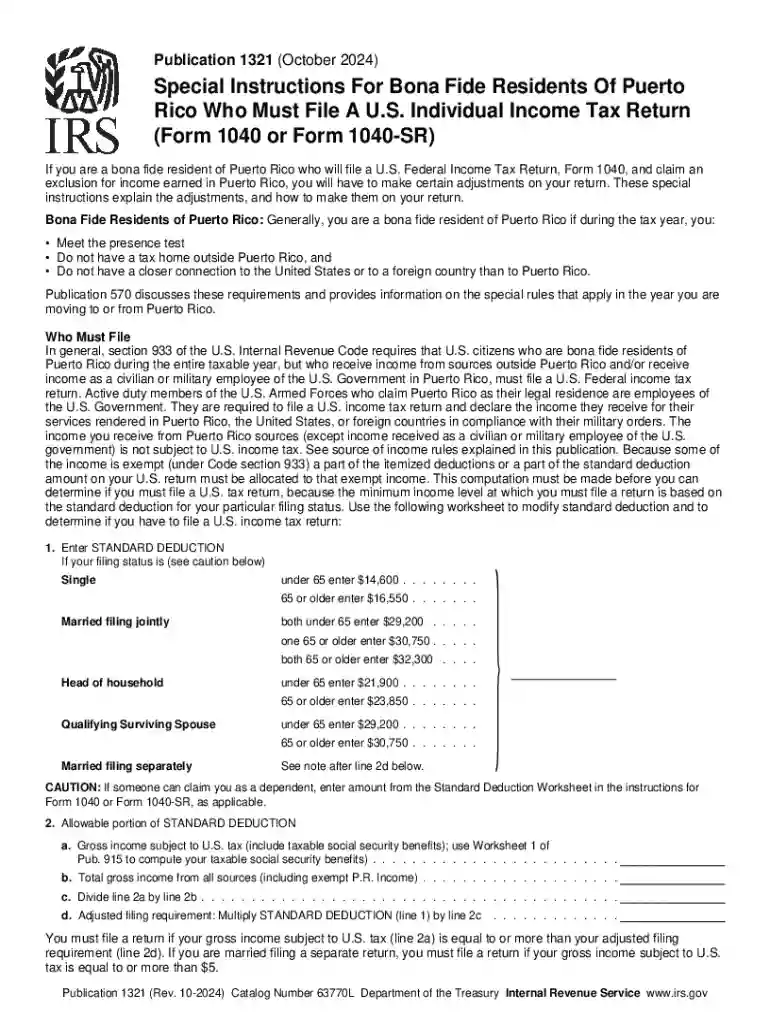
Publication 1321 (Rev 10-2024) Special Instructions For Bona Fide Residents Of Puerto Rico Who Must  Preview on Page 1

Here's how it works

01. Edit your form online
Type text, add images, blackout confidential details, add comments, highlights and more.

02. Sign it in a few clicks
Draw your signature, type it, upload its image, or use your mobile device as a signature pad.

03. Share your form with others
Send it via email, link, or fax. You can also download it, export it or print it out.

Definition and Meaning

Publication 1321 (Rev 10-2024), known as "Special Instructions for Bona Fide Residents of Puerto Rico Who Must File," is a document issued by the Internal Revenue Service (IRS). It serves as a detailed guide specifically for bona fide residents of Puerto Rico who are required to file a U.S. Individual Income Tax Return, either Form 1040 or Form 1040-SR. The publication provides instructions on how to report income, claim exclusions under section 933 of the Internal Revenue Code, and allocate deductions, among other tax-related procedures. Unlike other tax forms, this publication is tailored to address the unique tax scenarios faced by residents of Puerto Rico, offering clarity on their specific filing obligations.

How to Use Publication 1321

Residents of Puerto Rico can use Publication 1321 to navigate their U.S. tax filing requirements by following these steps:

  1. Determine Filing Necessity: Review the criteria outlined in the publication to assess whether you are required to file a U.S. tax return.
  2. Examine Income Sources: Identify income sources and determine what qualifies for exclusion under section 933.
  3. Allocation of Deductions: Learn how to properly allocate both standard and itemized deductions in accordance with IRS guidelines.
  4. Utilize Example Scenarios: Study real-life scenarios and detailed examples provided to better understand the application of these rules.
  5. Compliance with Source of Income Rules: Follow the guidance on how to accurately report income sourced from both inside and outside of Puerto Rico.

Steps to Complete Publication 1321

  1. Gather Required Documents: Collect all necessary financial records, including W-2 forms, interest statements, and dividend reports.
  2. Complete Basic Personal Information: Fill in personal data, such as name, address, and Social Security number.
  3. Calculate Income: Use the publication’s guidelines to calculate and report income, taking into account exclusions under section 933.
  4. Apply Deductions: Follow instructions to apply eligible deductions accurately, choosing between standard and itemized.
  5. Verify Credits: Explore and verify eligibility for potential credits, ensuring all documentation is prepared for claims.
  6. Final Review and Submission: Conduct a thorough review for accuracy before filing your tax return through the preferred method, either electronically or via mail.

Why Should You Use Publication 1321

Utilizing Publication 1321 offers several advantages:

  • Specific Guidance: Tailored instructions make it easier to comply with federal filing requirements for Puerto Rican residents.
  • Income Exclusion Clarity: Provides detailed guidance on which portions of income can be excluded under section 933, preventing overpayment.
  • Error Reduction: Aids in reducing errors in tax filings by offering step-by-step directions.
  • Legal Compliance: Helps ensure that you remain compliant with U.S. tax laws, safeguarding against potential legal issues.
  • Optimized Deductions and Credits: Clarifies how to leverage deductions and credits fully, maximizing tax benefits.

IRS Guidelines

Publication 1321 is underpinned by the Internal Revenue Service guidelines, which enforce rules regarding:

  • Filing Status: Clear criteria on filing status for residents of Puerto Rico.
  • Taxable Income: Specifications on which types of income are subject to U.S. tax and under what conditions exclusions apply.
  • Documentation: Detailed instruction on necessary documentation and records that must be kept for audit purposes.
  • Credits and Deductions: Eligibility criteria for various credits and deductions available to Puerto Rican residents.

Filing Deadlines and Important Dates

Residents of Puerto Rico must adhere to these critical deadlines:

  • April 15: Standard deadline for filing U.S. individual income tax returns unless an extension is filed.
  • October 15: Extended deadline for those who filed for an extension.

Filing on time helps avoid penalties and interest on unpaid taxes.

Required Documents

To accurately complete the filing process, ensure you have:

  • W-2 Forms: For income verification
  • 1099 Forms: To report other income sources
  • Proof of Residency: Documents that establish bona fide residency in Puerto Rico
  • Deduction Receipts: Evidence supporting claimed deductions
  • Previous Tax Returns: Last year's tax filings for comparison

Penalties for Non-Compliance

Failing to comply with filing requirements might result in:

  • Late Filing Penalties: Fines for failing to file on time.
  • Underpayment Penalties: Penalties for not paying the correct tax amount owed.
  • Interest on Unpaid Taxes: Accrual of interest on any unpaid tax amounts.
  • Potential Audits: Increased likelihood of IRS audits if discrepancies are found.

Understanding and following Publication 1321 minimizes the risk of these penalties.

Eligibility Criteria

Publication 1321 applies primarily to:

  • Residents of Puerto Rico: Those who have lived in Puerto Rico for the entire tax year.
  • Income Earners in Puerto Rico: Individuals with income sourced both within and outside of Puerto Rico.
  • Taxpayers with Complex Filings: Those requiring clarification on exclusion rules and deductions due to multi-source income.

Adhering to these criteria ensures that all eligible taxpayers properly file under the correct provisions.

By meticulously examining the detailed guidance contained within Publication 1321, residents of Puerto Rico can ensure adherence to their unique federal tax responsibilities, optimizing their chance for a smooth and accurate tax filing experience.


decoration image ratings of Dochub
be ready to get more

Complete this form in 5 minutes or less

Get form

Got questions?

We have answers to the most popular questions from our customers. If you can't find an answer to your question, please contact us.
Contact us
To qualify for the exemptions, you must become a bonafide resident of Puerto Rico. This implies residing on the island for more than 183 days per year, filling out IRS forms, such as form 8898 and applying for a tax exemption decree from the Secretary of Economic Development and Commerce of Puerto Rico.
To qualify for bona fide residence, you must reside in a foreign country for an uninterrupted period that includes an entire tax year. An entire tax year is from January 1 through December 31 for taxpayers who file their income tax returns on a calendar year basis.
If youre a bona fide resident of Puerto Rico during the entire tax year, you generally arent required to file a U.S. federal income tax return if your only income is from sources within Puerto Rico.
Individuals are expected to spend 183 days a year in the territory. Further, they must spend at least 549 days in a three-year period. Also, they are not permitted to be present in the US for more than 90 days in any year. In terms of income, the person cannot earn more than $3,000 in the US each year.
Bona Fide Residents of Puerto Rico: Generally, you are a bona fide resident of Puerto Rico if during the tax year, you: Meet the presence test Do not have a tax home outside Puerto Rico, and Do not have a closer connection to the United States or to a foreign country than to Puerto Rico.

Security and compliance

At DocHub, your data security is our priority. We follow HIPAA, SOC2, GDPR, and other standards, so you can work on your documents with confidence.

Learn more
ccpa2
pci-dss
gdpr-compliance
hipaa
soc-compliance
be ready to get more

Complete this form in 5 minutes or less

Get form

People also ask

0:00 0:34 Its not withheld. Its not reduced none of that stuff its just zero tax you get all of the moneyMoreIts not withheld. Its not reduced none of that stuff its just zero tax you get all of the money stick it in your pocket. And go out and celebrate. And this isnt some expired loophole.

Related links