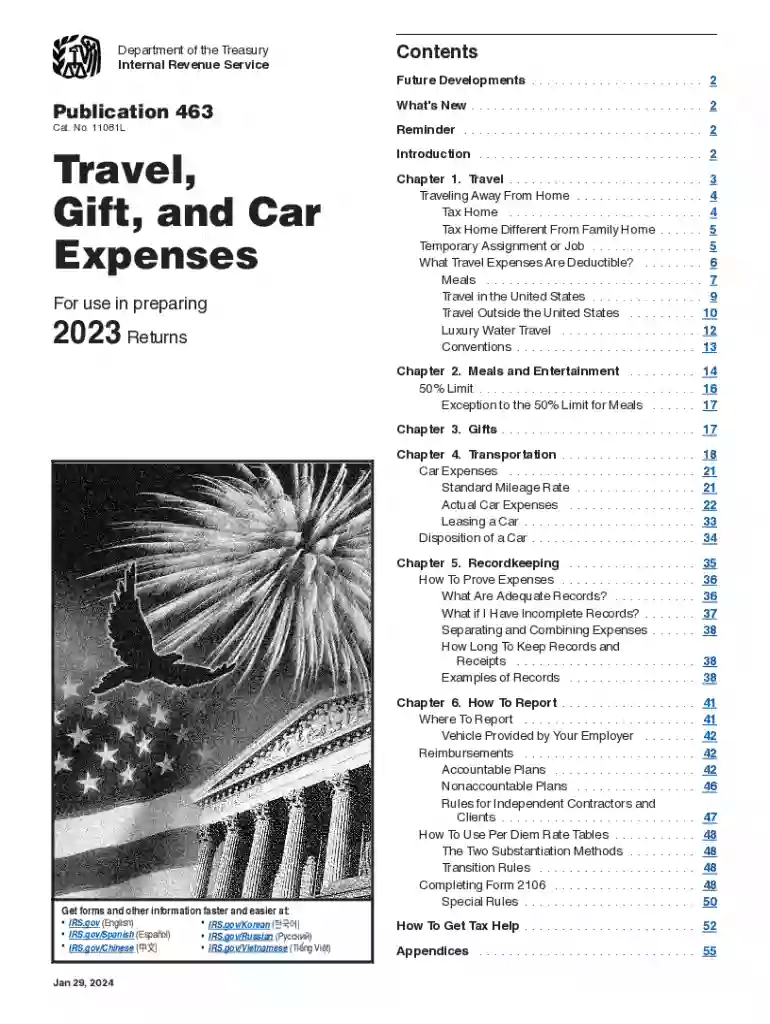
2023 Publication 463 Travel, Gift, and Car Expenses-2026

Get Form
2023 Publication 463 Travel, Gift, and Car Expenses Preview on Page 1

Here's how it works

01. Edit your form online
Type text, add images, blackout confidential details, add comments, highlights and more.

02. Sign it in a few clicks
Draw your signature, type it, upload its image, or use your mobile device as a signature pad.

03. Share your form with others
Send it via email, link, or fax. You can also download it, export it or print it out.

IRS Guidelines for 2023 Publication 463

Publication 463 provides essential guidance for deducting travel, gift, and car expenses related to business purposes. It clarifies what qualifies as deductible, outlines the general requirements for reporting these expenses on tax returns, and highlights the necessary recordkeeping practices.

Key Elements and Deductible Expenses

  • Travel Expenses: Defined as costs incurred while traveling away from one's tax home for business, including transportation, lodging, and meals.
  • Gift Expenses: Business gift deductions are capped at $25 per recipient per year.
  • Car Expenses: Includes deductions based on the standard mileage rate or actual expenses for operating a vehicle.

Employee and Self-Employed Rules

  • Employees: May deduct unreimbursed employee business expenses on Schedule A, but only if they surpass 2% of adjusted gross income.
  • Self-Employed Individuals: These expenses are deducted in full on Schedule C or Schedule F, providing more flexibility and potential tax savings.

How to Use the Publication 463

Publication 463 is designed as a reference document to help taxpayers determine eligibility and correctly document expenses. Understanding and applying sections related to specific business scenarios will ensure compliance with IRS regulations:

  1. Identify Deductible Expenses: Match your expenses against the IRS guidelines.
  2. Choose the Correct Reporting Method: Use the appropriate tax form for your employment type.
  3. Maintain Thorough Documentation: Keep receipts, logs, and notes to support deductions.

Recordkeeping and Reporting

  • Substantiation: Maintain detailed records such as receipts and logs detailing the date, amount, and business purpose of each expense.
  • Mileage Logs: Document all vehicle mileage, including the purpose and distances traveled, whether opting for standard mileage or actual expenses.

Important Terms in Publication 463

Understanding critical terminology is vital for applying Publication 463 correctly:

  • Tax Home: Your regular place of business, regardless of the location of your family home.
  • Accountable Plan: A reimbursement plan requiring verification of expenses and the return of excess amounts.

Examples of Applying Publication 463

Here are a few real-world applications to illustrate the use of Publication 463:

  • Sales Representative: Deducts travel expenses while visiting clients in different states.
  • Freelancer: Uses the standard mileage rate to deduct vehicle expenses for client meetings.
  • Small Business Owner: Claims business gifts while ensuring the $25 per recipient rule is enforced.

Version Alternatives and Digital Accessibility

  • Digital versus Paper: Publication 463 is available in both digital and print formats, but digital access provides immediate updates and enhanced search capabilities.

Software Compatibility

  • Integration with Tax Software: Compatible with popular tax software, such as TurboTax and QuickBooks, to streamline the deduction documentation process and ensure accurate reporting.

Business Entity Impact

Different business entities might derive varying benefits and responsibilities when applying Publication 463:

  • LLCs and Partnerships: Deductions are reported at the entity level, affecting distribution and member tax obligations.
  • Corporations: Corporate policies usually determine employee expense reimbursement, influencing deductible business expenses.

Filing Deadlines and Compliance Dates

Understanding key deadlines helps avoid penalties:

  • Reporting Deadlines: Typically align with the individual or business tax filing dates, generally due by April 15.
  • Extension Options: Filing for extensions can provide additional time to accurately document and report all qualifying expenses.

Taxpayer Scenarios

Publication 463 applies to diverse taxpayers, each presenting unique circumstances:

  • Armed Forces Reservists: May have additional provisions for travel expenses when away for duty.
  • Remote Workers: Need to closely monitor travel expenses if working from various locations.
decoration image ratings of Dochub

Penalties for Non-Compliance

Failing to adhere to Publication 463 guidelines can result in repercussions:

  • Disallowed Deductions: Improper or unsupported claims can lead to audits and denial of deductions.
  • Fines and Interest: Additional penalties can accrue if adjustments lead to underpayment of taxes owed.

Obtaining Publication 463

Publication 463 is available through the IRS website for free download, ensuring wide accessibility for taxpayers seeking to maximize their deductions while remaining compliant.

be ready to get more

Complete this form in 5 minutes or less

Get form

Got questions?

We have answers to the most popular questions from our customers. If you can't find an answer to your question, please contact us.
Contact us
Beginning on January 1, 2023, the standard mileage rates for the use of a car (also vans, pickups or panel trucks) will be: 65.5 cents per mile driven for business use, up 3 cents from the midyear increase setting the rate for the second half of 2022.
For 2023 these amounts are: The maximum first-year depreciation write-off is $12,200, plus up to an additional $8,000 in bonus depreciation. For SUVs with loaded vehicle weights over 6,000 pounds, but no more than 14,000 pounds, 80% of the cost can be expensed using bonus depreciation in 2023.
The amount of the $309 high rate and $214 low rate that is treated as paid for meals for purposes of 274(n) is $74 for travel to any high- cost locality and $64 for travel to any other locality within CONUS.
Light Section 179 vehicles: Any vehicle with a manufacturers gross vehicle weight rating (GVWR) under 6,000 pounds. This includes many passenger cars, crossover SUVs, and small utility trucks. For 2023, these autos have a Section 179 tax deduction limit of $12,200 in the first year they are used.
70 cents per mile driven for business use, up 3 cents from 2024. 21 cents per mile driven for medical purposes, the same as in 2024. 21 cents per mile driven for moving purposes for qualified active-duty members of the Armed Forces, unchanged from last year.

Security and compliance

At DocHub, your data security is our priority. We follow HIPAA, SOC2, GDPR, and other standards, so you can work on your documents with confidence.
Learn more
ccpa2
pci-dss
gdpr-compliance
hipaa
soc-compliance

People also ask

IRS rules on travel expenses Most business travel expenses are deductible if you travel outside your tax home. To claim travel expenses, you must be traveling outside of the area of your tax home for longer than a work day. Additionally, the trip must be long enough to necessitate rest in order to work on your trip.
If you itemize, you can deduct these expenses: Bad debts. Canceled debt on home. Capital losses. Donations to charity. Gains from sale of your home. Gambling losses. Home mortgage interest. Income, sales, real estate and personal property taxes.

Related links