
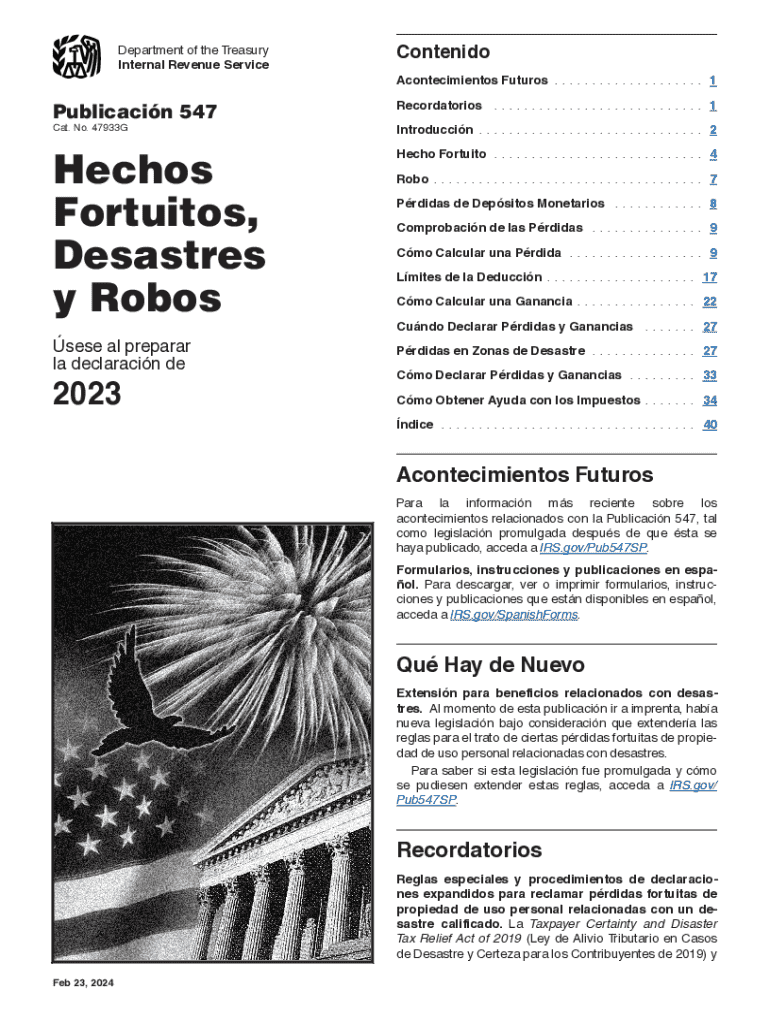







Definition & Meaning
Publication 547 (sp) outlines the tax treatment of losses due to casualties, thefts, and money deposit losses. It details the specific guidelines on how to calculate and report these losses, including those related to federally-declared disasters. The publication is part of the Internal Revenue Service's efforts to provide taxpayers with comprehensive information on handling such losses in their tax filings.
Key Considerations
- Casualty Losses: These refer to damage, destruction, or loss of property due to sudden, unexpected events like natural disasters.
- Theft Losses: Involves loss from illegal taking or stealing of money or property.
- Deposit Losses: Focuses on losses of deposited money under certain conditions, such as bank insolvency.
How to Use Publication 547 (sp)
To effectively utilize Publication 547 (sp), begin by identifying whether your situation qualifies as a casualty or theft loss. Detailed instructions within the publication help in determining the computation of allowable loss amounts and necessary documentation for substantiation.
- Determine Eligibility: Assess if your loss situation meets IRS definitions.
- Document Losses: Keep detailed records and evidence of the value of the lost property or funds.
- Calculate Losses: Utilize the specific IRS formulas provided to accurately assess deductible amounts.
- Report on Tax Return: Correctly include the information derived from Publication 547 (sp) on your tax filing.
How to Obtain Publication 547 (sp)
Publication 547 (sp) can be accessed through multiple methods:
- IRS Website: Download directly from the IRS official site.
- Physical Copies: Request a mailed copy by contacting the IRS directly or visiting a local IRS office.
- Third-party Platforms: Access through trusted online platforms that host IRS documents.
Steps to Complete Publication 547 (sp)
Completing the process as detailed in Publication 547 (sp) involves several systematic steps to ensure accurate reporting and compliance:
- Identify the Loss: Clearly categorize your loss type.
- Gather Documentation: Prepare necessary documentation such as appraisals, receipts, and photographs.
- Calculate the Loss:
- Initial Calculation: Compute the initial loss value based on original cost or current fair market value.
- Insurance and Reimbursement: Subtract any received insurance payouts or reimbursements.
- Adjustments for Limitations: Apply any IRS specified limitations or reductions.
- Complete Tax Forms: Use IRS forms such as Form 4684 to report your loss on your tax return.
IRS Guidelines
The IRS provides specific guidelines within Publication 547 (sp) to ensure taxpayers properly address their deductible losses:
- Documentation: Maintain thorough evidence of losses, including IRS-required forms.
- Deduction Limitations: Understand applicable deduction caps and floors.
- Amendments & Corrections: Recognize procedures for filing amended returns in case of errors or omissions.
Required Documents
For accurate reporting under Publication 547 (sp), ensuring the following documents are available is critical:
- Proof of Ownership and Value: Purchase receipts, title documents, or professional appraisals.
- Incident Evidence: Police reports, insurance claims, and damage assessments.
- Reimbursement Records: Information on all insurance settlements or reimbursements received.
Examples of Using Publication 547 (sp)
Real-world scenarios can elucidate the application of Publication 547 (sp):
- Natural Disaster: A homeowner might utilize the publication when claiming losses from a hurricane after applying insurance reimbursements.
- Theft Incident: An individual victim of a burglary could report losses by deducting reimbursed or recovered amounts from insurers.
- Deposit Loss: A taxpayer suffering a bank insolvency might report through the guidelines provided, especially when no reimbursement is possible.
Penalties for Non-Compliance
Failing to comply with IRS regulations using Publication 547 (sp) could result in significant ramifications:
- Fines: Monetary penalties might be imposed for inaccuracies or unreported losses.
- Interest: Late payment interest may accrue from incorrect filings or delay.
- Legal Actions: Persistent non-compliance could result in further audits or legal proceedings by the IRS.
Digital vs. Paper Version
Publication 547 (sp) is available in both digital and paper formats, each with its considerations:
- Digital Format: Easily accessible online and compatible with digital filing systems, offering quick reference links throughout the document.
- Paper Version: Preferred by those who wish to annotate or manually cross-reference without digital distraction.




