




01. Edit your form online
Type text, add images, blackout confidential details, add comments, highlights and more.

Type text, add images, blackout confidential details, add comments, highlights and more.

Draw your signature, type it, upload its image, or use your mobile device as a signature pad.

Send it via email, link, or fax. You can also download it, export it or print it out.
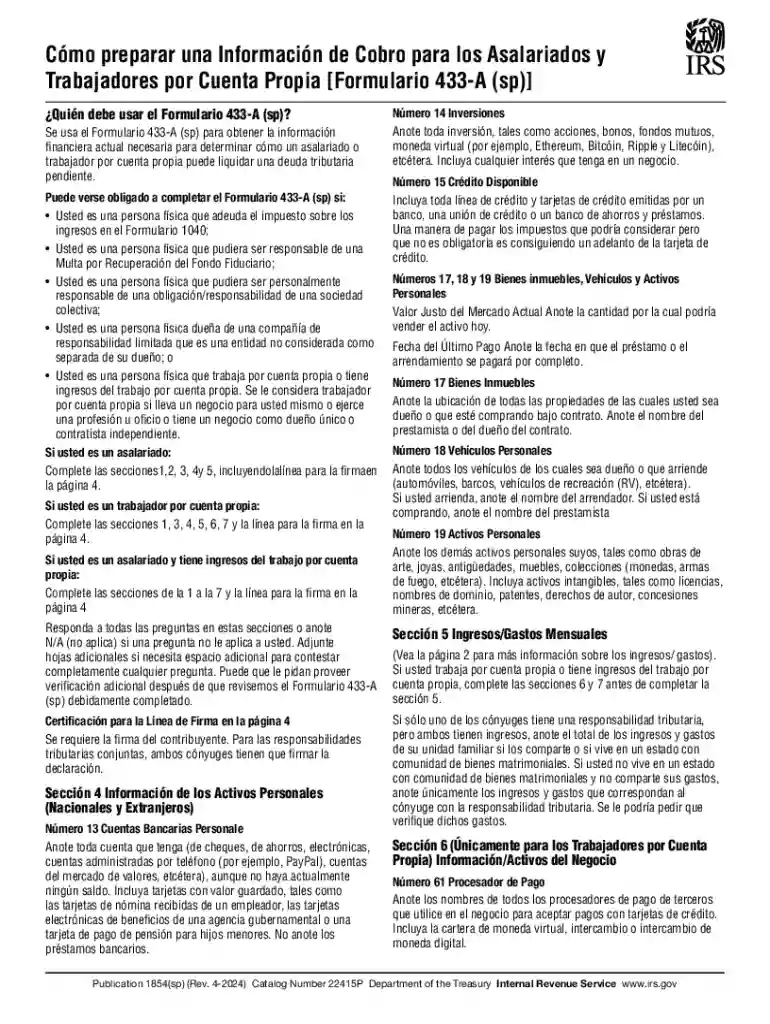
Publication 1854 sp (Rev 4-2024) and the Collection Information Statement (Form 433-A) Span are integral components for individuals in the U.S. needing to organize their financial information for tax purposes. Specifically, Form 433-A is used by employees and self-employed individuals to convey their financial situation to the IRS, so their ability to pay outstanding taxes or negotiate a payment plan can be assessed.
Gather Required Documents: Before beginning, collect recent pay stubs, bank statements, credit card statements, and documentation of any other income sources to ensure all financial information is complete and accurate.
Identify Your Financial Situation: Accurately fill in details about income, expenses, and assets. The form requires specific information on monthly living expenses, debts, and other obligations.
Complete the Necessary Sections: The form is divided into various parts for personal information, financial details, and certification. Pay special attention to sections that may require third-party signatures or additional proofs of information.
Review for Accuracy: Double-check all entries against your documentation. Errors can delay the IRS's processing time and affect your payment plans or offers in compromise.
Submit the Form: Once complete, submit via the method prescribed by the IRS – typically by mail or as an attachment to an electronic submission method if available. Follow specific IRS instructions regarding mode of submission.
The primary users of this form are wage earners and self-employed individuals in the United States who need to report their financial status to the IRS for purposes such as tax debt resolution or negotiation of payment terms.


Income Verification: A process where the IRS reviews the user's claimed income through presented documentation, such as tax returns.
Assets: Any property owned by the individual, including both tangible and intangible resources.
Liabilities: The user's financial obligations or debts, which should be thoroughly detailed in the form for an accurate assessment by the IRS.
Applicants will need:
These documents help substantiate the information provided and ensure an accurate representation of the individual's financial status.
The IRS mandates that the form be filled out with utmost accuracy and honesty. Misrepresentation or omission of any required financial data might lead to penalties or delay in processing. Users are advised to follow the official IRS guidelines, which outline the process for dispute resolution and representation, if necessary.
While traditionally submitted by mail, the IRS is moving toward accepting digital submissions. Check the IRS website for the most current submission methods, as some forms may now be uploaded directly through the IRS online portals or filed in person at designated IRS offices.
Failure to submit an accurate and timely Form 433-A can result in various penalties from the IRS, including fines, increased interest on existing debts, and possible legal action to recover unpaid taxes. It is crucial to ensure compliance to avoid such outcomes.
We've got more versions of the Publication 1854 sp (Rev 4-2024) How to prepare a Collection Information Statement (Form 433-A) Span form. Select the right Publication 1854 sp (Rev 4-2024) How to prepare a Collection Information Statement (Form 433-A) Span version from the list and start editing it straight away!
At DocHub, your data security is our priority. We follow HIPAA, SOC2, GDPR, and other standards, so you can work on your documents with confidence.




Apr 4, 2024 DOE uses Form OE-417 to collect information from the electric power industry relevant to DOEs overall national security and National Response
by D Wingfield 2025 Cited by 5 Part I explores twenty-first century trends in education resistance. Part II reveals how these debates about political rhetoric, censorship, and parental choice


