




01. Edit your free fillable 1120 online
Type text, add images, blackout confidential details, add comments, highlights and more.

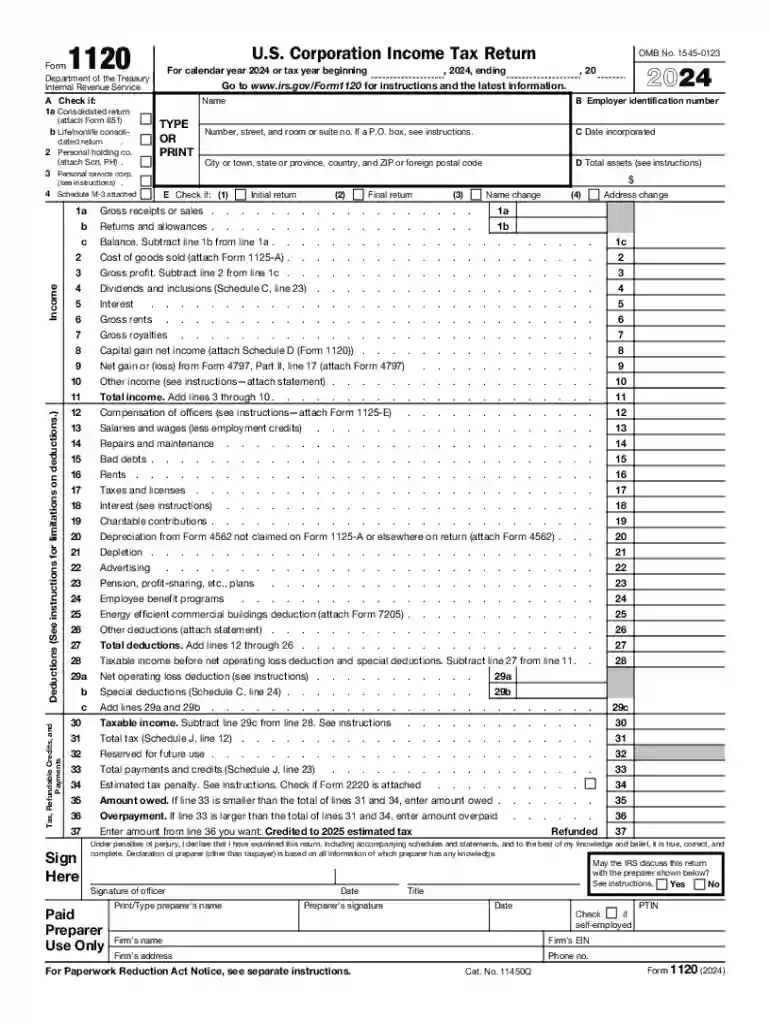
Type text, add images, blackout confidential details, add comments, highlights and more.

Draw your signature, type it, upload its image, or use your mobile device as a signature pad.

Send form 1120 2024 via email, link, or fax. You can also download it, export it or print it out.
The U.S. Life Insurance Company Income Tax Return refers to a federal document that life insurance companies use to report their taxable income to the Internal Revenue Service (IRS). This return is designed to capture the detailed financial activities of these entities, including income from premiums, investments, and other relevant financial transactions. The form serves both as a disclosure of a company's financial performance and as a tool for the IRS to assess tax liabilities. Life insurance companies are required by federal tax law to file this return, highlighting the importance of compliance in maintaining legal standing and financial accountability.
Using the U.S. Life Insurance Company Income Tax Return involves several steps that require careful attention to detail to ensure accuracy and compliance. Companies need to gather all significant financial data for the tax year, including premium receipts, investment income, operating expenses, and dividends paid to policyholders. The form requires precise reporting of this information, with separate sections for different types of income and deductions.
Life insurance companies can obtain the U.S. Life Insurance Company Income Tax Return directly from the IRS website or through official IRS mailings. Digital versions of tax forms, including this specific return, can be downloaded from IRS.gov, allowing organizations to complete and submit them electronically. Alternatively, a paper form can be requested for those preferring traditional mail filing.
Completing the U.S. Life Insurance Company Income Tax Return requires following a systematic approach to input all necessary financial information accurately. The process involves:
The U.S. Life Insurance Company Income Tax Return contains several key sections that are critical for accurate reporting:
Filing deadlines for the U.S. Life Insurance Company Income Tax Return are typically aligned with the fiscal year-end of the company. The standard filing due date is the 15th day of the fourth month after the end of the company’s tax year. Timely filing is essential to avoid penalties and interest on late payments.
To accurately complete the U.S. Life Insurance Company Income Tax Return, companies must prepare several documents, ensuring they have supporting evidence for all reported figures. These documents typically include:
The IRS provides specific guidelines to ensure compliance when filing the U.S. Life Insurance Company Income Tax Return. These guidelines include instructions on accurately reporting different income streams and deductions, as well as how to complete supplementary schedules for comprehensive tax calculation.
Non-compliance with the filing requirements of the U.S. Life Insurance Company Income Tax Return can result in significant financial penalties from the IRS. These penalties may include fines for late filing or for errors and omissions within the submitted tax return. Furthermore, unpaid taxes due may incur interest rates prescribed by the IRS.
By understanding these various aspects, life insurance companies can ensure they meet their federal tax obligations and maintain adherence to regulatory requirements. Each section of the U.S. Life Insurance Company Income Tax Return plays a vital role in accurately portraying the financial operations of a life insurance entity, facilitating proper tax assessment by the IRS.
We've got more versions of the free fillable 1120 form. Select the right free fillable 1120 version from the list and start editing it straight away!
| Versions | Form popularity | Fillable & printable |
|---|---|---|
| 2025 | 4.4 Satisfied (37 Votes) | |
| 2024 | 4.6 Satisfied (32 Votes) | |
| 2023 | 4.2 Satisfied (33 Votes) | |
| 2022 | 4.8 Satisfied (59 Votes) | |
| 2021 | 4.8 Satisfied (80 Votes) | |
| 2020 | 4.3 Satisfied (37 Votes) | |
| 2019 | 4.4 Satisfied (228 Votes) | |
| 2018 | 4.3 Satisfied (133 Votes) | |
| 2017 | 4.3 Satisfied (98 Votes) | |
| 2016 | 4.4 Satisfied (267 Votes) | |
| 2015 | 4.3 Satisfied (34 Votes) | |
| 2014 | 4.2 Satisfied (35 Votes) | |
| 2014 | 4 Satisfied (59 Votes) | |
| 2013 | 4 Satisfied (42 Votes) | |
| 2013 | 4.8 Satisfied (25 Votes) |
At DocHub, your data security is our priority. We follow HIPAA, SOC2, GDPR, and other standards, so you can work on your documents with confidence.




Prospective investors are recommended to seek independent legal, financial and tax advice before making any investment decision.
This separate 25 percent tax rate applies whether or not there is life insurance company taxable income, taxable investment income, or a gain or loss fromRead more


