
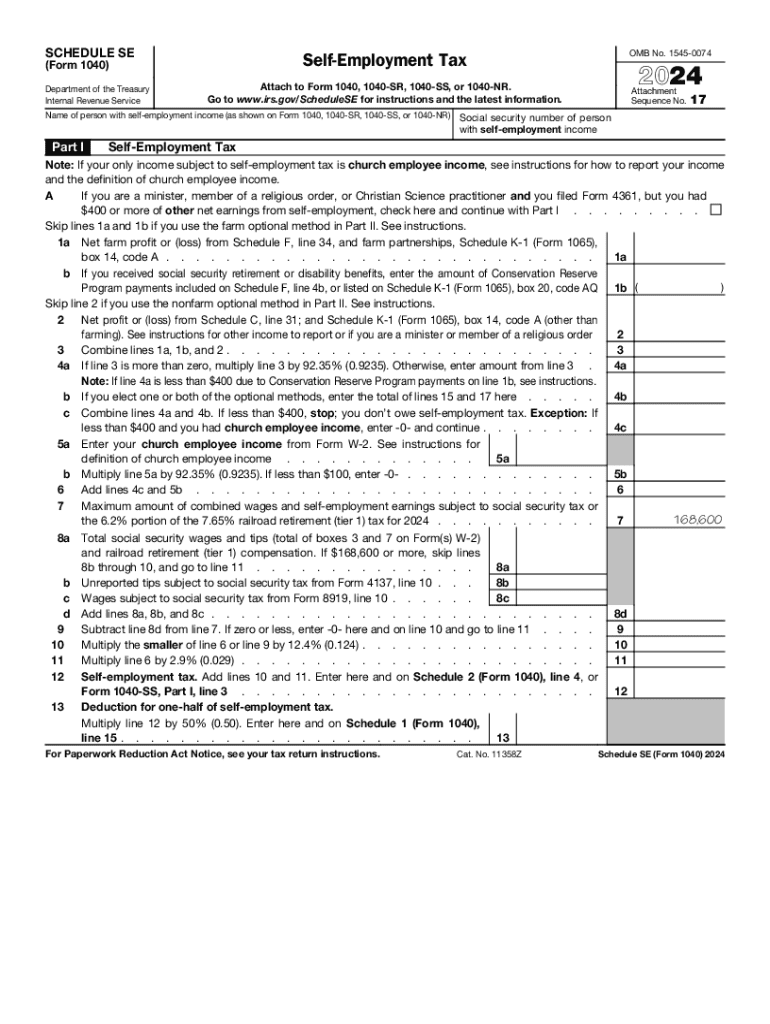







Definition and Meaning of the Schedule SE
The Schedule SE (Form 1040) is a critical tax form used by individuals in the United States for the calculation of self-employment tax. This tax is levied on individuals who earn income through self-employment, covering Social Security and Medicare taxes typically withheld from wage earners. The form provides a structured approach to determining net earnings from self-employment, ensuring individuals meet their tax obligations accurately.
- Purpose: The form calculates the self-employment tax, a counterpart to Social Security and Medicare contributions for employed workers.
- Applicability: Applies to freelancers, independent contractors, and small business owners.
How to Use the 2024 Schedule SE
Filing the Schedule SE is a necessary step for those with self-employment income. Use it to report your net earnings and calculate the self-employment tax owed.
- Calculate Net Earnings: Deduct business expenses to determine your net profit.
- Complete Parts I & II: Fill out sections related to self-employment tax calculation.
- Transfer Totals: Move the calculated self-employment tax to the main Form 1040.
Steps to Complete the 2024 Schedule SE
The completion of the Schedule SE form follows specific steps to ensure accuracy.
- Identify Total Income: Gather all forms of self-employment income.
- Deduct Allowable Expenses: Subtract business expenses applicable under IRS guidelines.
- Determine Net Earnings: Use the net figure to calculate your self-employment tax rate.
- Input on Schedule SE: Fill in relevant sections for Part I or II, depending on income level.
Detailed Breakdown of Part I
- Part I - Short Schedule: For individuals whose net earnings are $144,000 or less.
- Part II - Long Schedule: Utilized when net earnings exceed the threshold or using optional methods.
Who Needs to File the Schedule SE
This form is required for various individuals with self-employment income.
- Freelancers: Individuals offering services without a traditional employer.
- Small Business Owners: Owners who have a business structure not separating personal and business taxes.
- Gig Economy Workers: Individuals employed in short-term jobs or service-to-order work.
Important Terms in the Schedule SE
Understanding key terms enhances accuracy in completion.
- Net Earnings: Gross income from self-employment minus business expenses.
- Self-employment Tax: Total contribution equivalent to employer and employee parts of Social Security and Medicare.
IRS Guidelines and Compliance
The IRS provides guidelines crucial for correctness.
- Annual Updates: Check for any changes in tax laws that might affect filing.
- Form Instructions: Follow IRS-provided instructions to ensure proper filling.
- Accuracy Check: Ensure that all calculations align with IRS expectations to avoid penalties.
Filing Deadlines for the Schedule SE
Timely filing is essential to maintain compliance with tax regulations.
- Standard Deadline: Typically, April 15th, unless a weekend or holiday extends it.
- Extensions: File Form 4868 for an automatic six-month delay.
Required Documents to File Schedule SE
Organizing required documentation is vital for smooth filing.
- Income Records: Include 1099-MISC or 1099-NEC forms received.
- Expense Details: Gather a comprehensive list of deductible expenses.
- Previous Year’s Returns: Useful for historical comparison and accuracy.
Software Compatibility
Utilizing compatible tax software can simplify filing the Schedule SE.
- Popular Options: Programs like TurboTax and QuickBooks can guide through the Schedule SE.
- Integration Features: Ensure software can import previous returns for efficiency.
- Updates Availability: Confirm software provides updates on the latest tax code changes.
These sections collectively offer a comprehensive guide to understanding and completing the 2024 Schedule SE, ensuring all self-employed individuals can accurately fulfill their tax responsibilities.




