







Definition & Meaning
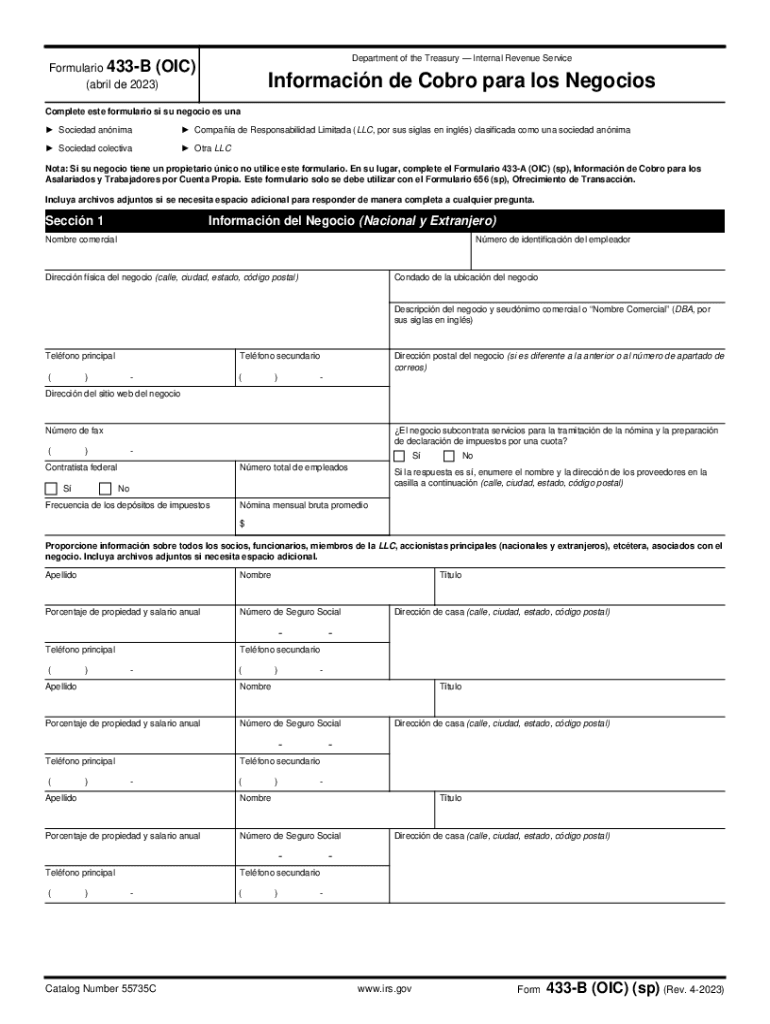
The Form 433-B (OIC), also known as the Collection Information Statement for Businesses, is a vital IRS document used by businesses such as corporations, partnerships, and LLCs. It serves as a comprehensive financial disclosure form required for applying for an Offer in Compromise (OIC). This Spanish version is geared towards Spanish-speaking business owners needing to report financial details, assets, income, and expenses. By completing this form, businesses can present a detailed financial picture to negotiate potential tax debt settlements with the IRS.
Steps to Complete the Form 433-B (OIC) (sp)
Completing Form 433-B (OIC) requires meticulous attention to detail. Follow these steps:
-
Gather Financial Documents: Collect all relevant financial documents, such as bank statements, profit and loss statements, balance sheets, and details of assets and liabilities.
-
Fill in Business Information: Enter the business name, address, type, and EIN. Accurate identification of your business is crucial for submission.
-
Disclose Business Assets: Provide a detailed account of all business assets, including cash, accounts receivable, inventory, and other tangible or intangible property.
-
Outline Income Sources: List all sources of business income over the relevant time period, ensuring all figures are precise and verifiable.
-
Detail Business Expenses: Accurately describe all business expenses, categorizing them for clarity and completeness.
-
Review and Validate: Double-check all entries for accuracy. Any discrepancies could delay the evaluation process.
Key Elements of the Form 433-B (OIC) (sp)
The form comprises several crucial sections where precise information is necessary:
- Business Identification: Encompasses the essential details for identifying the business, like the legal name and EIN.
- Asset Reporting: Requires detailed descriptions and valuations of business-owned assets.
- Income Data: Involves the thorough listing of all income streams.
- Expense Breakdown: Covers recurring and non-recurring business expenses.
- Financial Statement: Summarizes the overall financial health and operational status.
IRS Guidelines
The IRS stipulates specific guidelines for completing the Form 433-B (OIC). Adhering to these guidelines ensures accurate submission and processing:
- Truthful Reporting: Honesty is paramount. Misrepresentations can lead to penalties.
- Timeliness: Submit the form promptly as part of the Offer in Compromise process.
- Supporting Documentation: Attach copies of financial documents to validate claims.
Eligibility Criteria for Form 433-B (OIC) (sp)
To be eligible to use this form, a business must meet certain conditions that demonstrate inability to pay tax liabilities in full. Key criteria include:
- Accurate Reflection of Business Finances: Only businesses that owe more in back taxes than they can pay can qualify.
- Good Standing with Filings: All previous tax returns must be filed and current.


Filing Deadlines / Important Dates
Filing Form 433-B (OIC) often coincides with specific deadlines tied to tax resolution processes:
- Offer in Compromise Deadlines: Timelines are linked to the OIC submission schedule.
- Annual Reporting Dates: Sync with standard business tax filing periods.
- IRS Response Times: Submission initiates a processing period wherein the IRS reviews the offer.
Business Entity Types Using the Form
Form 433-B (OIC) is essential for various business structures:
- Corporations: Offers a structured way to disclose financial instability.
- LLCs and Partnerships: Facilitates negotiation of debt relief for collective business entities.
Required Documents
Submitting Form 433-B (OIC) necessitates assorted documentation to support financial claims:
- Bank Statements: Recent months of statements to demonstrate financial activity.
- Profit and Loss (P&L) Statements: To illustrate business revenue and expenses.
- Asset Documentation: Proof of ownership and valuation of business assets.
Application Process & Approval Time
The process for submitting Form 433-B (OIC) includes application and approval steps:
- Application Preparation: Gather necessary documents and information.
- Form Submission: Deliver the completed form to the IRS. This can be done in-person, by mail, or electronically, depending on IRS guidelines.
- IRS Review & Response: The IRS will review the submission, which may take several months for approval or rejection.
Penalties for Non-Compliance
Failure to submit Form 433-B (OIC) accurately and on time can result in:
- Rejection of Offer: An improperly filled form can delay or result in denial of OIC applications.
- Monetary Penalties: Additional interests and fines may be accrued.
- Legal Consequences: Continued non-compliance can lead to collections actions by the IRS.
By understanding and thoroughly navigating these aspects, businesses can effectively manage their tax liabilities through the Form 433-B (OIC) process.




