




01. Edit your tab hearing by mail online
Type text, add images, blackout confidential details, add comments, highlights and more.

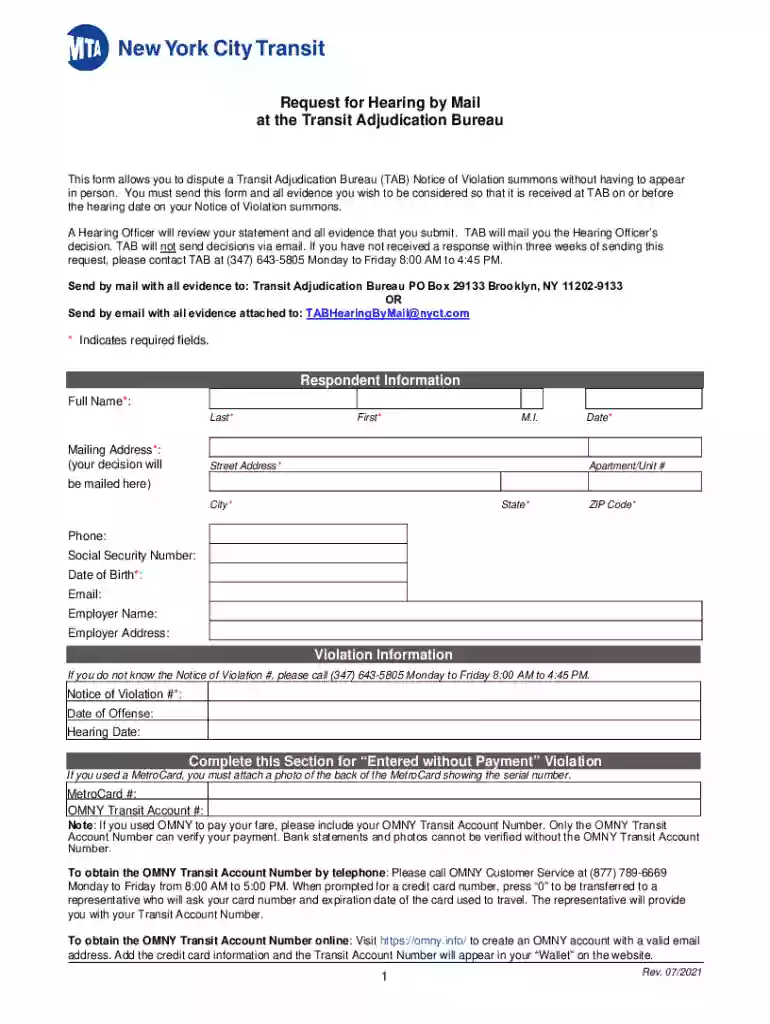
Type text, add images, blackout confidential details, add comments, highlights and more.

Draw your signature, type it, upload its image, or use your mobile device as a signature pad.

Send it via email, link, or fax. You can also download it, export it or print it out.
The "Request for Hearing by Mail at the Transit Adjudication" form allows respondents to challenge a Notice of Violation without appearing in person at the Transit Adjudication Bureau (TAB). This option is particularly beneficial for individuals who cannot attend an in-person hearing due to scheduling conflicts or geographic constraints. The form facilitates a convenient way to submit evidence and statements by mail, ensuring that a fair hearing process can occur without the need to be physically present.
To effectively use this form, individuals must carefully follow the required steps to gather and submit relevant documentation. Respondents need to provide a detailed written statement explaining their case and any supporting evidence that might influence the decision. Common types of evidence include receipts, photographs, or witness statements. The objective is to present a comprehensive argument that justifies the respondent's position on the violation.
The form can be obtained from the Transit Adjudication Bureau's website or by contacting their office directly to request a mailed copy. It is crucial for people to use the most current version of the form to ensure compliance with any updated guidelines or requirements. Instructions for acquiring the form, including potential online alternatives or downloadable PDFs, are also typically available to streamline the process.
Opting to request a hearing by mail can save time and provide flexibility, allowing individuals to present their case without the need for travel or time off work. This process is often less intimidating than in-person hearings and can be done entirely from home, helping to make the administrative process more accessible and efficient.
Individuals who receive violations related to transit use but cannot attend an in-person hearing due to personal or professional obligations are typical users of this form. This includes people living outside of the immediate geographic area, those with mobility constraints, or individuals who find it challenging to attend due to work schedules.


The completed form serves as an official document within the legal framework of transit violations adjudication. It forms part of the respondent's legal strategy to contest a violation and must be filled out with accurate and honest information. Misrepresentation or falsification can lead to negative legal implications, including potential penalties or lack of consideration in the adjudication process.
When submitting the Request for Hearing by Mail, respondents should include copies of all relevant evidence. This may include correspondence related to the violation, receipts or records validating transactions, photographs that provide context to the situation, or any official records that offer support to the respondent's claims. It's essential to check the form instructions for any specific document requirements to avoid delays or rejections.
Although primarily designed for mail submission, check if the Transit Adjudication Bureau offers online submission capabilities on their website. If sending by mail, ensure to use a reliable postal service that provides delivery confirmation to mitigate the risk of the form not reaching its intended destination.
We've got more versions of the tab hearing by mail form. Select the right tab hearing by mail version from the list and start editing it straight away!
At DocHub, your data security is our priority. We follow HIPAA, SOC2, GDPR, and other standards, so you can work on your documents with confidence.



May 29, 2026 Pay a TAB fine online and see the different fine amounts; What to expect at a TAB hearing How to appeal a hearing decision; Request yourRead more
Parking Adjudication will notify you via US Mail of the date and time of the scheduled administrative hearing. can call (760) 750-7505, or email:


