
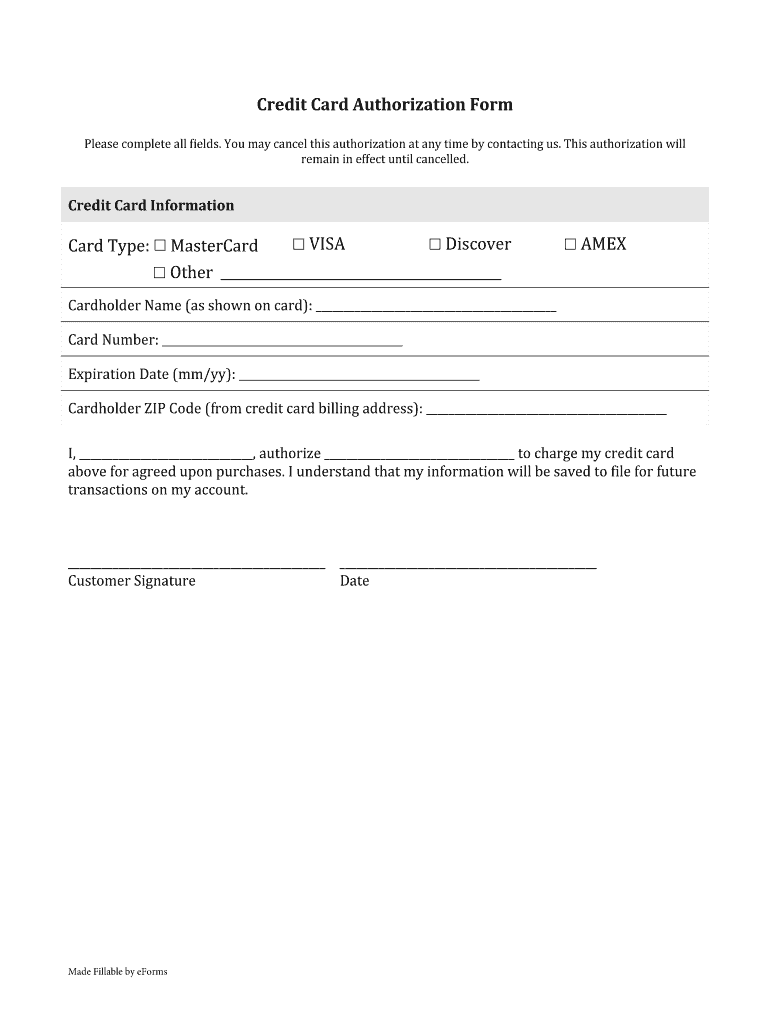







Definition and Meaning of the Simple Credit Authorization Form
The simple credit authorization form is a financial document that allows individuals or businesses to authorize a company to charge their credit card for specific transactions. This form usually contains key details such as the cardholder's name, card number, expiration date, and a signature that confirms the cardholder's agreement to the charges. It is commonly used in scenarios where recurring payments are required, such as membership fees, subscription services, or payment plans.
- Purpose: The primary purpose of this form is to ensure that the merchant has permission from the cardholder to process charges. It serves as proof that the cardholder is aware of and accepts the terms of payment.
- Legality: In the United States, electronically signed credit authorization forms are legally binding under the ESIGN Act, which helps to standardize electronic transactions across various sectors.
Understanding this form is essential for both consumers and businesses to maintain proper financial practices and ensure compliance with legal standards.
Key Elements of the Simple Credit Authorization Form
When filling out a simple credit authorization form, various essential elements must be included to ensure its effectiveness and legal compliance. Each component serves a specific purpose in safeguarding both the payer and the payee.
-
Cardholder Information: This section typically requires the full name of the cardholder, ensuring that the authorization comes from the rightful owner of the credit card. This is crucial for preventing unauthorized transactions.
-
Credit Card Details: Include the card number, expiration date, and the billing address associated with the card. This information is essential for processing payments accurately and reflects where the charges should be directed.
-
Merchant Information: The form should specify the merchant's name, contact information, and any reference number related to the transaction. This allows for easy tracking and accountability if disputes arise.
-
Authorized Amount: Clearly state the amount that will be charged, whether it is a one-time payment or recurring payments. Specifying this prevents misunderstandings about charges.
-
Signature Line: A space for the cardholder's signature is necessary to validate the authorization. Digital signatures are also acceptable and are subject to the same legal standards as handwritten signatures.
Steps to Complete the Simple Credit Authorization Form
Filling out a simple credit authorization form correctly is crucial for ensuring permission for charges and protecting both parties involved in the transaction. Follow these steps for a successful completion:
-
Gather Necessary Information: Collect the cardholder's details, including receipts or invoices that pertain to the transaction.
-
Fill Out Cardholder Information: Enter the cardholder’s full name exactly as it appears on the credit card.
-
Provide Credit Card Details: Accurately fill in the credit card number, expiration date, and billing address. Ensure no errors are made to avoid complications during the transaction.
-
Include Merchant Information: Clearly list the organization's name and contact information for transparency and accountability.
-
Specify Authorization Scope: Indicate whether this is a one-time transaction or an ongoing authorization. Include specific amounts if necessary.
-
Obtain Signature: The cardholder must sign the document to give formal approval for the charges. If done digitally, ensure the signature is captured in a legally acceptable manner.
Digital vs. Paper Version of the Simple Credit Authorization Form
Both digital and paper versions of the simple credit authorization form have distinct advantages and disadvantages, depending on the context of their use.
-
Digital Version:
- Convenience: Easily accessible from various devices, allowing users to complete and submit forms without needing to print.
- Security: Digital forms can be secured with encryption measures, protecting sensitive information.
- Tracking: Provides a clear record of submission times and changes made, often through an automated system.
-
Paper Version:
- Tangible Record: Physical copies may be required for certain legal contexts or industries.
- Compliance with Certain Regulations: Some businesses or sectors may have legal requirements stipulating paper documentation.
- Signature Validity: Handwritten signatures are sometimes viewed as more legitimate in traditional business settings.
The choice between digital and paper versions largely depends on the preferences of the parties involved and any applicable regulations. Both forms serve the same legal purpose, but the method of submission can impact efficiency and security.
Examples of Using the Simple Credit Authorization Form
The simple credit authorization form finds application in various everyday scenarios, ensuring that transactions proceed smoothly and securely. These examples illustrate its practicality across different contexts.
-
Subscription Services: Many organizations, such as gyms or streaming services, utilize the form to obtain ongoing payments from customers. By securing this authorization, businesses can automatically charge members monthly or annually.
-
Contractor Services: Home improvement companies may ask clients to fill out the form prior to starting work. This guarantees that payment will be processed as agreed upon for materials and labor.
-
Charitable Donations: Nonprofits often use the credit authorization form to allow supporters to make ongoing contributions. This ensures that donors can conveniently support causes they care about without having to remember to make payments repeatedly.
-
School Tuition Payments: Parents might authorize their children's school to charge tuition or extracurricular fees, ensuring that payments are made on time to prevent any disruptions in services.
These examples highlight how the simple credit authorization form simplifies payment processes across various sectors, benefiting both consumers and providers alike.




