







Definition & Meaning
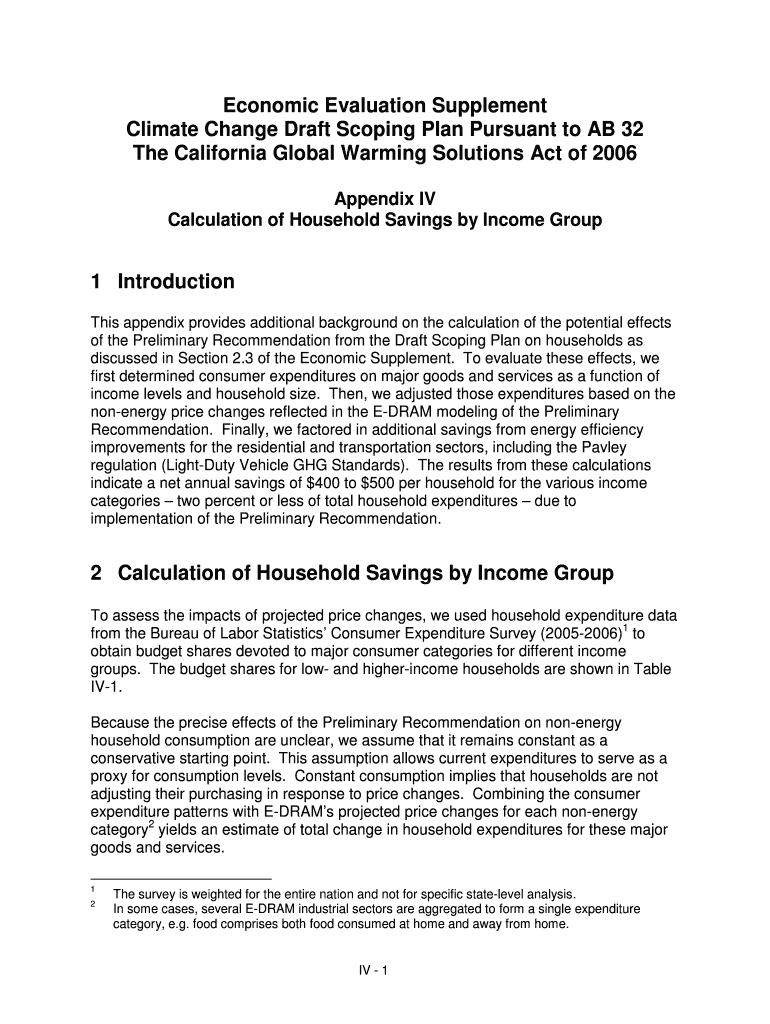
The Economic Evaluation Supplement is a critical document that assesses the financial implications of policy measures, specifically in the context of California's Climate Change Draft Scoping Plan. It serves as an analytical tool to estimate potential savings or costs for households associated with these measures. By examining consumer expenditures, this supplement provides essential insights into the economic impact across different income groups, allowing policymakers and stakeholders to make informed decisions. Such evaluations are crucial in understanding the broader implications of proposed climate policies and their effects on household finances.
How to Use the Economic Evaluation Supplement
Using the Economic Evaluation Supplement involves analyzing projected savings and expenditures to gauge the economic impact of specific policy recommendations. Users should carefully review sections detailing consumer expenditure across income groups to understand potential savings. For instance, the supplement may highlight how energy efficiency improvements, incorporated into policy measures, can lead to annual household savings of $400 to $500. It's essential for users to consider the data sources, such as the Bureau of Labor Statistics, to ensure the credibility of the analysis and to focus on sections projecting price changes in essential goods and services.
Steps to Analyze the Document
- Identify Key Sections: Start by locating sections that outline the projected financial impact.
- Review Consumer Expenditure Analysis: Examine how different income groups are affected.
- Understand Source Data: Familiarize yourself with data sources to validate the analysis.
- Assess Projected Savings: Focus on expected household savings and underlying assumptions.
- Consider Price Change Projections: Analyze how price changes in energy and services affect savings.
Steps to Complete the Economic Evaluation Supplement
Completing the Economic Evaluation Supplement requires a systematic approach to gather and input relevant data accurately. Begin by collecting data on consumer expenditures across various income groups, ensuring it's aligned with the Bureau of Labor Statistics. Use this data to calculate potential savings or costs from the proposed policies. Populate sections with projections on energy efficiency improvements and their economic impacts. Collaboration with experts in economics and public policy is recommended to enhance the accuracy of calculations and interpretations.
Step-by-Step Process
- Gather Relevant Data: Collect data from trustworthy sources, like the Bureau of Labor Statistics.
- Calculate Potential Savings: Analyze how proposed measures influence household expenditures.
- Input Data into Supplement: Enter data in the relevant sections, ensuring accuracy.
- Review Energy Efficiency Projections: Focus on improvements and their projected impacts.
- Collaborate with Experts: Work alongside public policy and economic experts for validation.
Key Elements of the Economic Evaluation Supplement
The core elements of the Economic Evaluation Supplement revolve around accurately projecting household savings, analyzing consumer expenditures, and incorporating price change forecasts for major goods and services. A fundamental aspect is understanding how energy efficiency improvements play a critical role in these projections. The supplement's framework includes findings from trusted sources, ensuring an evidence-based approach to evaluating economic impacts. A thorough comprehension of these elements is essential for making the supplement a useful tool in policy decision-making.
Essential Components
- Household Savings Projections: Estimated savings derived from policy measures.
- Consumer Expenditure Analysis: Insights into expenditure across income brackets.
- Energy Efficiency Improvements: Impact on household savings.
- Price Change Forecasts: Expected shifts in costs of essential goods and services.
- Data Sources and Credibility: Incorporation of reliable data, like that from the Bureau of Labor Statistics.
Legal Use of the Economic Evaluation Supplement
The Economic Evaluation Supplement holds significant legal implications as it informs policy-making, influencing legislative decisions. Legal use involves leveraging the supplement to assess compliance with environmental regulations, like California's AB 32, focusing on climate change mitigation. It's also utilized in legal contexts to analyze potential financial burdens or savings for various stakeholders. Adhering to legal standards in the creation and application of the supplement ensures its validity and reliability in legal and policy discussions.
Legal Contexts
- Policy Compliance: Evaluation of regulatory alignment with environmental laws.
- Legislative Decision-Making: Informing legal frameworks around climate policies.
- Financial Impact Analysis: Assessing potential economic burdens on households.
- Regulatory Standards: Ensuring adherence to applicable laws and guidelines.
Examples of Using the Economic Evaluation Supplement
Real-world scenarios illustrate the utility of the Economic Evaluation Supplement in estimating economic impacts of climate policies. One example is analyzing the projected savings for different income brackets under California's Climate Change Draft Scoping Plan, which outlines potential household savings between $400 and $500 due to energy efficiency measures. Such analyses facilitate stakeholder understanding of policy impacts, guiding businesses and consumers in adapting to new regulations. The supplement is a vital tool for planning and communication among state agencies and the public.
Practical Scenarios
- Policy Impact Analysis: Predicting financial outcomes for specific demographic groups.
- Planning and Communication: Guiding businesses and public entities in response to policies.
- Stakeholder Engagement: Engaging various stakeholders with evidence-based projections.
- State Agency Utilization: Aiding in strategic planning and regulatory compliance.
Important Terms Related to Economic Evaluation Supplement
Understanding the vocabulary associated with the Economic Evaluation Supplement is crucial for accurate interpretation and implementation. Key terms include "projected savings," "consumer expenditures," "energy efficiency," and "price changes." Familiarity with these terms helps users navigate the supplement effectively, ensuring a precise analysis of economic impacts. This knowledge is essential for stakeholders, including policymakers, economists, and the public, to interpret findings and apply them to practical contexts.
Key Terms
- Projected Savings: Estimated reduction in household expenses due to policy measures.
- Consumer Expenditures: Spending patterns across different income groups.
- Energy Efficiency: Improvements leading to economic benefits.
- Price Changes: Variations in costs of significant goods and services.
- Bureau of Labor Statistics: Primary data source for expenditure analysis.




