
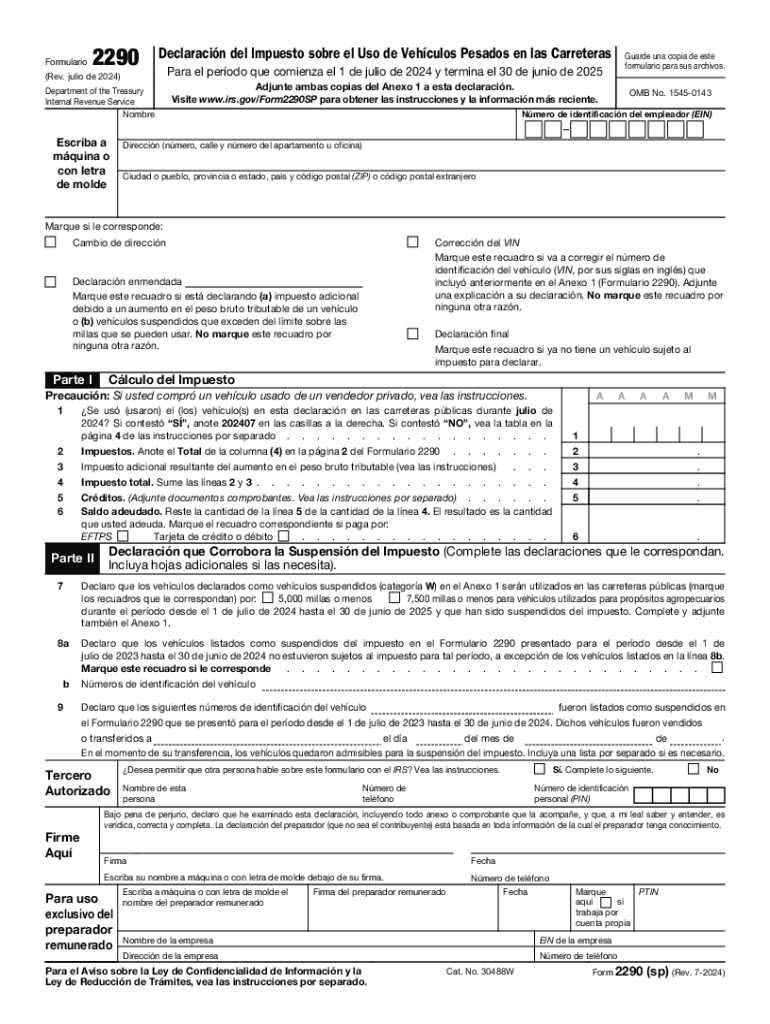







Definition & Purpose of Form 2290 (sp) (Rev July 2024)
Form 2290 (sp) (Rev July 2024) is the Spanish version of the Heavy Vehicle Use Tax Return, essential for reporting and paying the Heavy Highway Vehicle Use Tax to the IRS. This form applies to vehicles with a taxable gross weight of 55,000 pounds or more used on public highways. The primary purpose is to ensure compliance with federal tax laws by collecting taxes that contribute to the maintenance of highways used by these vehicles.
Key Elements
- Applicable Tax Period: July 1, 2024, to June 30, 2025
- Eligible Vehicles: Those with a taxable gross weight of at least 55,000 pounds
- Taxpayer: The person or entity registering the vehicle with the state
Steps to Complete the Form 2290 (sp)
Completing Form 2290 (sp) involves a series of steps to ensure accuracy and legal compliance.
- Gather Vehicle Information: Collect details such as Vehicle Identification Numbers (VINs) and the taxable gross weight of each vehicle.
- Calculate Tax: Use the IRS tax rate tables provided in the instructions to compute the applicable tax based on the vehicle's weight.
- Select Payment Method: Choose from electronic funds withdrawal, electronic federal tax payment system, credit/debit card, or check/money order.
- Signature and Date: Ensure that the form is properly signed and dated before submission.
Who Typically Uses the Form 2290 (sp)
Form 2290 (sp) is primarily used by operators of heavy highway vehicles, such as trucking companies, owner-operators, and certain public transportation agencies. Companies and individuals operating vehicles that meet the weight criteria and travel on U.S. highways for significant portions of the year must file this form. It is crucial for any entity required to register a heavy vehicle with a state or local government.


Filing Deadlines & Important Dates
The deadline to file Form 2290 (sp) is typically August 31, following the start of the new tax year. However, if the due date falls on a weekend or legal holiday, the deadline is extended to the next business day. It is advised to submit well in advance of this deadline to avoid penalties and interest for late filing.
Required Documents
- Current Form 2290 (sp): Ensure the latest revision is used
- Vehicle Registration Information
- Proof of Payment for Expired Statement: Previous year's tax document as reference if available
How to Obtain Form 2290 (sp)
Form 2290 (sp) can be obtained through several methods:
- IRS Website: Download directly from the IRS website for free
- Physical Copies: Request a paper form by phone from the IRS
- Tax Professional: Obtain assistance from tax preparers who have copies of the form
How to Use the Form 2290 (sp)
Using Form 2290 (sp) involves understanding its structure and application. It starts with identifying each vehicle subject to tax, then proceeds to accurately calculate the tax. Information regarding any suspended vehicles or tax-exempt vehicles should be clarified. It is crucial to double-check all entries for consistency and accuracy to prevent any discrepancies with the IRS.
Important Terms
- Taxable Gross Weight: The sum of the unloaded weight, trailers, and maximum load carried by the highway vehicle
- VIN: Unique number identifying the vehicle for tax and registration purposes
Legal Use of the Form 2290 (sp)
Completing Form 2290 (sp) allows vehicle owners to remain compliant with federal tax regulations. The information provided in the form is also shared with state and federal agencies to coordinate tax collection and ensure that the taxes collected are used for highway maintenance and improvements.
Filing Methods: Online, Mail, In-Person
There are multiple ways to submit Form 2290 (sp):
- Online Submission: Preferred for ease and speed, many e-filing services are available for this form.
- Mail: Physical copies can be mailed directly to the IRS, allowing for traditional paper filing.
- In-Person: Limited service is available at IRS Taxpayer Assistance Centers for manual submissions.
Advantages of Online Submission
- Efficiency: Quicker processing time, with acknowledgments generally received within 24 hours
- Easy Access: Immediate access to forms and instructions
- Environmentally Friendly: Reduces paper usage and physical storage requirements
Penalties for Non-Compliance
Failing to file Form 2290 (sp) by the deadline can lead to significant penalties. These include fines for both late filing and late payment. A penalty of 4.5% of the total tax due applies to late filers, adding to the overall cost. Consistent non-compliance might result in further legal action by the IRS to recoup owed taxes.
Avoiding Penalties
- Timely Filing: Submit prior to the deadline
- Accurate Payment: Ensure payment matches calculation to avoid discrepancies
- Regular Updates: Keep informed of any IRS changes to rules or rates that may affect filing requirements




