




01. Edit your 2290 form online
Type text, add images, blackout confidential details, add comments, highlights and more.

Type text, add images, blackout confidential details, add comments, highlights and more.

Draw your signature, type it, upload its image, or use your mobile device as a signature pad.

Send form 2290 via email, link, or fax. You can also download it, export it or print it out.
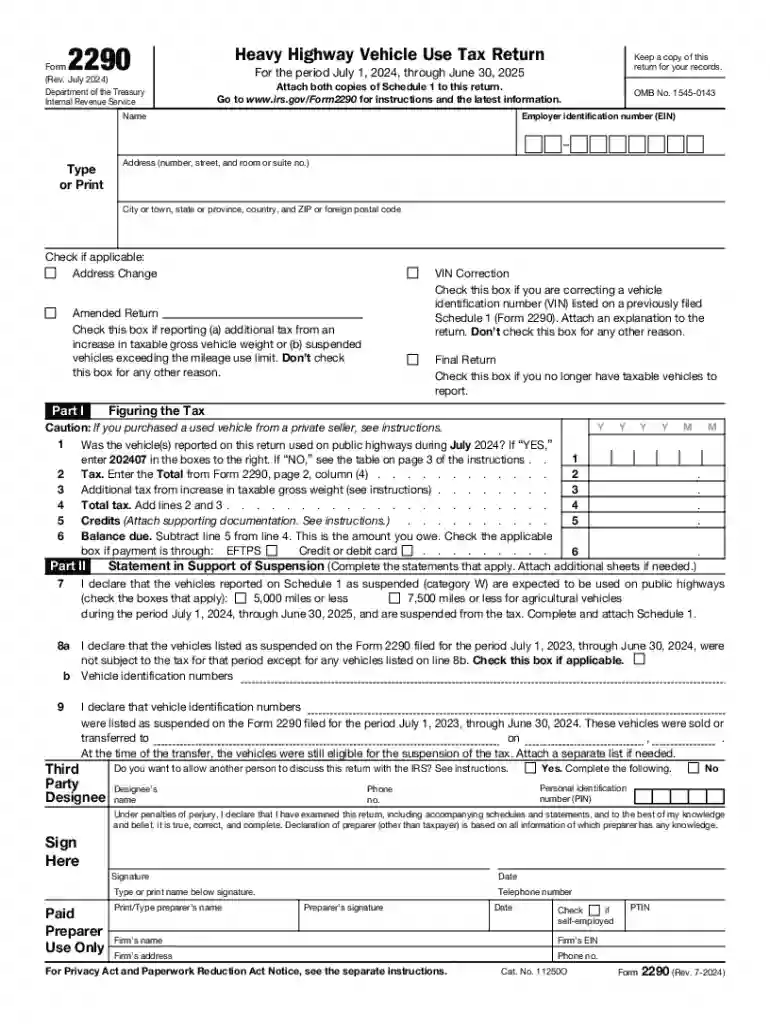
Form 2290 (Rev July 2024) Heavy Highway Vehicle Use Tax Return is a tax form used to report and pay taxes on highway motor vehicles that have a taxable gross weight of 55,000 pounds or more. It covers the tax period from July 1, 2024, to June 30, 2025. This form helps the Internal Revenue Service (IRS) assess taxes for heavy vehicles that utilize public highways, contributing to the maintenance and development of the highway infrastructure. Filing Form 2290 is crucial for businesses and individuals operating heavy vehicles, as it ensures compliance with federal tax regulations.
To acquire the Form 2290 for the tax period beginning July 2024, taxpayers can access it through the IRS official website, where they can download and print the form. Alternatively, it is available at local IRS offices for those who prefer to collect physical copies. Utilizing tax software or an authorized e-file provider can also simplify the process, as these platforms allow the form to be filed electronically, streamlining submission and reducing processing times.
Form 2290 is necessary for legal compliance with federal tax laws concerning heavy highway vehicles. Filing ensures that vehicle operators contribute to the infrastructure they utilize, addressing public highway wear and tear. Accurate and timely filing prevents penalties and secures the vehicle's registration. Toll companies often verify tax payments during inspections, making it crucial to present proof of payment.
Taxpayers must adhere to IRS guidelines while filing Form 2290. Key instructions include accurately reporting vehicle details, computing tax based on official IRS rates, and maintaining records of any tax payments or credits. E-filing is recommended for faster processing, especially for those filing for twenty-five or more vehicles, as it simplifies the documentation and compliance process.
Filing deadlines for Form 2290 must be met to avoid penalties. The form and payment are due by the last day of the month following the first use of the vehicle on public highways during the tax period. For vehicles first used in July 2024, the deadline is August 31, 2024. Consistent adherence to these dates ensures compliance and avoids additional fees or interest charges.
Before filing Form 2290, gather essential documents including:
Form 2290 can be submitted through different channels:
We've got more versions of the 2290 form form. Select the right 2290 form version from the list and start editing it straight away!
| Versions | Form popularity | Fillable & printable |
|---|---|---|
| 2025 | 4.2 Satisfied (37 Votes) | |
| 2024 | 4.8 Satisfied (56 Votes) | |
| 2023 | 3.2 Satisfied (48 Votes) | |
| 2022 | 4.4 Satisfied (60 Votes) | |
| 2021 | 4.8 Satisfied (181 Votes) | |
| 2020 | 4.4 Satisfied (108 Votes) | |
| 2019 | 4.3 Satisfied (93 Votes) | |
| 2018 | 4.3 Satisfied (63 Votes) | |
| 2017 | 4.2 Satisfied (130 Votes) | |
| 2016 | 4.2 Satisfied (65 Votes) | |
| 2015 | 4.4 Satisfied (50 Votes) | |
| 2014 | 4 Satisfied (43 Votes) | |
| 2013 | 4 Satisfied (27 Votes) | |
| 2012 | 3.7 Satisfied (35 Votes) | |
| 2011 | 4 Satisfied (52 Votes) |
At DocHub, your data security is our priority. We follow HIPAA, SOC2, GDPR, and other standards, so you can work on your documents with confidence.



Jul 1, 2024 Form 2290-V is used to credit your heavy highway vehicle use tax payment to your account. You must file Form 2290 and Schedule 1 for the tax
Jan 9, 2022 This publication cites many South Carolina code sections, regulations, attorney general opinions, and Department advisory opinions (RevenueRead more


