







Definition & Meaning
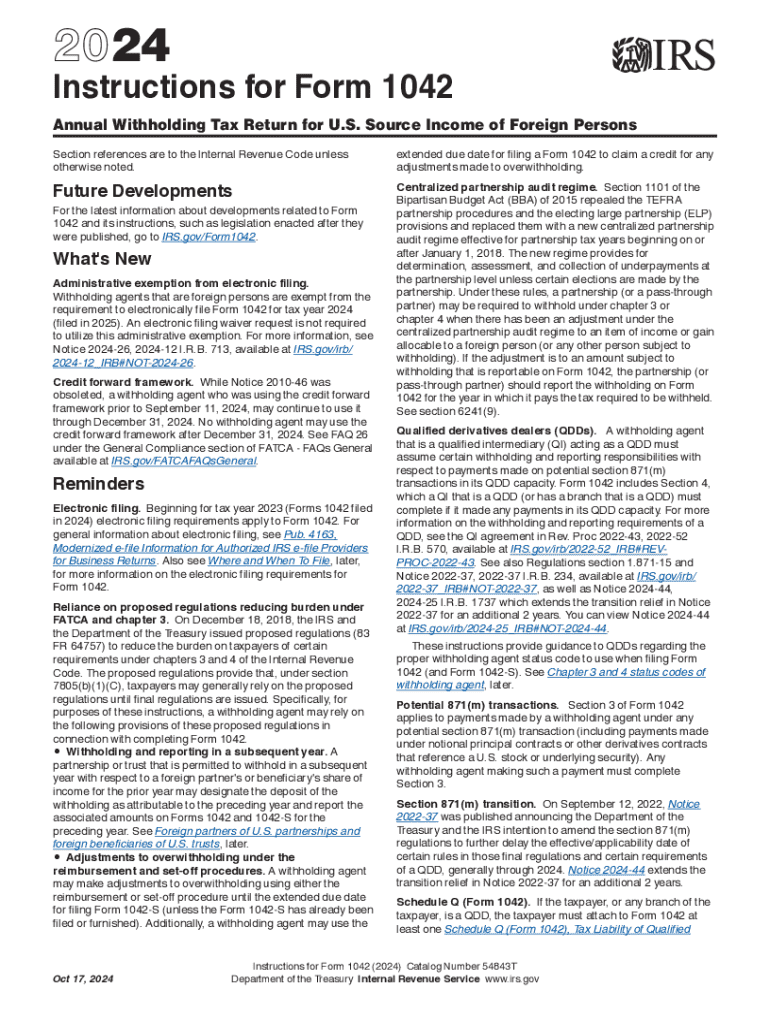
Form 1042, commonly referred to as the "Annual Withholding Tax Return for U.S. Source Income of Foreign Persons," is used by withholding agents to report payments made to foreign persons, including interest, dividends, royalties, and other types of U.S. source income. The form documents the total amount of income subject to withholding, the amount withheld, and any adjustments necessary throughout the year. Withholding agents are typically U.S. financial institutions or any entity that controls, receives, or pays income to a foreign person. Understanding its implications is crucial as it affects tax compliance and reporting accuracy.
Steps to Complete the Instructions for Form 1042
-
Review the Income Details: Begin by gathering information about the U.S. source income paid to foreign persons during the tax year. This includes interest, dividends, rents, royalties, and similar income.
-
Calculate Withholding Amounts: Determine the amount that should have been withheld according to IRS regulations. This helps in assessing overwithholding or underwithholding conditions.
-
Fill Out the Required Fields: Enter the appropriate information into each field, ensuring accuracy in amounts and correct identification of recipients.
-
Adjust for Overwithholding/Underwithholding: If any discrepancies are found between expected and actual withholding amounts, make necessary adjustments on the form.
-
Verify All Entries: Double-check all figures and recipient details to ensure there are no errors before submission.
-
Submit the Form: Choose whether to file electronically or via mail, ensuring compliance with IRS submission guidelines.
Who Typically Uses the Instructions for Form 1042
Form 1042 is primarily utilized by withholding agents such as financial institutions, businesses making royalty payments, or any entity with control over U.S source income payable to foreign individuals. This includes:
- Banks: Handling interest payments to non-U.S. residents.
- Multinational Corporations: Paying dividends to foreign shareholders.
- Real Estate Companies: Distributing rental income to overseas entities.
- Individual Business Owners: With U.S. source royalties directed to foreign owners.
Each entity must understand its responsibility in ensuring accurate withholding and reporting for tax compliance.


Key Elements of the Instructions for Form 1042
- Identification Section: Clearly state the withholding agent's name, address, and other identifying information.
- Income Reporting: Specify the types and amounts of income subject to withholding.
- Withholding Calculation: Detail the total withholding amount calculated over the tax year.
- Adjustments and Credits: List any justifiable adjustments related to overwithholding or underwithholding.
- Certification: Include a signature from an authorized agent certifying the form's accuracy.
These components contribute to the overall compliance with IRS regulations and accurate tax reporting.
IRS Guidelines
IRS guidelines provide the framework for filling out Form 1042, detailing:
- Who Must File: Any withholding agent making U.S source income payments to foreign persons.
- Filing Thresholds: Define situations requiring a return, based on the amount and type of income.
Following IRS guidelines ensures compliance, reducing the risk of penalties attributable to misreporting or non-compliance.
Filing Deadlines / Important Dates
The Form 1042 must be filed by March 15 of the year following the calendar year in which the income was paid. If this date falls on a weekend or public holiday, the deadline extends to the next business day. Timely filing is crucial to avoid penalties, which can include fines for late submission or incorrect reporting.
Penalties for Non-Compliance
Failure to accurately complete or submit Form 1042 can lead to significant financial penalties. These can encompass:
- Late Filing Fees: Imposed for any delay in the return’s submission past the deadline.
- Incorrect Information: Fines for inaccuracies in reported withholding or income amounts.
- Failure to Withhold: Additional penalties for not withholding the correct amount of tax when required.
Ensuring compliance with deadlines and reporting standards is crucial to mitigate these risks.
Taxpayer Scenarios
Different taxpayer scenarios necessitate unique approaches:
- Self-Employed Individuals: Attending international clients receiving U.S income.
- Retirees Abroad: Drawing pensions from U.S. sources or investments.
- Students: Receiving scholarships or grants as foreign nationals.
Each scenario underlines the importance of understanding specific withholding and reporting obligations under IRS guidelines.

Business Entity Types
Form 1042 is relevant to various business entities, including:
- Limited Liability Companies (LLCs): Engaged in cross-border transactions.
- Corporations: Paying dividends to foreign investors.
- Partnerships: With foreign partners, distributing U.S source partnership income.
Comprehending these distinctions ensures each entity accurately fulfills its withholding tax obligations.
Digital vs. Paper Version
While the IRS allows both digital and paper submissions, filing electronically is encouraged due to streamlined processing and reduced error rates. Digital submissions often integrate easily with software solutions used by businesses and filing agents for better efficiency and data safety. Understanding differences in submission methods informs the decision on the most effective approach for compliance.
Software Compatibility
Form 1042 can be completed using various tax software, such as TurboTax and QuickBooks, enhancing accuracy and efficiency. These programs:
- Automate Calculations: Ensuring precise withholding figures and reducing manual errors.
- Provide Step-by-Step Guidance: For proper form completion and submission.
By integrating form completion with these platforms, entities can streamline their tax workflow and enhance compliance.




