01. Edit your ohio contractors form online
Type text, add images, blackout confidential details, add comments, highlights and more.

Type text, add images, blackout confidential details, add comments, highlights and more.

Draw your signature, type it, upload its image, or use your mobile device as a signature pad.

Send sales and use tax contractors exemption certificate via email, link, or fax. You can also download it, export it or print it out.
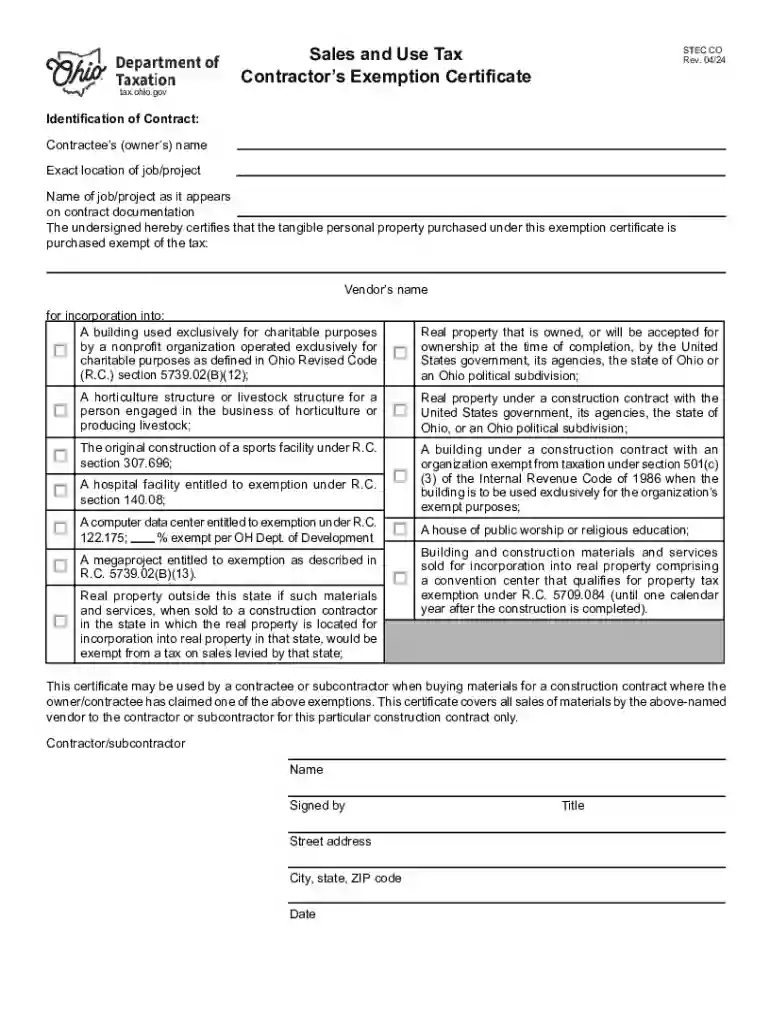
The Ohio Sales and Use Tax Contractor's Exemption Certificate is a specialized form issued by the Ohio Department of Taxation. This certificate allows contractors and subcontractors to purchase tangible personal property without paying state sales tax. It is specifically designed for construction projects with tax-exempt statuses, such as those related to charitable organizations, government entities, hospitals, and data centers. This exemption ensures that contractors can acquire materials more affordably, enhancing project feasibility and completion efficiency.
For instance, when a contractor is hired to build a new wing for a charitable hospital, the Ohio Sales and Use Tax Contractor's Exemption Certificate allows the contractor to purchase construction materials tax-free, thereby reducing the overall project costs. Similarly, a subcontractor working on a state government office renovation can benefit from this certificate to avoid sales tax on materials, aligning with the project's tax-exempt status.
Using the Ohio Sales and Use Tax Contractor's Exemption Certificate involves several steps to ensure compliance and proper utilization:
Identify Eligible Projects: First, determine if your construction project qualifies for tax exemption. Eligible projects typically include those for charities, government entities, or certain facilities like hospitals.
Official Completion: Fill out the exemption certificate accurately. You must include relevant details about the project, such as the name of the exempt entity and project description.
Submit to Vendors: Present the completed certificate to your materials suppliers. By doing so, they can apply the exemption to qualifying purchases.
Record-Keeping: Maintain a copy of the certificate for audit purposes. Ohio law requires contractors to keep detailed records to substantiate tax-exempt purchases.
Properly completing the exemption certificate is crucial:
Gather Information: Before starting, collect all necessary details about the project and the qualifying entity. This includes entity name, project type, and exempt status proof.
Fill Out the Form:
Sign and Date: The contractor or an authorized representative must sign and date the form. This signature verifies the information provided is accurate.
Submit for Validation: Some projects might require submission to the state for validation. Check Ohio’s specific guidelines to see if this step applies.
The certificate is a legal document aimed at facilitating tax-exempt transactions within specific parameters. It allows contractors to legally avoid sales tax on materials under conditions outlined by Ohio tax law.
Critical features of the certificate include:
Accurate information is paramount. Both contractors and suppliers rely on this data to process transactions correctly and legally.
To complete and use the form effectively, you might need:
Keep all documents organized and accessible. This ensures readiness for any review or audit by the Ohio Department of Taxation.
To use the Ohio Sales and Use Tax Contractor's Exemption Certificate, contractors must:


If uncertain about eligibility, contractors can consult with the Ohio Department of Taxation or a tax professional for verification and peace of mind.
Failure to comply with the appropriate use of the Ohio Sales and Use Tax Contractor's Exemption Certificate can lead to:
Ensure all uses of the certificate are justified and well-documented. Regular audits of internal records can preempt any state-initiated reviews and mitigate risks of penalties.
We've got more versions of the ohio contractors form form. Select the right ohio contractors form version from the list and start editing it straight away!
At DocHub, your data security is our priority. We follow HIPAA, SOC2, GDPR, and other standards, so you can work on your documents with confidence.