2024 Partner's Instructions for Schedule K-1 (Form 1065)-2026

Get Form
2024 Partner's Instructions for Schedule K-1 (Form 1065) Preview on Page 1

Here's how it works

01. Edit your form online
Type text, add images, blackout confidential details, add comments, highlights and more.

02. Sign it in a few clicks
Draw your signature, type it, upload its image, or use your mobile device as a signature pad.

03. Share your form with others
Send it via email, link, or fax. You can also download it, export it or print it out.

Definition & Meaning

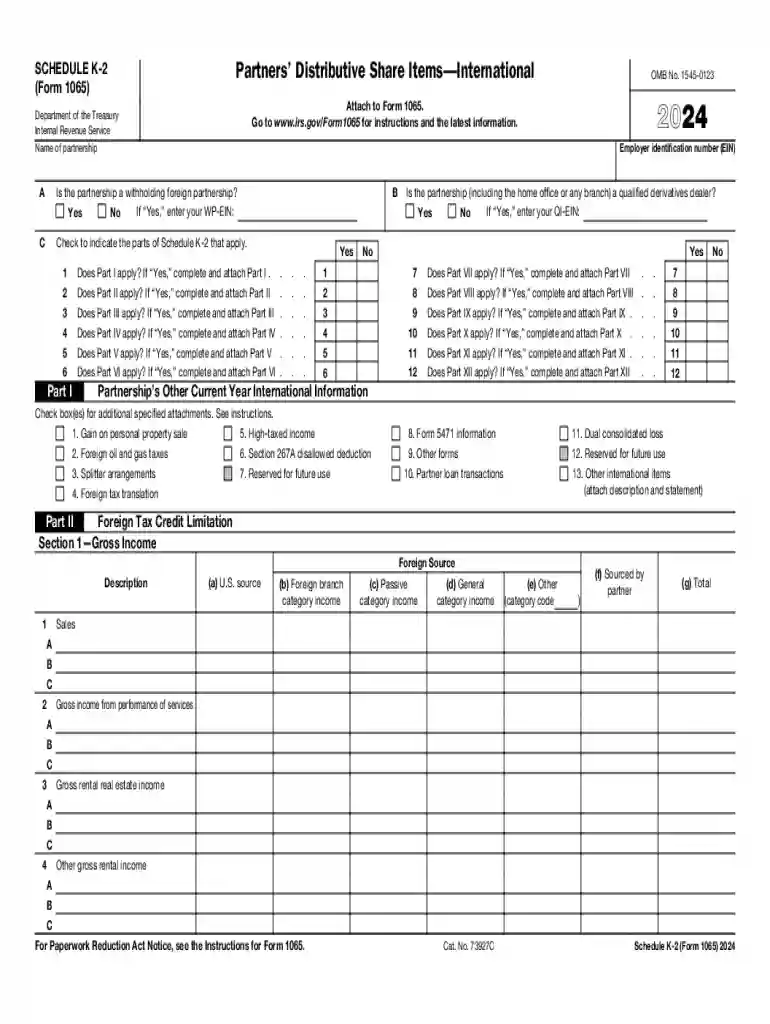
Schedule K-1 (Form 1065) is used to report a partner's share of income, deductions, credits, and other items from a partnership. The 2024 Partner's Instructions for Schedule K-1 accompany this form, offering detailed guidance on how to accurately report each section, ensuring compliance with federal tax requirements. This document is critical for both partnerships and individual partners, allowing transparent documentation of each participant's financial entitlements and obligations.

Practical Examples

  • For a partner who has invested in a tech startup, the Schedule K-1 would detail their share of any dividends or profits earned.
  • A real estate partnership would use this form to delineate rental income among property co-owners.

How to Use the 2024 Partner's Instructions for Schedule K-1 (Form 1065)

The instructions provide step-by-step guidance on completing your Schedule K-1, elucidating each line item you need to fill out.

Steps to Follow

  1. Identify your share of partnership income: Use the provided guidelines to calculate and report your share accurately.
  2. Report deductions and credits: Follow detailed procedures on how to account for deductions from business expenses and applicable credits.
  3. Review foreign transactions: The instructions clarify how to report any international financial activities, relevant for partnerships with overseas operations.

Key Elements of the 2024 Partner's Instructions for Schedule K-1 (Form 1065)

Several crucial components are detailed in the instructions, each impacting how partners complete their tax submissions.

Primary Sections

  • Income and Loss Items: Guidelines explain how to distribute different types of income, such as interest or rental income, and related losses.
  • Credits and Deductions: Instructions on how partners can claim their portion of credits such as the Foreign Tax Credit.
  • International Reporting: Directions for reporting info related to foreign investments and income, including PFICs and foreign corporations.

IRS Guidelines

The IRS provides foundational rules that you must follow when using the Schedule K-1.

Important Considerations

  • Accurate Accounting: Ensure all figures are precise and backed by evidence.
  • Timely Filing: Submit completed forms by applicable deadlines to avoid penalties.
  • Documentation: Maintain comprehensive records to support all reported items.

Required Documents

Partners need several documents and records to complete the Schedule K-1 accurately.

Essential Papers

  • Partnership Agreement: Provides details on profit distribution and obligations.
  • Financial Statements: Shows income and deductions for the fiscal year.
  • Prior Year Tax Returns: Useful for consistency in reporting consecutive years' data.

Filing Deadlines / Important Dates

Timeliness is critical in tax reporting to avoid penalties.

Key Dates

  • April 15, 2024: The typical deadline for filing returns using Schedule K-1.
  • March 15, 2024: Partnerships must provide copies to partners by this date.

Software Compatibility (TurboTax, QuickBooks, etc.)

Modern tax software can streamline the process of completing Form 1065 and its Schedule K-1.

Compatible Platforms

  • TurboTax: Provides features for importing partnership data directly into the software.
  • QuickBooks: Assists in generating necessary financial data aligned with IRS requirements.
  • H&R Block: Offers tools to navigate complex partnership tax scenarios.

Business Entity Types (LLC, Corp, Partnership)

Schedule K-1 is crucial for various business structures, particularly partnerships.

Relevant Structures

  • LLC taxed as a partnership: Members must use the form to report personal shares of income.
  • Traditional partnerships: Each partner requires a Schedule K-1 for tax filing purposes.
  • S-Corporations: Use a similar form named Schedule K-1 (Form 1120S) for shareholders.

Penalties for Non-Compliance

Failing to comply with filing requirements can lead to significant repercussions.

Consequences

  • Monetary Fines: Partners and partnerships may face financial penalties for missing deadlines or inaccuracies.
  • Legal Complications: Incorrect filings could trigger audits or legal scrutiny.
  • Loss of Tax Benefits: Missing out on deductions or credits due to improper reporting.
be ready to get more

Complete this form in 5 minutes or less

Get form

Got questions?

We have answers to the most popular questions from our customers. If you can't find an answer to your question, please contact us.
Contact us
The partnership must file one Form 1065 to represent the tax details of the business for the tax year. This partnership tax return is then used to prepare each Schedule K-1 for the partners to claim their share of the businesss income and loss on their individual tax returns.
Schedule K-1 is an IRS form used by partnerships, S corporations, and estates and trusts to declare the income, deductions, and credits that partners, shareholders, and beneficiaries have received in the tax year. Individual taxpayers transfer the financial information on their K-1s to their tax returns.
Schedule K-1 (Form 1065), Partners Share of Income, Deductions, Credits, etc. The partnership files a copy of Schedule K-1 (Form 1065) with the IRS to report your share of the partnerships income, deductions, credits, etc.
Partnership Income or Loss If you were a general or limited partner in a partnership, include on line 1a or line 2, whichever applies, the amount of net earnings from self-employment from Schedule K-1 (Form 1065), box 14, code A.
Do partners need to file a Form 1065? The partnership must file one Form 1065 to represent the tax details of the business for the tax year. This partnership tax return is then used to prepare each Schedule K-1 for the partners to claim their share of the businesss income and loss on their individual tax returns.

Security and compliance

At DocHub, your data security is our priority. We follow HIPAA, SOC2, GDPR, and other standards, so you can work on your documents with confidence.

Learn more
ccpa2
pci-dss
gdpr-compliance
hipaa
soc-compliance
be ready to get more

Complete this form in 5 minutes or less

Get form

People also ask

There are four main types of entities that are required to file a K-1: business partnerships. LLCs that have at least two partners or elect to be taxed as corporations. S corporations. trusts and estates.
Schedule K-1 is a schedule of IRS Form 1065, U.S. Return of Partnership Income. Its provided to partners in a business partnership to report their share of a partnerships profits, losses, deductions and credits to the IRS.
Schedule K-1 is a tax form required to be filed by several different types of business entities as part of their annual tax return. The person responsible for filing the K-1s is the person responsible for preparing the tax return: This may be an owner of the entity or an accounting professional.

Related links