




01. Edit your 1040c form online
Type text, add images, blackout confidential details, add comments, highlights and more.

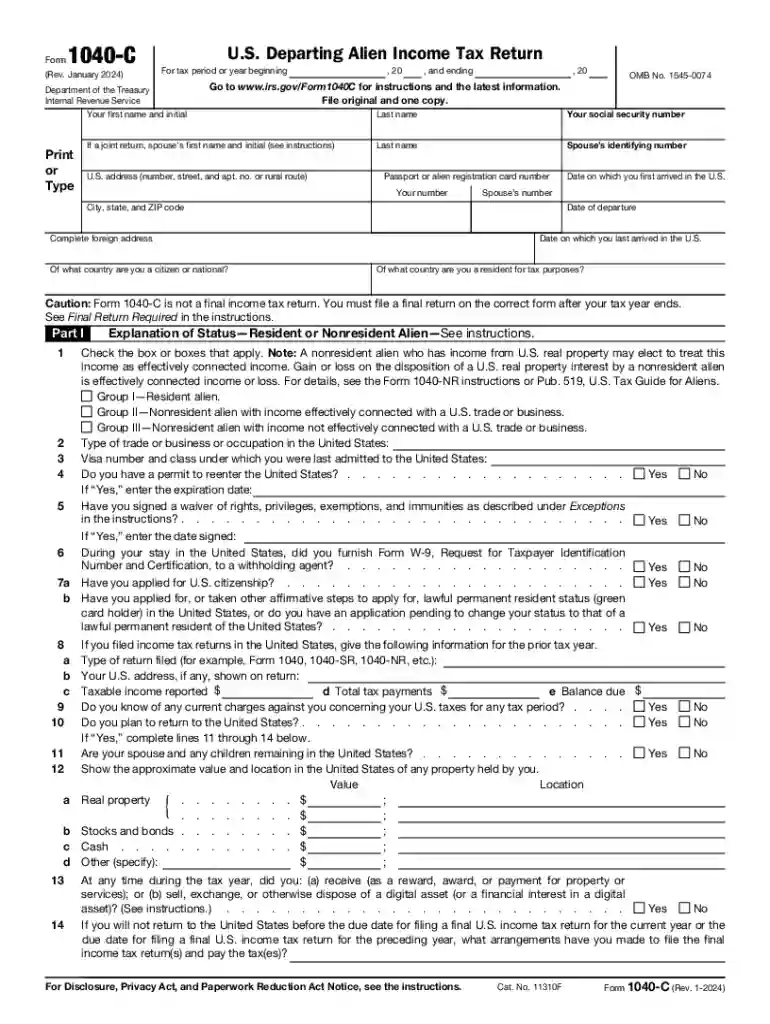
Type text, add images, blackout confidential details, add comments, highlights and more.

Draw your signature, type it, upload its image, or use your mobile device as a signature pad.

Send 1040c via email, link, or fax. You can also download it, export it or print it out.
Form 1040-C, also known as the U.S. Departing Alien Income Tax Return, is utilized by non-U.S. citizens who are departing the United States permanently or for an extended period. This form serves as a preliminary tax return, ensuring that any tax obligations are addressed before leaving the country. It includes sections for personal identification, income reporting, and applicable deductions, ensuring compliance with U.S. tax laws.
Form 1040-C caters to both resident and nonresident aliens, guiding them in reporting income earned while in the U.S. It acts as a bridge between their departure and the subsequent final tax return, which must be filed after the end of the tax year.
Gather Necessary Documents: Collect all income statements, such as W-2s or 1099s, and records of deductions and credits claimed. This ensures all financial information is accurately represented on the form.
Complete Personal Information: Fill in details such as your name, address, SSN or ITIN, and visa status. This helps the IRS identify your tax profile accurately.
Report Income Earned: Enter sources and amounts of income earned during your U.S. residency. Include wages, dividends, interest, and any other taxable income, ensuring all amounts align with provided documents.
Calculate Tax Liability: Use the form's instructions to compute your tax obligation. This involves determining your taxable income after deductions and applying the relevant tax rates.
Sign and Submit the Form: After reviewing your entries for accuracy, sign the form and submit it to the IRS prior to your departure. Ensure you understand the submission requirements, whether filing electronically or by mail.
The primary eligibility criteria for filing Form 1040-C include individuals classified as aliens (non-U.S. citizens) who plan to depart from the U.S. This includes resident aliens who no longer meet residency requirements and nonresident aliens who are concluding a temporary stay.
Another key factor is having earned income while residing in the U.S., which mandates reporting through this form. Additionally, eligible individuals must have an SSN or ITIN to file their tax return accurately.


Filing Form 1040-C must align with your departure schedule. It is essential to file before leaving the country to avoid complications with your tax records. Although there isn't a set calendar date, the timeline is dictated by the specific departure plans of the individual, necessitating careful coordination with the IRS.
Form 1040-C's legal mandate ensures compliance with U.S. tax obligations for departing aliens. The form's completion is crucial not only for settling tax liabilities but also for maintaining lawful exit from the U.S. under immigration guidelines. Misuse or failure to file appropriately can result in delays or penalties, emphasizing the importance of adhering to all form requirements.
Failing to file Form 1040-C before departing can result in significant penalties, including interest on unpaid taxes and potential legal actions. These penalties are designed to enforce compliance and ensure that all U.S.-based income is accounted for and taxed appropriately. It's vital to engage with the form requirements early in the departure planning process to avoid any last-minute issues or sanctions.
The IRS provides comprehensive guidelines to assist with understanding and completing Form 1040-C. These guidelines detail who must file, specific sections of the form, and instructions for accurately reporting income and deductions. Understanding these guidelines is critical to ensuring compliance and reducing the risk of errors in the tax filing process.
We've got more versions of the 1040c form form. Select the right 1040c form version from the list and start editing it straight away!
At DocHub, your data security is our priority. We follow HIPAA, SOC2, GDPR, and other standards, so you can work on your documents with confidence.





A Form 1040-C is not a final return. reporting your worldwide income. If you are an alien, you should not leave the United States. Departing Alien Income Tax
U.S. Departing Alien Income Tax Return 1040-C Form. You must file a final return on the correct form after your tax year ends. a resident alien, you may claim


