




01. Edit your form online
Type text, add images, blackout confidential details, add comments, highlights and more.

Type text, add images, blackout confidential details, add comments, highlights and more.

Draw your signature, type it, upload its image, or use your mobile device as a signature pad.

Send it via email, link, or fax. You can also download it, export it or print it out.
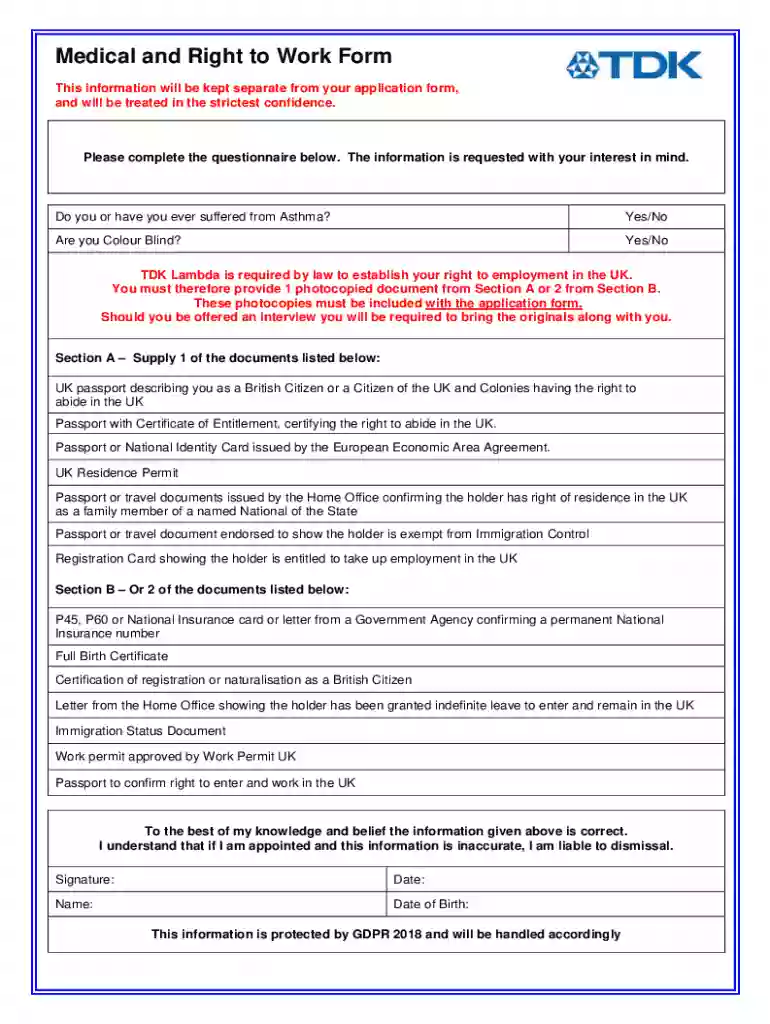
The Medical and Right to Work Form is a crucial document required by employers, particularly those like TDK Lambda in the UK, to ensure both medical compliance and verification of an applicant's legal right to work. The form comprises two main sections: a confidential medical questionnaire and documentation for right-to-work verification. The medical questionnaire typically addresses specific health conditions such as asthma and color blindness, ensuring that applicants can meet the physical demands of their role. The right-to-work section is divided into two parts, where applicants must provide either one document from Section A or two documents from Section B to verify their eligibility to work under UK law. This form is integral for aligning with legal employment standards and safeguarding employee welfare, while stringent adherence to GDPR 2018 regulations ensures the confidentiality and protection of personal information.
To effectively utilize the Medical and Right to Work Form, it's important to understand its dual function. First, applicants should complete the medical questionnaire honestly, providing detailed responses to ensure accurate health assessments. This information is kept confidential and is only used to evaluate if any adjustments or accommodations are necessary for the applicant's role. For the right-to-work verification, applicants need to provide the appropriate documentation that aligns with the requirements in Sections A and B. It's crucial to check the document's validity and relevance to your employment status in the UK. Employers should guide applicants through the process, ensuring clarity and accuracy in each section to avoid potential delays in the recruitment process.
Review the Form Thoroughly: Begin by familiarizing yourself with both the medical and legal sections of the form. Understand what information and documents are required.
Complete the Medical Questionnaire: Provide honest and comprehensive details about any health conditions requested, such as asthma or color blindness. This information is confidential and aids in evaluating your working conditions.
Gather Right-to-Work Documentation: Depending on your legal status, gather either one document from Section A or two documents from Section B. Ensure these documents are current and can sufficiently verify your right to work.
Fill Out Personal Details: Complete all required personal information fields accurately. Double-check for any errors or omissions.
Submit the Form: Once completed, submit the form to the designated department within the company. Make sure to follow any additional instructions provided for form submission.
Follow Up on Submission: After submission, confirm receipt with the employer and inquire about any further requirements or next steps in the employment process.
For the right-to-work verification, applicants need to present:
These documents must be valid and recognized under UK law, ensuring no disruptions in the employment process.
The form serves a legal purpose, enabling employers to comply with employment laws and regulations in the UK. It verifies that an employee is not only medically fit for the role but also legally authorized to work. The form aids businesses in maintaining compliance with immigration policies, mitigating the risk of penalties or legal issues associated with employing unauthorized workers. Ensuring the accurate completion and secure storage of this form is fundamental for both employer and employee under current employment standards.
This form is commonly used by applicants seeking employment within the UK, particularly in sectors where health assessments are critical, such as manufacturing or positions involving physical labor. Employers in industries that require strict adherence to legal and health regulations leverage this form to ensure workforce eligibility and productivity. HR professionals responsible for recruitment and compliance are primary users, as they guide, evaluate, and verify all submitted documentation and personal data according to company policy and legal standards.


In practice, companies like TDK Lambda implement this form during their onboarding process. For instance, an applicant for a technical maintenance role may be asked to complete this form to ascertain their fitness for operating machinery and their legal eligibility to work. The form ensures that no applicant is discriminated against based on health conditions, as long as they can safely and effectively fulfill job duties. Furthermore, it facilitates a streamlined onboarding process, allowing all necessary legal and health checks to be conducted efficiently and systematically.
At DocHub, your data security is our priority. We follow HIPAA, SOC2, GDPR, and other standards, so you can work on your documents with confidence.

The Family and Medical Leave Act (FMLA) is a federal law that provides eligible employees with job-protected leave for qualifying family and medical reasons.Read more
This form is used to record efforts made to search for work within the claimants medical restrictions and with the assistance of an agency or employmentRead more


