
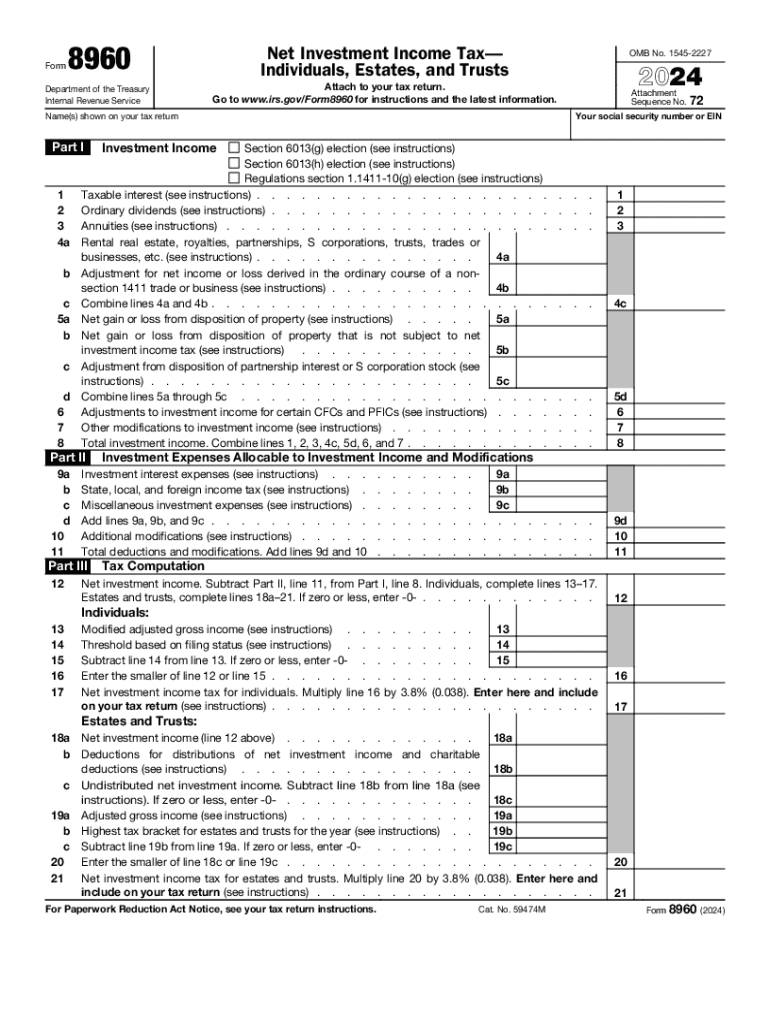







Definition and Meaning of 2024 Form 8960
The 2024 Form 8960, titled "Net Investment Income Tax for Individuals, Estates, and Trusts," is issued by the Internal Revenue Service (IRS) to calculate and report the Net Investment Income Tax (NIIT). This tax generally applies to individuals, estates, and trusts with significant investment income and is an additional levy on investment income above specific income thresholds. The form requires taxpayers to detail various types of investment income, deductions, and relevant expenses, ensuring accurate tax computation. The NIIT, also known as the Medicare surtax, was established to assist in funding healthcare programs, underlining its public service orientation.
How to Use the Form
Completing Form 8960 involves detailed steps that necessitate careful attention to ensure accurate reporting:
-
Gather Necessary Documentation: Have all financial documents ready, including dividend statements, interest income, and records of capital gains and losses.
-
Calculate Total Investment Income: Summarize all forms of investment income accrued during the taxable year, including dividends, capital gains, interest, rental income, and any other applicable sources.
-
Deduct Applicable Expenses: Review and deduct expenses directly related to generating the investment income, as noted on the form, ensuring that only allowable expenses are included.
-
Follow Specific IRS Instructions: Adhere to IRS instructions for determining deductions and calculating the total net investment income for the taxable year.
-
Determine Applicable Tax: Apply the 3.8% NIIT to your net investment income as calculated, or to the excess of your modified adjusted gross income over the applicable threshold, whichever is less.
How to Obtain the Form
The 2024 Form 8960 can be accessed through several reliable methods:
- IRS Website: The form is available for download directly from the IRS official website, ensuring you have the latest version.
- Tax Software: Most tax filing software programs include Form 8960 as part of their package, offering both digital and printable options.
- Professional Tax Preparers: Engage a certified public accountant or tax preparer, who will provide the form as part of their service.
Steps to Complete the Form
To ensure proper completion of the form, follow these steps meticulously:
-
Fill Out Personal Information: Begin with your full name, Social Security Number (SSN), and address.
-
Report Investment Income: Use Part I to report the specifics of your investment income, itemizing each source as required.
-
Claim Deductions: Utilize Part II to document investment-related deductions and expenses, adhering strictly to IRS guidelines on eligible items.
-
Calculate Net Investment Income: Subtract deductions from the total income to arrive at your net investment income amount.
-
Compute Tax Owed: In Part III, use the calculated net investment income to determine the tax owed, applying the appropriate NIIT rate.
-
Attach to Tax Return: Once completed, attach Form 8960 to your primary tax return (Form 1040, 1041, etc.) as part of your annual tax filing.
Who Uses the Form
Form 8960 is primarily used by:
- High-Income Individuals: Taxpayers exceeding set income thresholds with significant investment portfolios.
- Estates and Trusts: Entities collecting investment income on behalf of beneficiaries must report this using the form.
- Executors or Administrators: Those managing estates or trusts need to accurately report income to fulfill legal obligations and avoid penalties.
Important Terms Related to the Form
Understanding key terms is crucial for accurately completing the form:
-
Net Investment Income (NII): Encompasses interest, dividends, capital gains, rental and royalty income, and certain non-qualified annuities, with deductions factored in.
-
Modified Adjusted Gross Income (MAGI): An adjustment to your gross income, affecting your eligibility for NIIT.
-
Threshold Amounts: Specific income levels set by the IRS, exceeding which subjects individuals and entities to NIIT.
IRS Guidelines
Adhere strictly to IRS-provided guidelines to ensure compliance:
-
Deductions: Only claim deductions directly tied to the production of investment income.
-
Filing Thresholds: For individuals, the threshold is $200,000 ($250,000 if married filing jointly); ensure your income closes above these values to assess NIIT.
-
Exemptions and Exceptions: Note any specific exemptions such as income from tax-exempt bonds or IRA distributions.
Penalties for Non-Compliance
Non-compliance with Form 8960 can lead to the following consequences:
-
Financial Penalties: Fines accrue for unpaid taxes, interest, and penalties based on underreporting investment income.
-
Legal Repercussions: Chronic non-compliance can lead to audits or legal challenges from the IRS.
-
Future Filings: Accumulated penalties may influence future tax liabilities, complicating subsequent filings.
Ensure accurate and timely filing to mitigate the risk of these penalties.
Each section, detailed with comprehensive insights, will assist individuals, estates, and trusts in successfully completing and understanding their obligations related to Form 8960. Through precision and informed reporting, taxpayers can efficiently navigate the complexities of the Net Investment Income Tax.




