
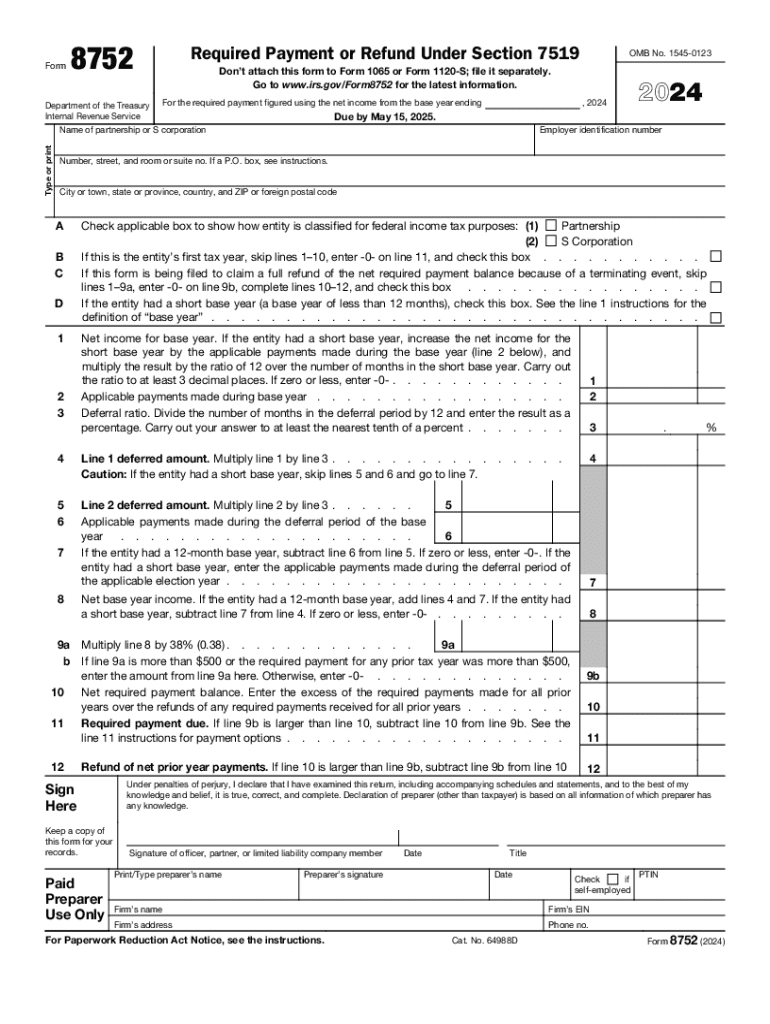







Overview of the 2024 Form 8752
Form 8752, known as the "Required Payment or Refund Under Section 7519," is a crucial document for partnerships and S corporations in the United States. It is used to determine the necessary financial transactions related to annual payments required under Section 7519 or to claim refunds for overpayments in previous fiscal years. This form must be filed separately from income tax returns, such as Forms 1065 or 1120-S, and plays a pivotal role in financial compliance for certain business entities.
Purpose and Significance
Why File the 2024 Form 8752?
Filing Form 8752 ensures that partnerships and S corporations accurately report and remit payments or claim refunds concerning the deferred income passes through to their owners. These financial settlements arise because specific entities may have fiscal years that do not align with the calendar year, thereby creating timing differences in recognizing income.
Core Benefits of Compliance
- Maintains regulatory compliance by adhering to IRS requirements.
- Avoids penalties and interest due to non-compliance or late payments.
- Facilitates efficient fiscal management by addressing deferred tax liabilities.
Step-by-Step Instructions
Completing the 2024 Form 8752
- Gather Financial Documentation: Collect records pertaining to your entity's net income for the base year and any prior year payments.
- Calculate Net Income: Use the instructions within the form to determine the net income that is subject to Section 7519.
- Determine Required Payments or Refunds: Follow the form's guidelines to compute the necessary payment to the IRS or identify if a refund is due.
- Submission Details: Ensure the form is filed by May 15, 2025, for the applicable election year beginning in 2024. Filing after this date may incur penalties or interest.
Key Elements
Essential Components of the Form
- Entity Information: Includes the name, address, Employer Identification Number (EIN), and fiscal year details.
- Payment Calculation: Detailed sections for computing required payment amounts based on income deferrals.
- Penalty Guidelines: Outlines potential penalties for inaccuracies or late submissions.
Filing Requirements
Required Documentation
- Financial statements for the base and prior years.
- Records of previous required payments or refunds.
Submission Options
- Online Submissions: Use the IRS electronic filing system.
- Mail-In Option: Send completed forms to designated IRS processing centers.
- In-Person Submission: Possible at IRS local offices, if necessary.
Eligibility Criteria


Who Should File the Form?
Partnerships and S corporations operating on a fiscal year that diverges from the calendar year must file Form 8752 when they have deferred income that requires payments or refunds adjustment.
Business Entity Types
- Partnerships: Any entity with multiple owners reported as partners.
- S Corporations: Pass-through entities that elect to report corporate income and losses on shareholders' personal tax returns.
Penalties and Compliance Risks
Non-Compliance Consequences
- Late Filing Penalties: Firms may incur financial penalties for failing to file by the specified deadline.
- Interest Charges: Accrued on late payments or underpayments if the form is not submitted timely.
State-Specific Considerations
Variations in State Laws
While Form 8752 is federally mandated, individual states may have additional requirements or separate forms to reconcile state-specific tax liabilities related to deferred income.
Examples and Scenarios
Real-World Applications
- Partnership Scenario: A partnership with a diverse group of investors might need to adjust its financials mid-year to accommodate deferred income that has been realized. Form 8752 provides a mechanism to address these adjustments efficiently.
- S Corporation Case Study: An S corporation that has recently changed its fiscal year to better align with business cycles will utilize Form 8752 to manage associated tax obligations accurately.
This comprehensive review addresses the most critical aspects of the 2024 Form 8752, ensuring that partnerships and S corporations grasp the necessary steps, requirements, and benefits associated with this essential financial document.


