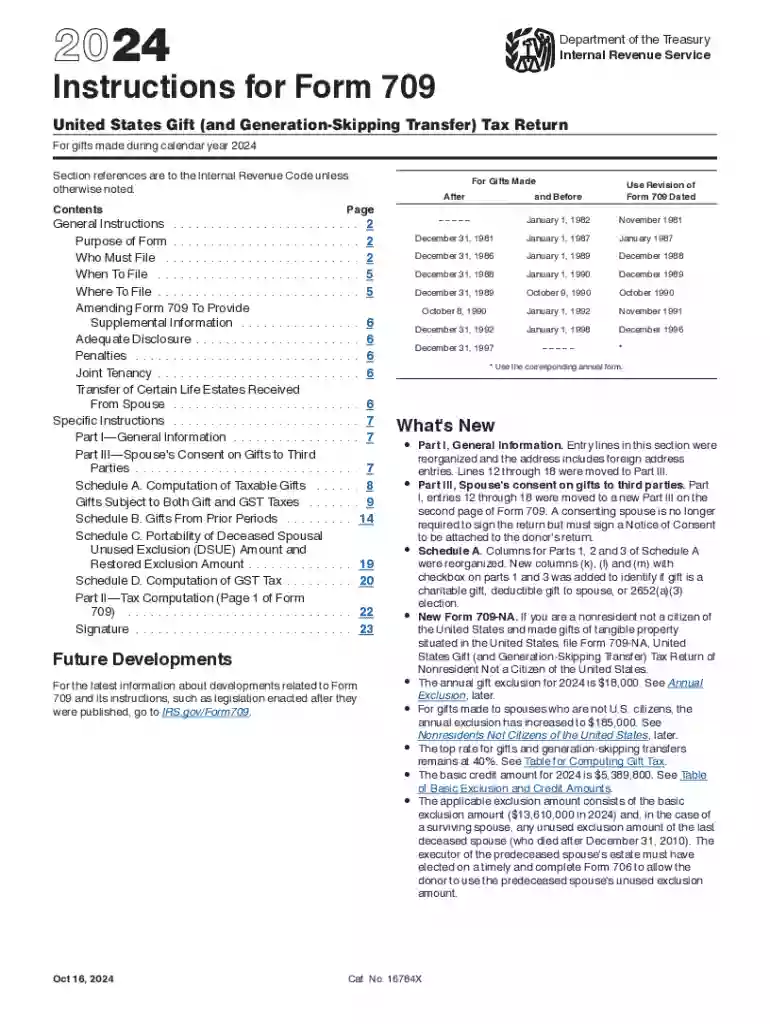
2024 Instructions for Form 709 Instructions for Form 709, United States Gift (and Generation-Skippin-2026

Get Form
irs form 709 Preview on Page 1

Here's how it works

01. Edit your irs form 709 online
Type text, add images, blackout confidential details, add comments, highlights and more.

02. Sign it in a few clicks
Draw your signature, type it, upload its image, or use your mobile device as a signature pad.

03. Share your form with others
Send instructions gift tax via email, link, or fax. You can also download it, export it or print it out.

Definition and Purpose of Form 709

Form 709, officially known as the United States Gift (and Generation-Skipping Transfer) Tax Return, is a federal tax form used to report gifts and generation-skipping transfers. The form is used to relay essential details about gifts made during the tax year to ensure compliance with U.S. tax law. The form's primary purpose is to calculate the total gift tax liability, taking into account the annual exclusions and lifetime exemption limits provided by the IRS.

  • Gift Definition: A gift is any transfer to an individual, directly or indirectly, where full consideration (measured in money or money's worth) is not received in return.
  • Generation-Skipping Transfer: This involves transfers to beneficiaries who are two or more generations below the donor, like grandchildren.

Steps to Complete Form 709

Filling out Form 709 requires detailed information on each gift, with accuracy being critical. Follow these steps to complete the form effectively:

  1. Gather Information: Collect all relevant information regarding the gifts, including dates, recipients, and amounts.
  2. Part 1: Donor Information: Fill in your personal information, such as name, address, and Social Security number.
  3. Schedule A: Report all gifts made during the year, specifying the kind and monetary value of each gift.
  4. Part 2: Tax Computation: Calculate the total gift tax, factoring in any exclusions and deductions.
  5. Signature: Ensure the form is signed and dated before submission.

IRS Guidelines

The IRS provides detailed guidelines for completing Form 709, which help taxpayers understand their obligations and submit accurate information. These guidelines include:

  • Annual Exclusion Limits: For 2024, the annual exclusion for gifts is $17,000 per recipient.
  • Lifetime Exemption: As of 2024, the lifetime exemption amount stands at $12.92 million.
  • Spousal Gifts: Generally, gifts between spouses are not subject to gift tax.

Filing Deadlines and Important Dates

Understanding the timeline is crucial when dealing with tax documents like Form 709 to avoid penalties.

  • Standard Deadline: Typically, Form 709 is due on April 15th of the year following the gift tax year. For 2024, ensure filing by April 15, 2025.
  • Extensions: A six-month extension can be filed using Form 8892, aligning with the personal tax return extension if necessary.

Who Typically Uses Form 709

Form 709 is primarily utilized by individuals who are transferring significant wealth and want to stay compliant with tax regulations.

  • Estate Planners: Professionals assisting clients in estate planning to minimize tax liabilities.
  • High Net-Worth Individuals: Those with substantial estates who regularly gift assets are required to file.
  • Families Incorporating Generation-Skipping Strategies: Households leveraging trust setups to reduce tax burdens on transfer of wealth across generations.

Important Terms Related to Form 709

Familiarity with tax-related terminology is crucial when dealing with Form 709.

  • Gift Tax: A federal levy on transfers deemed gifts, not compensated through any service or goods.
  • GST Tax: Generation-Skipping Transfer tax pertains to direct skips or transfers to generations two or more below the donor.
  • Unified Credit: A federal tax credit that applies to both gift and estate taxes, allowing for a substantial tax-free lifetime gifting amount.

Penalties for Non-Compliance

Non-compliance with Form 709 filing requirements can result in severe penalties, emphasizing the need for conscientious completion.

  • Late Filing Penalties: Failing to file or pay taxes due can incur additional charges, often a percentage of the unpaid tax.
  • Inaccuracies: Deliberate understatement or misrepresentation can lead to audit risks and additional fines.

Required Documents

Indispensable documentation is necessary to validate entries made in Form 709.

  • Appraisals: Reliable third-party assessments of gift values, especially for non-cash items.
  • Proof of Disbursement: Bank statements, transfer records, or gift receipts confirming transactions.
  • Prior Year Filings: Previous Form 709 filings to confirm lifetime exemption usage and ongoing transactions.

Software Compatibility for Form 709

To streamline the process of completing Form 709, leveraging technology tools designed for tax preparation can be beneficial.

  • TurboTax and H&R Block: Popular tax software options offering guided processes to fill out Form 709.
  • Professional Tax Systems: Solutions like Lacerte provide advanced features for estate planning advisors.

By implementing these detailed insights and following outlined procedures, taxpayers can ensure compliance, accuracy, and maximum efficiency in reporting under the 2024 Instructions for Form 709.

be ready to get more

Complete this form in 5 minutes or less

Get form

Got questions?

We have answers to the most popular questions from our customers. If you can't find an answer to your question, please contact us.
Contact us
The federal estate tax applies to the transfer of property at death. The gift tax applies to transfers made while a person is living. The generation-skipping transfer tax is an additional tax on a transfer of property that skips a generation.
The annual federal gift tax exclusion allows you to give away up to $18,000 each in 2024 to as many people as you wish without those gifts counting against your $13.61 million lifetime exemption. (After 2024, the $18,000 exclusion may be increased for inflation.)
What Triggers the Generation-Skipping Transfer Tax? The generation-skipping transfer tax is triggered when a person gifts another person an asset but skips a generation in doing so.
Money in a GST can go to grandchildren, grandnieces, grandnephews, or anyone who is at least 37.5 years younger than the grantor.
Since 2001, the exemption has matched the federal estate tax exemption, meaning for 2024, its $13,610,000 per person or $27,220,000 for a married couple. The exemption will grow each year, based on inflation.

Security and compliance

At DocHub, your data security is our priority. We follow HIPAA, SOC2, GDPR, and other standards, so you can work on your documents with confidence.
Learn more
ccpa2
pci-dss
gdpr-compliance
hipaa
soc-compliance
be ready to get more

Complete this form in 5 minutes or less

Get form

People also ask

Do I Have to Worry About the Gift Tax If I Give My Son $75,000 Toward a Down Payment? Unless you have given away more than $13.99 million in your lifetime, a $75,000 gift will not trigger the federal gift tax. Using this for a down payment also does not affect the result.
An inter vivos direct skip is a transfer made during the donors lifetime that is: Subject to the gift tax, Of an interest in property, and. Made to a skip person. (See Gifts Subject to Both Gift and GST Taxes, later.)
Having a permanent set of estate tax rules means that the shelf-life of an estate plan has suddenly risen from approximately 18 months to a reasonable multiple of years. Estate planning may now deal with generations rather than months or years.

how to file form 709