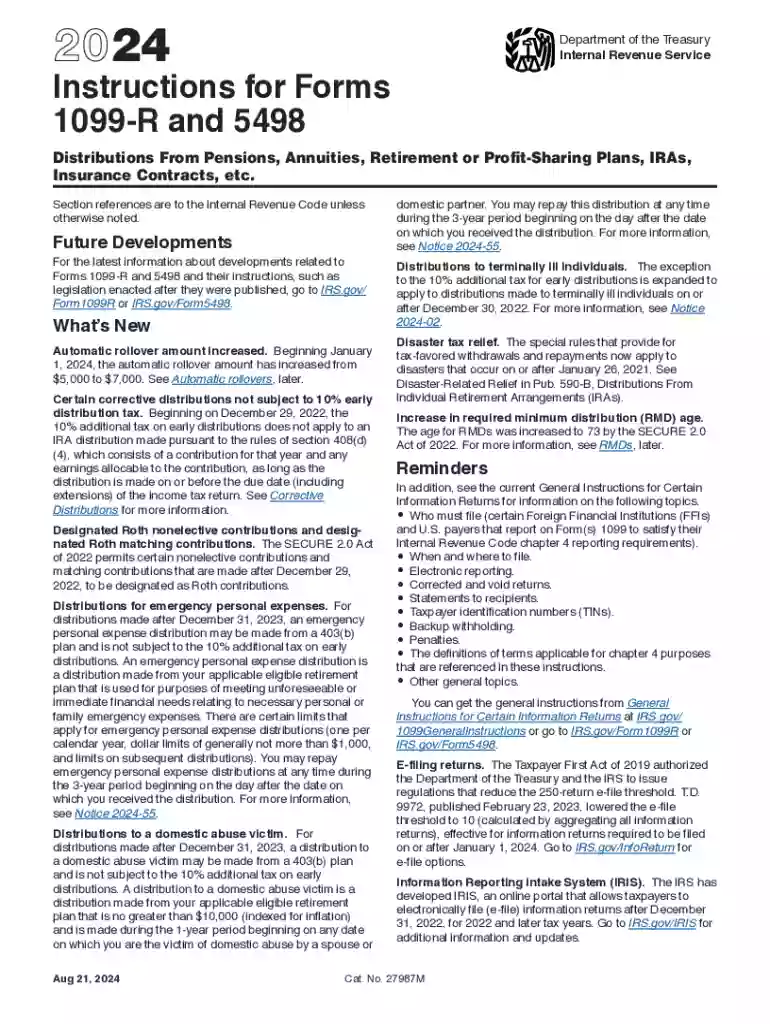
2024 Instructions for Forms 1099-R and 5498-2026

Get Form
r form 1099r Preview on Page 1

Here's how it works

01. Edit your r form 1099r online
Type text, add images, blackout confidential details, add comments, highlights and more.

02. Sign it in a few clicks
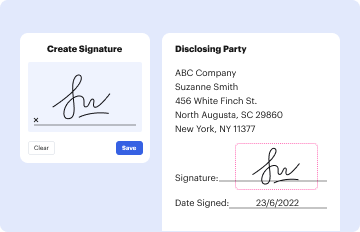
Draw your signature, type it, upload its image, or use your mobile device as a signature pad.

03. Share your form with others
Send form 1099r pdf via email, link, or fax. You can also download it, export it or print it out.

Definition and Meaning

The 2024 Instructions for Forms 1099-R and 5498 are essential guidelines provided by the Internal Revenue Service (IRS). These instructions offer comprehensive guidance on how to report distributions from pensions, annuities, retirement plans, and IRAs. Form 1099-R deals with reporting distributions, while Form 5498 focuses on contributions. These forms are critical for both individual taxpayers and financial institutions to accurately report and comply with tax regulations.

Importance of Forms 1099-R and 5498

  • Form 1099-R: Reports the total distributions from pensions, annuities, or retirement plans. It includes details such as the gross distribution amount and taxable amount.
  • Form 5498: Used to report IRA contributions, including rollovers and fair market value. It provides valuable information for both the IRS and individuals in planning their taxes.

Key Features

  • Updated to reflect changes in tax laws for 2024.
  • Provides detailed instructions on how to complete each section of the forms.
  • Essential for avoiding penalties and ensuring compliance with all federal tax requirements.

How to Use the 2024 Instructions for Forms 1099-R and 5498

Using the instructions effectively requires understanding the nuances and specific sections in detail. These instructions serve as a step-by-step guide to accurately filling out the forms.

Steps for Effective Usage

  1. Identify Relevant Sections: Begin by locating the specific sections relevant to your forms, such as distributions or contributions.
  2. Read Thoroughly: Ensure you understand each section's requirements, including definitions and examples provided in the instructions.
  3. Follow Step-by-Step Procedures: Use the procedures outlined to complete your forms correctly, focusing on fields like gross distribution and contributions.

Practical Tips

  • Refer to examples provided to understand complex sections.
  • Utilize the glossary to clarify technical terms or unfamiliar concepts.
  • Double-check each entry for accuracy to avoid common mistakes in filing.

Key Elements of the 2024 Instructions for Forms 1099-R and 5498

The key components of these instructions are designed to facilitate accurate reporting and compliance. They are comprehensive, covering all aspects of the forms.

Important Components

  • Distributions: Detailed instructions on how to report distributions, including corrective distributions and required minimum distributions.
  • Contributions: Guidance on reporting contributions, rollovers, and fair market values.
  • Tax Regulations Compliance: Emphasizes adherence to new tax laws for the 2024 tax year.

Detailed Breakdown

  • Understand the difference between taxable and non-taxable distributions.
  • Recognize exceptions to early distribution taxes to minimize penalties.
  • Learn about reporting rollover contributions accurately.

IRS Guidelines

Adhering to IRS guidelines is crucial for anyone using Forms 1099-R and 5498. These guidelines ensure tax compliance and accurate financial reporting.

Specific IRS Guidelines

  • Filing Requirements: Clarifies who needs to file and under what circumstances.
  • Electronic Filing: Guidelines for submitting forms electronically, which is encouraged for faster processing and greater accuracy.
  • Taxpayer Responsibilities: Explains what is expected from taxpayers and issuers in terms of timely and correct filing.

Electronic vs. Paper Filing

  • Electronic filing is preferred due to its efficiency and reduced error rates.
  • Paper filing is still an option but requires strict adherence to submission instructions to avoid processing delays.

Filing Deadlines and Important Dates

Recognizing critical filing deadlines ensures compliance and prevents penalties. The IRS specifies exact dates for submission each year.

Important Dates for 2024

  • Form 1099-R: Must be sent to recipients by January 31 and filed with the IRS by February 28 for paper submissions or March 31 for electronic submissions.
  • Form 5498: Typically due to the IRS by May 31, reflecting contributions through April 15 for the previous tax year.

Consequences of Late Filing

  • Penalties for missing deadlines can be significant, particularly for financial institutions.
  • Filing on time is essential to avoid interest and fines.

Who Typically Uses the 2024 Instructions for Forms 1099-R and 5498

Understanding who commonly uses these forms aids in ensuring they are filled out accurately and consistently.


decoration image ratings of Dochub

Typical Users

  • Financial Institutions: Required to file these forms to report client distributions and contributions.
  • Taxpayers: Individuals with distributions from retirement plans or pension holders.
  • Tax Professionals: Use the instructions to assist clients in accurately reporting income and contributions.

User Responsibilities

  • Financial institutions must provide accurate information to clients and the IRS.
  • Taxpayers need to review the forms for accuracy before filing.
  • Tax professionals interpret and apply instructions to assist with client filings.

Penalties for Non-Compliance

Failure to comply with the instructions can lead to penalties. Understanding these helps motivate timely and accurate filing.

Types and Implications of Penalties

  • Late Filing Penalties: Can range from modest to substantial, depending on the lateness and the reason for the delay.
  • Accuracy-Related Penalties: Imposed for errors or incorrect information.
  • Failure to File Penalties: Occur when required forms are not submitted, with penalties increasing over time.

Avoiding Penalties

  • Meet all filing deadlines as outlined in the instructions.
  • Ensure all data is verified and double-checked for accuracy.
  • Seek professional advice if uncertain about any filing requirements.

Taxpayer Scenarios

Different taxpayer scenarios require tailored approaches to using the instructions. Identifying your situation ensures the most accurate use of the form.

decoration image

Common Scenarios

  • Self-Employed Individuals: May have complex distribution scenarios requiring careful analysis.
  • Retirees: Typically have distributions from multiple retirement accounts.
  • Students or Young Workers: May be starting contribution journeys and need detailed guidance to understand implications.

Customized Guidance

  • Adjust reporting strategies based on individual or business tax circumstances.
  • Consider seeking professional guidance for complex reporting situations.

By following the detailed explanations and guidelines in these sections, individuals and entities can ensure that they adhere to IRS requirements and accurately report their financial activities related to forms 1099-R and 5498 for the 2024 tax year.

be ready to get more

Complete this form in 5 minutes or less

Get form

Got questions?

We have answers to the most popular questions from our customers. If you can't find an answer to your question, please contact us.
Contact us
Form 1099-R discloses both full and partial retirement distributions, including rollover contributions, and any taxable amounts. Form 5498 reports IRA contributions, amounts rolled over from other types of retirement accounts to your IRA, RMDs, and the FMV of the account at the end of the previous tax year.
Box 16 on the 1099-R is for state distributions. Many states require box 16 to be completed. If box 16 is blank you will enter the amount from box 2a. Box 2a is the taxable amount of the gross distribution. If box 2a is blank, and you havent made after-tax contributions to the account, you can use the amount in box 1.
The information on Form 5498 is submitted to the IRS by the trustee or issuer of your individual retirement arrangement (IRA) to report contributions, including any catch-up contributions, required minimum distributions (RMDs), and the fair market value (FMV) of the account.
You arent required to do anything with Form 5498 because its for informational purposes only. Please be sure to keep this form for your records as youll need this information to calculate your taxable income when you decide to take distributions from your IRA.
There is a separate input screen for Retirement Income (1099-R). You can located this on the Your Income page in FreeTaxUSA, in the Common Income section.

Security and compliance

At DocHub, your data security is our priority. We follow HIPAA, SOC2, GDPR, and other standards, so you can work on your documents with confidence.
Learn more
ccpa2
pci-dss
gdpr-compliance
hipaa
soc-compliance
be ready to get more

Complete this form in 5 minutes or less

Get form

People also ask

These distributions are reportable on Form 1099-R and are generally taxable in the year of the distribution (except for excess deferrals under section 402(g)). Enter Code 8 or P in box 7 (with Code B, if applicable) to designate the distribution and the year it is taxable.
Form 1099-R Instructions - A Detailed Look Box 1 is used to report the Gross Distributions. Box 2a is reserved for the taxable amount of the distribution. Box 2b is used to indicate the total distribution, if the amount in Box 1 is the total distribution, enter an x in Box 2b.
Box 2a, Taxable Amount: This is the portion of pre-tax money of your Gross Distribution (in Box 1). Any post-tax money distributed would be represented in Box 5. When combined, these two boxes should equal your total distribution in Box 1.

the 1099 r form