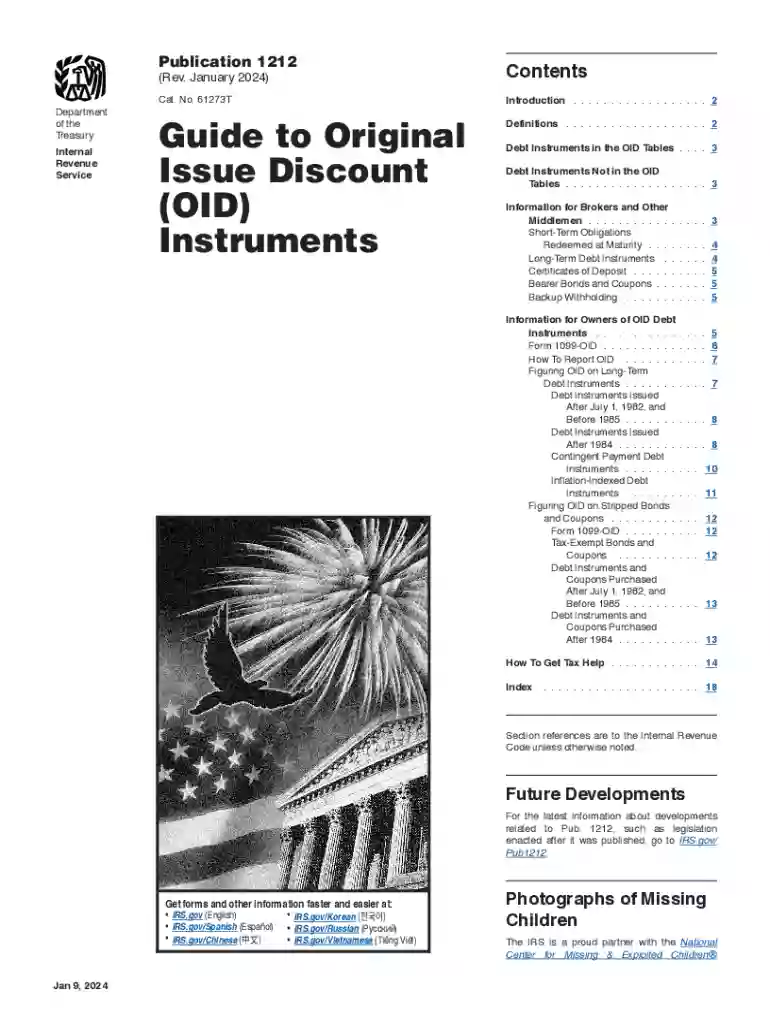
Publication 1212 (Rev January 2024) Guide to Original Issue Discount (OID) Instruments-2026

Get Form
publication 1212 Preview on Page 1

Here's how it works

01. Edit your publication 1212 online
Type text, add images, blackout confidential details, add comments, highlights and more.

02. Sign it in a few clicks
Draw your signature, type it, upload its image, or use your mobile device as a signature pad.

03. Share your form with others
Send publication 1212 pdf via email, link, or fax. You can also download it, export it or print it out.

Definition & Overview of Publication 1212

Publication 1212, an IRS guideline, is dedicated to Original Issue Discount (OID) debt instruments. This document is essential for understanding the definitions and intricacies associated with OID, which represents the discount at which a bond is issued compared to its face value. It details the process for computing OID and explains the nuances of reporting requirements. OID instruments encompass a variety of financial instruments, such as long-term and short-term obligations, stripped bonds, and tax-exempt bonds.

  • OID Instruments: Financial products like corporate or government bonds, which are issued at prices lower than their face values.
  • Purpose: Simplifies the complexities involved with tax handling for these instruments, ensuring taxpayers and brokers are compliant with IRS requirements.

How to Effectively Use Publication 1212

Publication 1212 serves as a comprehensive guide for taxpayers and financial professionals who engage with OID instruments. Its clear instructions allow users to accurately calculate and report OID-related income and deductions.

  1. Understand Reporting Requirements: A key component tailored for both bondholders and brokers detailing specific reporting obligations.
  2. OID Calculation: Instructions provided for calculating the OID over each tax year.
  3. Completing Tax Returns: Offers precise details on what information needs to be included when filing.

Obtaining Publication 1212

Securing a copy of Publication 1212 is straightforward and can be done via several methods:

  • IRS Website Download: Visit the official IRS website where a downloadable PDF version of the publication is available.
  • Request by Mail: Physical copies can be requested from the IRS should you prefer a hard copy for reference.

Steps to Complete the Guide

Efficiently using Publication 1212 involves several well-defined steps:

  1. Review Relevant Definitions: Start by understanding key terms such as OID, adjusted issue price, and yield to maturity.
  2. Identify Applicable Instruments: Determine which financial instruments fall under these guidelines.
  3. Calculate OID Yearly: Use provided formulas and examples to compute the discount over time.
  4. Report Accurate Figures on Tax Returns: Transpose calculated information to relevant tax forms precisely.

Typical Users of Publication 1212

Several individuals and entities would find Publication 1212 particularly useful:

  • Bond Investors: Those who invest in bonds that possess OID characteristics.
  • Financial Brokers: Required to report OID earnings information.
  • Tax Professionals: Those tasked with preparing returns for clients engaged with OID instruments.

Key Elements of Publication 1212

Several core elements are pivotal to understanding Publication 1212:

  • Definitions and Abbreviations: Clarity on jargon specific to OID.
  • Rules for Various Bonds: Diverse rules applicable to corporate, government, and municipal bonds.
  • OID Income Reporting: How and when income should be reported on tax returns.

IRS Guidelines on OID Reporting

The IRS provides specific guidelines and rules related to the reporting and handling of OID income:

  • Form 1099-OID Issuance: Brokers must provide this form to investors detailing OID income.
  • Tax Impact: Details on how OID affects your taxable income and potential deductions.

Filing Deadlines and Important Dates

Adhering to these dates is critical for compliance:

  • Annual Reporting: OID must be reported annually on your tax returns.
  • Record-keeping Requirements: Documentation supporting OID calculations should be retained for the duration stipulated by the IRS.

Penalties for Non-Compliance

Failure to adhere to OID reporting requirements can result in penalties:

  • Accurate Reporting Requirement: Inaccuracies in reporting can attract fines.
  • Timely Filing: Failure to report within deadlines can also result in penalties.

Digital versus Paper Considerations

Publication 1212 is accessible via both digital and traditional means, but choosing between them can affect your workflow:

  • Digital Advantages: Easier access and searchability; updates are immediate.
  • Paper Copies: Preferred by those who require offline access or wish to make physical annotations.
be ready to get more

Complete this form in 5 minutes or less

Get form

Got questions?

We have answers to the most popular questions from our customers. If you can't find an answer to your question, please contact us.
Contact us
Form 1099-OID is usually sent by a brokerage company that holds the debt instruments for investors that have OID.
The discount from the face value of a bond or other debt instrument at the time that it is issued. Under relevant tax rules, OID is the difference between the stated redemption price at maturity and the offering price.
OID is a form of interest. It is the excess of a debt instruments stated redemption price at maturity over its issue price (acquisition price for a stripped bond or coupon). Zero coupon bonds and debt instruments that pay no stated interest until maturity are examples of debt instruments that have OID.
You will receive a 1099-OID form if you have reportable original issue discount interest. Original issue discount is the excess of an obligations stated redemption price at maturity over its issue price, and it is taxable as interest over the life of the obligation.

Security and compliance

At DocHub, your data security is our priority. We follow HIPAA, SOC2, GDPR, and other standards, so you can work on your documents with confidence.

Learn more
ccpa2
pci-dss
gdpr-compliance
hipaa
soc-compliance