Definition & Meaning
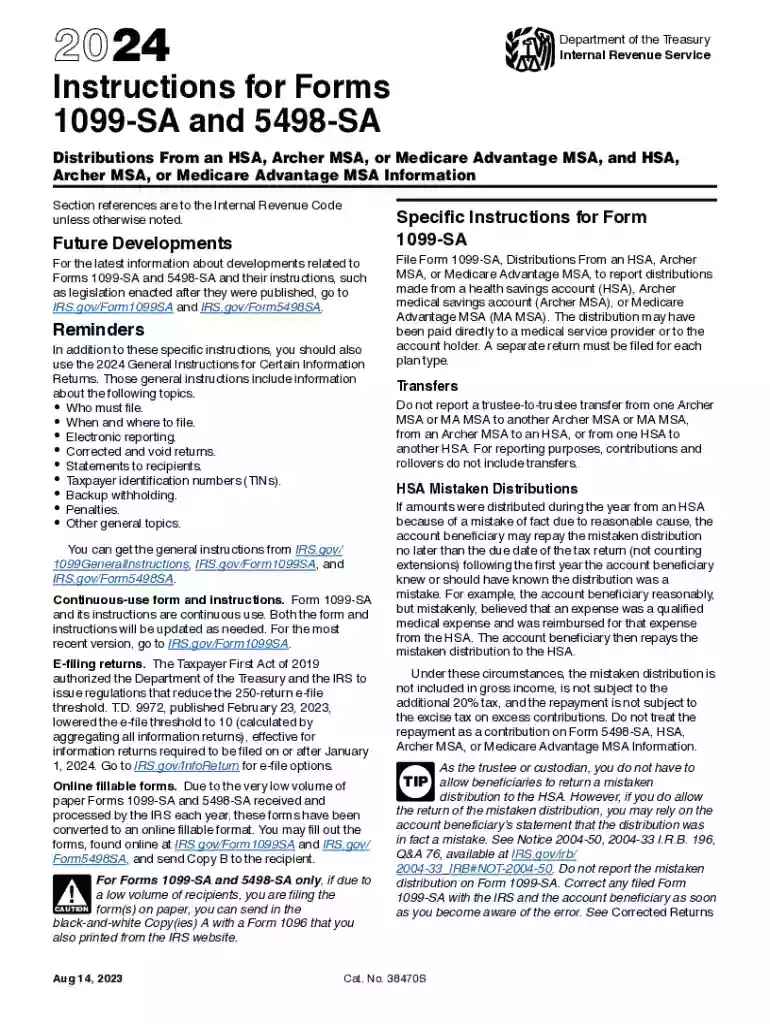
Form 1099-SA is used to report distributions from Health Savings Accounts (HSAs), Archer Medical Savings Accounts (MSAs), and Medicare Advantage MSAs. The Internal Revenue Service (IRS) requires this form to ensure that distributions from these accounts are reported accurately for tax purposes. Distributions may be taxable if they are not used for qualified medical expenses.
Important Terms Related to Form 1099-SA
Understanding key terms is crucial when dealing with Form 1099-SA:
- Qualified Medical Expenses: Costs incurred for medical services that can be covered by distributions without incurring a tax penalty.
- Custodian or Trustee: Financial institutions managing HSAs, Archer MSAs, or Medicare Advantage MSAs.
- Distribution Code: A code indicating the reason for a distribution, such as normal distributions or those due to the death of the account holder.
- Mistaken Distribution: An inaccurate withdrawal that can be corrected within a specific time frame.
Key Elements of the Form 1099-SA
The form includes several essential sections:
- Account Number: Identifier linked to the account from which funds are distributed.
- Gross Distribution: Total amount distributed from the account.
- Earnings on Excess Contributions: Interest accrued on any over-contributions to the account that must be included in taxable income.
- Distribution Code: Explanation for the type of distribution, such as normal or due to death.
Steps to Complete the Form 1099-SA
When completing Form 1099-SA, follow these steps for accuracy:
- Gather Required Information: Collect all necessary account details, including the account number and the name of the custodian or trustee.
- Enter Gross Distribution: Report the total amount distributed from the account during the tax year.
- Check Distribution Code: Select the appropriate code that describes the purpose of the distribution.
- Submit Form to the IRS and Recipient: Send copies to the IRS and the individual who received the distribution.
IRS Guidelines
The IRS provides specific instructions for filing Form 1099-SA:
- Reporting Requirements: Custodians must report all distributions, whether taxable or not.
- Electronic Filing: Electronic filing is mandatory for issuers submitting 250 or more forms.
- Statement to Recipients: Distribute form copies to recipients by January 31.
Filing Deadlines / Important Dates
Timeliness is critical with Form 1099-SA:
- Form Distribution: Custodians and trustees must provide recipients with their copy by January 31.
- IRS Submission: Forms should be sent to the IRS by February 28 if filed on paper, or by March 31 if filed electronically.
Penalties for Non-Compliance
Failing to comply with the IRS requirements for the Form 1099-SA may result in penalties:
- Late Filing: A penalty is imposed for failing to file by the deadline, with the amount depending on the form’s lateness.
- Incorrect Information: Providing inaccurate information may also result in fines.
- Intentional Disregard: Purposefully failing to submit the form incurs more severe penalties.
Examples of Using the Form 1099-SA
Practical scenarios for using Form 1099-SA include:
- Normal Distribution: Funds are withdrawn for qualified medical expenses with no tax penalty.
- Rollovers: Portions of distributions are rolled over to another eligible account.
- Death of an Account Holder: Distributions made due to an account holder's death are reported, influencing tax assessments.