




01. Edit your form online
Type text, add images, blackout confidential details, add comments, highlights and more.

Type text, add images, blackout confidential details, add comments, highlights and more.

Draw your signature, type it, upload its image, or use your mobile device as a signature pad.

Send it via email, link, or fax. You can also download it, export it or print it out.
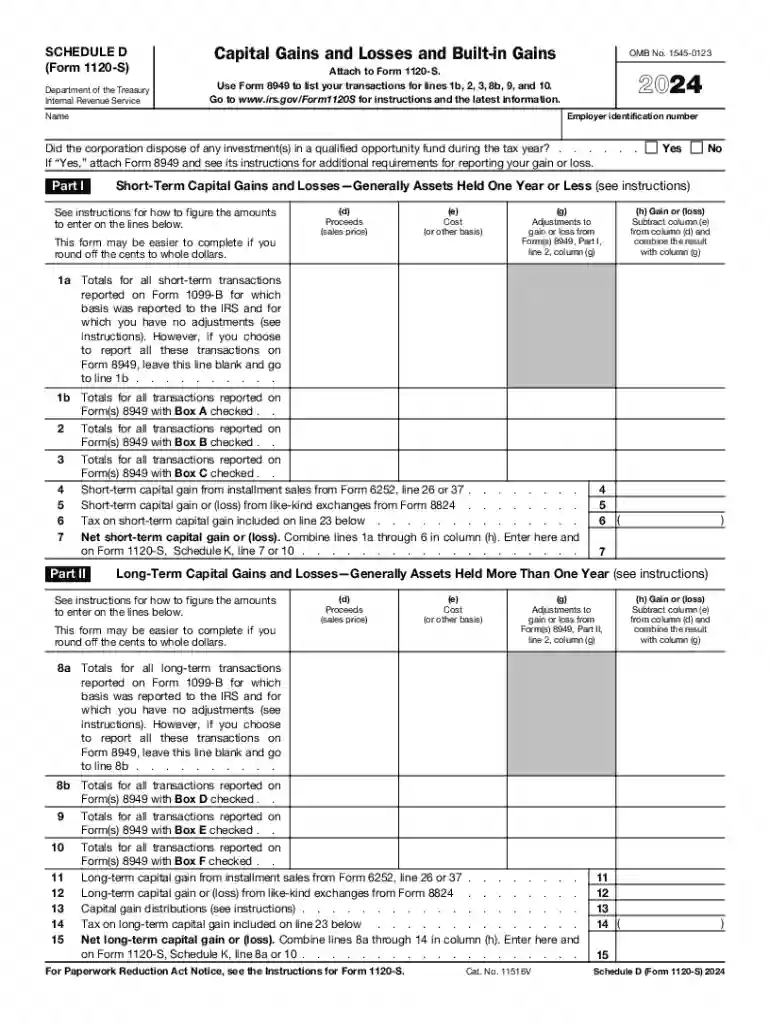
Schedule D (Form 1120-S) is a tax document used by S-corporations in the United States to report capital gains and losses incurred during the fiscal year. This includes short-term and long-term transactions, along with built-in gains. The form requires comprehensive details to ensure correct computation and reporting to the IRS.
Gather Necessary Information: Collect all relevant documentation including transaction dates, descriptions, and amounts involved in capital gains and losses.
Form 8949 Attachment: Utilize Form 8949 to report individual transactions, providing a detailed list of sales or exchanges that impact capital gains or losses.
Complete Short-Term and Long-Term Sections: Distinguish between short-term (held for a year or less) and long-term (held for more than a year) transactions, as this impacts tax calculations.
Calculate Built-In Gains: Determine any built-in gains using Part III of Schedule D, which may require further computations if the S-corporation has undergone an ownership change.
Final Review: Ensure all entries are accurate and correspond with Form 8949, reviewing for any discrepancies that could lead to filing errors.
Built-In Gains Tax Calculation: Includes sections that require specific computations for businesses converting from a C-corporation with preexisting gains.
Reporting Requirements: Addresses how to report gains and losses, adjustments from Form 8949, and the consolidated totals on the S-corporation's tax return.
Differentiation of Gains: Sectioned categorically for short-term and long-term capital assets to apply correct tax rules.
Annual Filing Deadline: Schedule D is typically filed along with the corporation’s annual tax return. The standard deadline is March 15 for S-corporations.
Extension Options: An automatic six-month extension can be requested, moving the deadline to September 15, but estimated taxes must still be paid by the original deadline.
Accuracy and Completeness: Ensure all reported figures are exact and supported by form attachments like Form 8949.
Federal and State Compliance: While primarily a federal filing requirement, taxpayers must be aware of additional state-specific reporting obligations.
The form is commonly used by:
S-Corporations: Corporations that have elected to pass income, losses, deductions, and credits through to their shareholders for federal tax purposes.
Business Owners: Individuals with interest or management responsibilities in an S-corporation needing to track and report capital gains.
Accountants and Tax Preparers: Professionals dedicated to preparing tax returns for businesses will frequently handle Schedule D (Form 1120-S) for their clients.
Failure to file on time or inaccurately reporting capital gains and losses can result in penalties, which may include:
Late Filing Penalties: Imposed if the S-corporation tax return is not filed by the deadline or extension date.
Underpayment Penalties: If estimated taxes are underpaid due to inaccurate capital gains reporting, additional charges could be accrued.
Amended Returns: Corrections post-filing can necessitate revised returns, potentially leading to further penalties if discovered after an IRS review.
Popular tax preparation software designed to assist with Schedule D filing includes:
TurboTax: Offers guided steps to simplify reporting capital gains and losses for S-corporations.
QuickBooks: Allows for tracking of financial transactions that can seamlessly integrate with tax preparation software.
H&R Block: Provides professional-grade platforms for both individual filers and businesses, streamlining form completion.
Examples of when Schedule D (Form 1120-S) comes into play include:
Self-Employed Business Owners: Reporting income derived from long-term investments.
Retirees with Investment Income: Understanding how gains and losses impact annual retirement income.
Real Estate Investors: Managing transition of properties within the S-corporation framework, necessitating capital gains tax considerations.
These sections should provide clarity and comprehensive insights into the many components of Schedule D (Form 1120-S), ensuring a clear understanding for U.S.-based business entities.


We've got more versions of the Instructions for Schedule D (Form 1120S), Capital Gains and form. Select the right Instructions for Schedule D (Form 1120S), Capital Gains and version from the list and start editing it straight away!
At DocHub, your data security is our priority. We follow HIPAA, SOC2, GDPR, and other standards, so you can work on your documents with confidence.



Schedule D is used by all S corporations to report (a) sales or exchanges of capital assets (defined below), (b) gains on distributions to shareholders
Oct 4, 2024 Use Schedule D to report the following. The overall capital gains and losses from transactions reported on Form 8949, Sales and Other


