
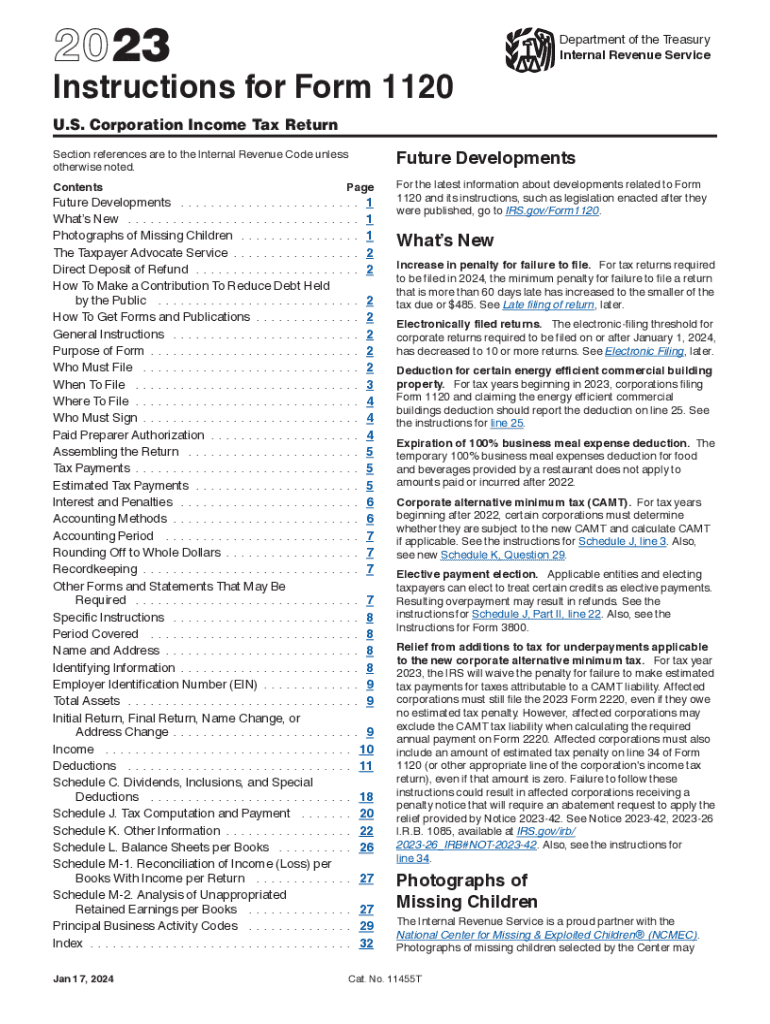







Definition and Purpose of Form 1120
Form 1120, known in full as the U.S. Corporation Income Tax Return, is a tax form used by corporations to report their income, gains, losses, deductions, and credits to the Internal Revenue Service (IRS). The form serves as a critical component for compliance with federal tax laws, providing the IRS with necessary financial information about a corporation's taxable income for a given tax year. It plays a vital role in determining the corporation's tax liability or potential refunds, contingent on tax payments made throughout the year.
Understanding Terminology
Several terms are commonly found within the 2023 Instructions for Form 1120. These include:
- Taxable Income: The portion of income that is subject to taxation after deductions and exemptions.
- Deductions: Expenses that a corporation can subtract from its gross income to reduce taxable income.
- Credits: Reductions in the tax liability owed, often offered as incentives for specific business activities, such as research and development.
- Rate Schedule: The graduated rate applied to determine the corporation's tax liability based on income brackets.
Steps to Complete Form 1120
Filing Form 1120 involves several detailed steps:
- Gather Documentation: Compile financial statements, including income statements and balance sheets.
- Calculate Gross Income: Sum up all revenue streams, including sales and investment income, to determine total gross income.
- Apply Deductions and Credits: Use available deductions and credits to reduce gross income, following the detailed instructions in the guidelines.
- Determine Tax Liability: Apply the appropriate tax rates to the taxable income based on the IRS-provided schedules.
- Final Review and Submission: Conduct a thorough review to ensure accuracy and submit the form via approved methods.
Filing Methods
The form can be submitted:
- Electronically via IRS-approved e-filing platforms, which often provide automatic confirmation of receipt.
- Mail by sending a completed paper form to the designated IRS processing center, as detailed in the instructions.
Key Elements of 2023 Form 1120 Instructions
The 2023 instructions outline several critical components necessary for accurate completion of Form 1120:
- Updated Tax Rules: Recent changes in tax legislation affecting corporate taxation should be carefully reviewed and applied.
- Recordkeeping Requirements: Adequate maintenance of financial records is essential, including documentation of all deductions and revenue.
- Filing Deadlines: Normally due by the 15th day of the fourth month after the end of the corporation's fiscal year, extensions may be available upon request.
Important IRS Guidelines and Penalties
Corporations must adhere to the IRS guidelines outlined in the instructions to avoid penalties:
- Timely Filing: Late submission may incur penalty fees, calculated as a percentage of unpaid taxes.
- Accurate Reporting: Misreported information or omission of critical details can result in additional fines or audits.
Penalties Overview
Penalties can include:
- Late Filing: Generally, five percent of the unpaid tax for each month or part of a month the return is late.
- Non-Payment: Interest and additional fines may accrue on any unpaid taxes.
Who Typically Uses Form 1120
Form 1120 is primarily used by:
- Domestic Corporations: Any U.S.-based corporation, except those required to file special forms (e.g., Form 1120-S for S corporations).
- Foreign Corporations: Operate a branch or have business activity generating income within the U.S.
- Other Legal Entities: Such as limited liability companies (LLCs) choosing to be taxed as corporations.
Business Entity Types and Eligibility
The form caters to various business entities:
- C Corporations: Required to separate business income and expenses from personal tax responsibilities.
- Non-Profit Corporations: While generally exempt from income taxes, must still file certain sections if engaged in taxable business activities.
- Partnerships and S Corporations: Usually exempt from filing Form 1120, using other specific forms instead.
Business Scenarios and Real-World Application
Practical examples demonstrating the application of Form 1120:
- Filing under a Fiscal Year: Companies with non-calendar fiscal years should adapt timelines accordingly.
- Handling Complex Revenue Streams: Businesses with diverse income sources, like royalties and dividends, need careful categorization.
Digital vs. Paper Filing
Digital filing advantages include:
- Efficiency: Fast, confirmation of filing and immediate correction capabilities.
- Integration: Compatibility with tax software like TurboTax, facilitating data transfer and error checking.
Qualifying to file online typically depends on IRS stipulations, such as gross income thresholds.




