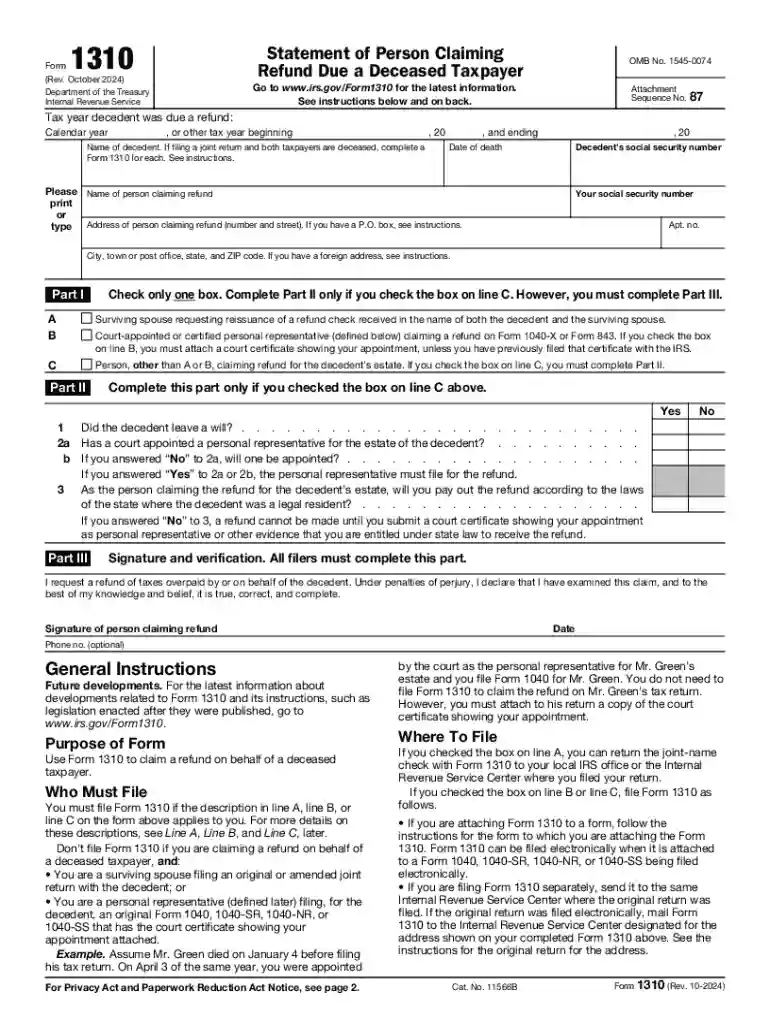
Form 1310 (Rev October 2024) Statement of Person Claiming Refund Due a Deceased Taxpayer-2026

Get Form
form 1310 Preview on Page 1

Here's how it works

01. Edit your form 1310 online
Type text, add images, blackout confidential details, add comments, highlights and more.

02. Sign it in a few clicks
Draw your signature, type it, upload its image, or use your mobile device as a signature pad.

03. Share your form with others
Send irs form 1310 via email, link, or fax. You can also download it, export it or print it out.

Definition and Purpose of Form 1310

Form 1310, officially known as the "Statement of Person Claiming Refund Due a Deceased Taxpayer," is a crucial document utilized by individuals seeking to claim a tax refund on behalf of a deceased taxpayer. This form serves to provide the necessary information for the Internal Revenue Service (IRS) to process such claims.

Key Aspects

  • Purpose: It ensures that refunds due to the taxpayer at the time of death are properly distributed to the rightful claimant.
  • Primary Users: Surviving spouses, personal representatives, and executors are typically the individuals who file this form.
  • Information Required: Includes the deceased taxpayer's name, social security number, date of death, and the claimant's relationship to the deceased.

Obtaining Form 1310

To acquire Form 1310, there are several accessible methods suitable for various preferences and technological capabilities.

Available Methods

  1. IRS Website: The form can be downloaded directly from the official IRS website. This is the most common method for obtaining the most current version.

  2. IRS Offices: Physical copies are available at local IRS offices for those who prefer a tangible format.

  3. Mail Request: Taxpayers can request a mailed copy by calling the IRS if they are unable to access it online.

Steps to Complete Form 1310

Completing Form 1310 requires careful attention to detail to ensure accurate processing by the IRS.

Instructions

  1. Identify the Deceased: Fill in the deceased's name, social security number, and date of death.

  2. Claimant's Information: Provide your name, address, and the relationship to the deceased.

  3. Reason for Claim: Select the appropriate checkbox which explains the reason for your claim, noting whether you are a surviving spouse or other representative.

  4. Signature: Ensure the form is signed and dated by the claimant to affirm its veracity.

Additional Tips

  • Double-check all entries for accuracy.
  • Attach any required supporting documents, such as a death certificate or court documents authorizing you as the representative.

Eligibility Criteria

Not everyone is eligible to submit Form 1310. Specific criteria must be met to ensure lawful submission.


decoration image ratings of Dochub

Qualifying Conditions

  • Relationship: Must be a surviving spouse, court-appointed personal representative, or legal representative such as an executor.
  • Documentation: Possess adequate documentation proving eligibility, such as a death certificate or court orders for representation.

Non-Qualifying Conditions

  • Individuals with no legal claim to the deceased’s estate or without requisite legal documentation will not qualify.

IRS Guidelines

The IRS provides specific guidelines to ensure that the claim process through Form 1310 is correctly executed.

Compliance Requirements

  • Submissions: Must be compliant with IRS deadlines, which typically align with the filing date for the final tax return of the deceased.
  • Accuracy: All information provided must be accurate, as discrepancies can delay processing and potential refunds.

Exceptions

  • In certain cases, if the deceased was due a sizeable refund, additional documentation may be required beyond Form 1310, depending on IRS determinations.

Filing Deadlines and Important Dates

Adhering to IRS deadlines is vital for the smooth processing of Form 1310 and avoiding complications or penalties.

Timelines

  • General Deadline: Typically, the form should be submitted when filing the final tax return of the deceased.
  • Extensions: In some cases, taxpayers may request an extension for filing the final return, directly impacting the submission of Form 1310.

Importance

Meeting these deadlines ensures timely processing of claims and minimizes delays in any refunds due.

Required Documents

Submission of Form 1310 often necessitates accompanying documentation to verify claims.

Necessary Documentation

  • Death Certificate: Confirms the taxpayer's passing.
  • Court Orders: If applicable, showing legal authority as a representative.
  • Identification: Valid ID proving the claimant's relationship and identity.

Document Handling

  • All documents must be authentic and submitted as per IRS guidelines to ensure validity and acceptance.

Penalties for Non-Compliance

The IRS enforces strict rules regarding the completion and filing of Form 1310, with penalties applicable for non-compliance.

Possible Consequences

  • Rejected Claims: Incomplete or incorrect forms may result in claim rejections.
  • Delayed Refunds: Failure to provide necessary documents can lead to significant processing delays.
  • Legal Repercussions: If false information is submitted, legal action may be taken against the claimant.

By adhering to these guidelines and understanding the nuances of Form 1310, claimants can effectively navigate the process of claiming refunds on behalf of deceased taxpayers, ensuring compliance with IRS regulations and facilitating smooth transactions.

be ready to get more

Complete this form in 5 minutes or less

Get form

Got questions?

We have answers to the most popular questions from our customers. If you can't find an answer to your question, please contact us.
Contact us
If a tax refund is due, the person claiming the refund must fill out IRS Form 1310: Statement of Person Claiming Refund Due to Deceased Taxpayer unless the person is a surviving spouse filing a joint return or a court-appointed personal representative.
Form 1310 is an IRS form used to claim a federal tax refund for the beneficiary of a recently deceased taxpayer. This one-page form notifies the IRS that a taxpayer has died and directs it to send the refund to the beneficiary.
Processing times can vary, but it typically takes several weeks for the IRS to process Form 1310 and issue a refund. What if the deceased taxpayer owes taxes? If the deceased taxpayer owes taxes, the amount due must be paid before any refund can be issued.
If the deceased was due to receive a tax refund, determining who is entitled to the money is a key issue for the surviving spouse, family members and estate representatives. In most cases, the IRS allows those legally responsible for the estate to claim the refund.
To get the refund, you must complete and attach Form 1310 to your fathers final return. You should check the box on line C of Form 1310, answer all the questions in Part II, and sign your name in Part III. You must also attach a copy of the death certificate or proof of death.

Security and compliance

At DocHub, your data security is our priority. We follow HIPAA, SOC2, GDPR, and other standards, so you can work on your documents with confidence.
Learn more
ccpa2
pci-dss
gdpr-compliance
hipaa
soc-compliance
be ready to get more

Complete this form in 5 minutes or less

Get form