




01. Edit your form online
Type text, add images, blackout confidential details, add comments, highlights and more.

Type text, add images, blackout confidential details, add comments, highlights and more.

Draw your signature, type it, upload its image, or use your mobile device as a signature pad.

Send it via email, link, or fax. You can also download it, export it or print it out.
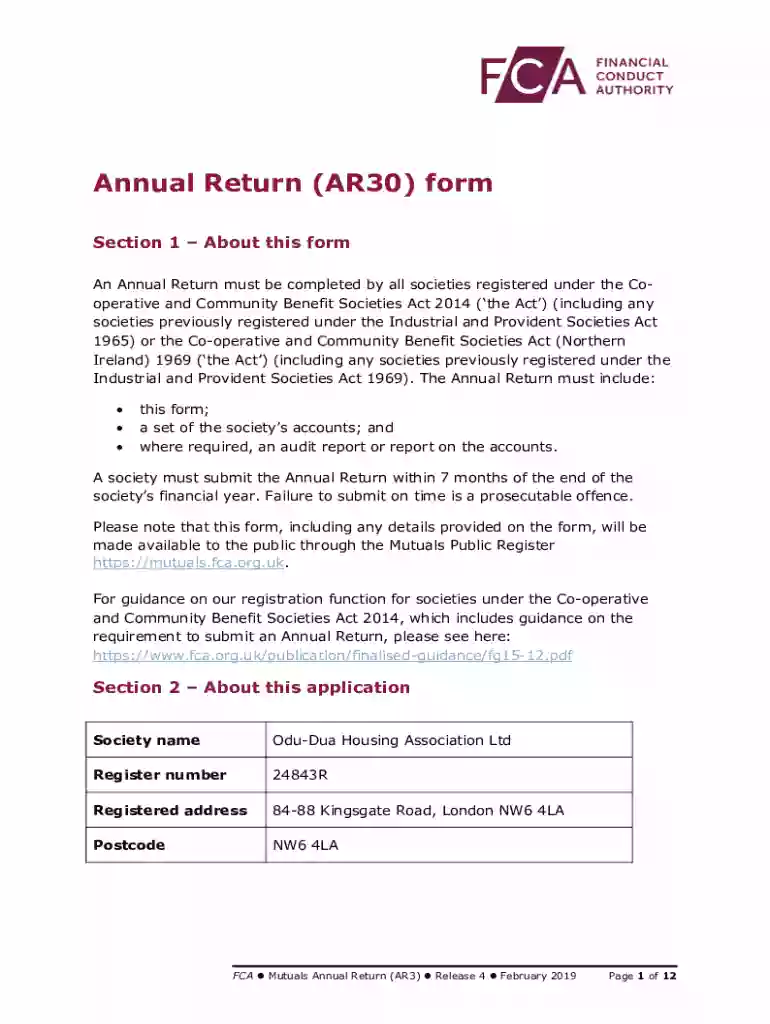
The Mutual Societies Annual Return Form (AR30) is essential for societies registered under the Cooperative and Community Benefit Societies Act 2014. It serves as a statutory requirement, ensuring that societies fulfill their financial and compliance obligations to the regulating authority. This form includes crucial details like society information, financial accounts, audit reports, and community benefit descriptions, which are pivotal in maintaining transparency and operational integrity.
Societies such as housing associations often utilize this form to detail their initiatives aimed at addressing social issues like homelessness and poverty. Through the AR30, these organizations can demonstrate how they align with community-focused objectives while adhering to legal mandates.
Accurate completion of the AR30 involves several key steps:
Gather Required Information: Compile all necessary data, including society details, financial accounts, and audit reports.
Fill Out Society Details: Enter the society’s name, registration number, and principal business activities.
Document Financial Data: Provide a comprehensive financial overview, including income statements and balance sheets, for the specified financial year.
Audit Compliance: Indicate whether the society's accounts have been audited and, if necessary, include the audit report.
Describe Community Benefits: Detail the initiatives and activities that demonstrate the society's commitment to community welfare.
Review and Submit: Carefully review the completed form for accuracy before submission. Ensure all required fields are filled out correctly.
Following these steps helps societies present a clear, compliant overview of their operations.
To access the AR30 form, societies can visit the regulatory authority’s official website, where the form is available for download. Depending on jurisdiction, the form might be downloadable in PDF or other compatible formats. It's also possible to obtain physical copies through mail requests to the regulatory office. For convenience, many organizations allow electronic submissions, streamlining the annual return process.
Additionally, some societies may choose to engage with third-party software solutions or document management platforms such as DocHub to fill out and submit this form. These platforms offer enhanced functionality like collaboration, digital signatures, and secure document storage, simplifying the overall workflow.
The AR30 form is legally mandated by the Cooperative and Community Benefit Societies Act 2014 and must conform to the specific requirements laid out by the regulation. It ensures all financial and member-related activities are reported annually, providing transparency and accountability. Failure to accurately fill out or submit the form may result in legal repercussions.
The legal stipulations include:
Legal advisors or relevant authorities should be consulted for guidance to ensure all elements are addressed correctly.
The AR30 comprises several critical components that societies must address:
Each section plays a vital role in presenting a comprehensive snapshot of the society’s operations and objectives.
Submitting the Mutual Societies Annual Return Form timely is crucial. Societies must file the AR30 within seven months following the end of their financial year. Adhering to these deadlines guarantees compliance with legal requirements and supports consistent regulatory oversight.
Staying proactive with submission timelines helps prevent legal complications or penalties.
The AR30 form submission necessitates various supporting documents that substantiate the information reported:
Preparing these documents in advance facilitates a smooth submission process.
Many societies leverage software like DocHub to manage and submit the AR30 form electronically. These platforms are compatible with various file types (e.g., PDF, DOC) and integrate seamlessly with cloud storage services such as Google Drive and Dropbox.
Choosing compatible software tools enhances accuracy and efficiency, streamlining compliance workflows for societies.
Failing to comply with AR30 form submission requirements can lead to significant consequences:
Ensuring timely and complete compliance not only avoids penalties but also maintains the society’s legal standing and credibility.
We've got more versions of the Mutual Societies Annual Return Form ( form. Select the right Mutual Societies Annual Return Form ( version from the list and start editing it straight away!
At DocHub, your data security is our priority. We follow HIPAA, SOC2, GDPR, and other standards, so you can work on your documents with confidence.


by JM White 2016 Cited by 6 Table 1 in Chaddad and Cook (2004a) notes that financial mutuals assign residual returns to customers (compared to member-patrons for cooperatives), have noRead more
Fraternal Societies Year-End 2025 Filing Instructions and Tax Forms. Annual Statement Filing Instructions Checklist and Due Dates


